


'Anointed with soaring song': The Gesualdo Six at the Proms
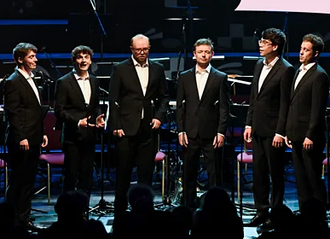
Gesualdo Six
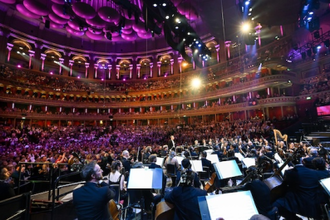
The Gesualdo Six thrilled the Proms audience at the Albert Hall in a late-night Prom last Wednesday.
The sweet-voiced singers sang sacred songs medieval and early modern, along with a new creation from their director Owain Park which itself had venerable roots.
Dressed in dark suits and white shirts, the six men were generally still, occasionally changing position or leaving the stage momentarily. This stillness only served to magnify the rich clarity of their melodious voices, apparent from the lively opening Kyrie from the poet-composer Guillaume de Machaut's Messe de Nostre Dame which was written for an annual Requiem Mass in memory of himself and his brother, both of whom were clerics in Rheims Cathedral.
Pérotin's Beata viscera (Blessed Flesh) came next - a hymn to the Virgin reminiscent in its pure melody and verse-refrain form of a troubadour's song. Pérotin was almost certainly associated with, and possibly in charge of liturgical celebrations at, the Cathedral of Notre Dame in Paris in the early twelfth century. The words of Beata viscera are by Philip the Chancellor, a theologian and librarian at Notre Dame. Here is the opening:
Blessed flesh of the Virgin Mary,
at whose breast the king of eminent name,
concealing, under altered guise, the force of
divine nature, has sealed a pact of God and humanity.
A fascinating interplay between rigorous complexity and freedom led to Johannes Ockeghem to be considered a forerunner of both constructivism and musical mysticism. His five-voice motet Intemerata Dei mater (Undefiled Mother of God) invokes Mary as a protectress of humanity and exemplifies the latter mystical tendency. (Its only previous outing at the Proms was under the direction of the legendary champion of the early music revival, David Munrow, in 1975.
Next came the great mystic and polymath St Hildegard of Bingen's O orzchis ecclesia (O immense Church) in a Proms première. This short chant for the dedication of a church is the only sung piece by the 'Sibyl of the Rhine' to use what she called her 'unknown language' (lingua ignota) for certain words, whose meaning she gave in regular Latin. 'Orzchis' translates thus as immense:
O immense Church,
girded with divine armour,
and adorned with jacinth, you are the balm
of the wounds of the nations
and the city of all knowledge.
O, o, you are
also anointed
with soaring song and are
a sparkling jewel.
Some 70 musical works by Hildegard survive - all containing the abbess's own words. Arching melodies find a delightful sensuality within the austerity of monophony and have no basis in plainchant. In addition to antiphons, hymns and responsories, there is a musical morality play Ordo virtutum (c.1151) in which the Devil and Virtues do battle for the human soul.
John Dunstable's splendid Veni Sancte Spiritus, in four voices, exemplifies the gentler harmony, with full chords, that Dunstable and other English composers introduced in the early fifteenth century. It was quite possibly sung at the coronations of the young Henry VI: as King of England in 1429 and King of France in 1431.
In its only previous appearance in 1969, it was the first note of music from before 1500 that had ever been heard at the Proms. Edward Greenfield of The Guardian noted that 'Its techniques have so much in common with today's avant garde, that it sounded like music on which the ink has scarcely dried.'
Unlike most of his contemporary composers, Dunstable was not a churchman. Nevertheless, he enjoyed the patronage of members of the royal family. An epitaph in St Stephen's Walbrook, in the City of London, reads: 'This man was your glory, your light, your chief, O Music, and he scattered your sweet arts throughout the world.' Certainly, he was rated in Europe.
In words evocative of the great Novenas to the Holy Spirit leading up to Pentecost, Dunstable's sacred piece contains the following verses:
Come, creator Spirit,
visit the minds of your people;
fill with heavenly grace
the breasts which you have made.
You who are called comforter,
the gift of God most high,
living fountain, fire, charity,
and spiritual unction.
You sevenfold in your gifts …
Ignite a light for our senses,
pour love into our hearts.
Owain Park's own Phos Hilaron ('Gladdening Light'), composed for Compline in Cambridge in 2017, also received its Proms première. St Athenogenes of Pedachtoë is believed to have composed the hymn at the heart of Park's piece on the way to being martyred in the fourth century. A solo soprano chanted the hymn in the translation of the Anglican hymnographer John Keble, over wordless chords intoned by the other singers:
Hail, gladdening light, of His pure glory poured…
Now we are come to the sun's hour of rest;
The lights of evening round us shine.
As W.T. Stead wrote in his Hymns That Have Helped (1897), 'As the Gloria was the Christian's salute to the rising sun, so the Phos hilaron was sung at eventide when the time of the lighting of lamps had come.'
The Gesualdo Six concluded their beautiful set with O virgo prudentissima ('O Virgin most wise') by Josquin des Prez in another Proms first. The words are by the humanist scholar Angelo Poliziano. Here is the third verse and the conclusion:
You as star of the sea are known,
who for us between rocks
between dark whirlpools
point to the harbour of safety.
Drive darkness from the minds,
shatter ice from the heart
glorious queen of the world.
We who to your protection
flee, keep safe.
Intercede for us with the Lord.
Alleluia.
To complex polyphonic interweaving, Josquin brought Renaissance virtues of clarity and naturalness. As Martin Luther put it: 'He is the master of the notes. They must do as he wills; as for the other composers, they have to do as the notes will.'
In the second half of the Prom, the great American composer Steve Reich was honoured in his 90th year by the excellent, virtuosic Colin Currie group who performed Reich's Tehillim (1981), a celebration of the Hebrew psalms, in a superb combination of voice, percussion, clapping and orchestral music.
In the earlier Prom of the evening at the Albert Hall, the Berlin Philharmoniker treated a hugely appreciative audience to Tchaikovsky's moving and portentous battle with Fate in his Fourth Symphony. This was preceded by Elgar's Enigma Variations of which Holst wrote appreciatively: 'I felt that here was music the like of which had not appeared in this country since Purcell's death.'
And what of the 'dark saying' Elgar left to his audience to interpret across the whole piece? Given its affectionate homage to dear friends and its tracing out of loneliness and self-realisation, might it be the faith that they will, in the words of St Thomas More, 'merrily meet in Heaven'? For now we see in a glass darkly but then… Love prevails (1 Corinthians 13). This was what I came away thinking after this beautiful rendition, under the baton of Kirill Petrenko.
 Facebook
 Twitter
 LinkedIn
 Print
Print Email
Email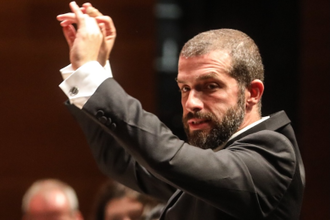
















 Facebook
 Twitter
 YouTube
 LinkedIn
 Pinterest