


Gospel in Art: Saint Gregory the Great, Pope, Doctor
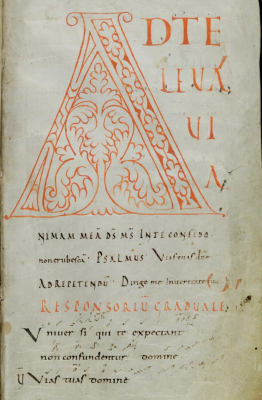
Gradual from St Gallen, MS 359, introit page around 922-925, ink on vellum © St Gallen, Stiftsbibliothek, Cod Sang 359
Source: Christian Art
Gospel of 3 September 2026
Luke 22:24-30
At that time: A dispute also arose among the Apostles, as to which of them was to be regarded as the greatest. And Jesus said to them, 'The kings of the Gentiles exercise lordship over them, and those in authority over them are called benefactors. But not so with you. Rather, let the greatest among you become as the youngest, and the leader as one who serves. For who is the greater, one who reclines at table or one who serves? Is it not the one who reclines at table? But I am among you as the one who serves.
'You are those who have stayed with me in my trials, and I assign to you, as my Father assigned to me, a kingdom, that you may eat and drink at my table in my kingdom and sit on thrones judging the twelve tribes of Israel.'
Reflection on the early manuscript page
Today we celebrate the feast of one of the great Fathers and Doctors of the Church: Saint Gregory the Great. A Benedictine monk, he became the first monk to ascend to the papacy, serving as pope (the 64th Bishop of Rome) from 3 September 590 until his death on 12 March 604.
He was born into a wealthy and noble family. His father, Gordianus, was a senator and held high office in the city of Rome, and his mother, Silvia, is also honoured as a saint. From this patrician background Gregory received an excellent education, especially in law and administration, preparing him for a career in public service. By his early thirties he had already risen to become Prefect of Rome, the highest civil position in the city.
Yet despite his success, Gregory felt drawn to a life of prayer and simplicity. After his father's death, he gradually turned away from political ambitions. He converted his family's estates in Rome into monasteries, one of which was dedicated to Saint Andrew on the Caelian Hill, where he himself became a monk. This radical choice, of a senator's son turning into a humble Benedictine monk, shaped his spirituality and impacted people around Him.
Gregory is remembered as the "Father of Christian Worship" because of his reforms to the Roman liturgy, which shaped the life of the Church for centuries. Many of us know his name most readily through Gregorian chant, the style of sacred music associated with him, though historians debate how directly he influenced its composition. For this reason he is honoured as the patron saint of musicians, singers, teachers, and students.
So today I am sharing the Introit page of he Cantatorium of St Gall (Codex Sangallensis 359), written between 922 and 926 in the Benedictine Abbey of St Gall in present-day Switzerland. It is one of the greatest treasures in the history of Christian music. It is the earliest complete surviving manuscript to preserve the solo chants of the Mass and remains one of the principal sources for Gregorian chant. The page illustrated here is the Introit, the chant sung as the priest and ministers enter for Mass. What makes the manuscript especially remarkable is its use of neumes. Neumes are small signs written above the text that indicate the flow and shape of the melody. Before the invention of the musical stave, these neumes served as a memory aid for monks who already knew the chants by heart, preserving a tradition of sung prayer that had been passed down through generations.
Gregorian chant has long been associated with St Gregory the Great, whose feast we celebrate today. Although he almost certainly did not compose the chants himself, his leadership shaped the Church's liturgy so profoundly that this sacred music eventually came to bear his name. Medieval artists often portrayed a dove, symbolising the Holy Spirit, whispering the melodies into Gregory's ear, expressing the belief that the Church's most beautiful music is ultimately inspired by God. This beautiful manuscript reminds us that the liturgy was never simply meant to be spoken, but sung.
LINKS
Christian Art: www.christian.art
Today's image: https://christian.art/daily-gospel-reading/luke-22-24-30-2026/
 Facebook
 Twitter
 LinkedIn
 Print
Print Email
Email














 Facebook
 Twitter
 YouTube
 LinkedIn
 Pinterest