

Gospel in Art: All in the synagogue were filled with wrath
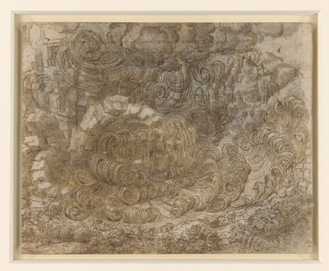
A Deluge by Leonardo da Vinci, drawn circa 1517-1518, black chalk, pen and ink, wash on paper © The Royal Collection Trust, London
Source: Christian Art
Gospel of 31 August 2026
Luke 4:16-30
At that time: Jesus came to Nazareth, where he had been brought up. And as was his custom, he went to the synagogue on the Sabbath day, and he stood up to read. And the scroll of the prophet Isaiah was given to him. He unrolled the scroll, and found the place where it was written,
'The Spirit of the Lord is upon me, because he has anointed me to proclaim good news to the poor.
He has sent me to proclaim liberty to the captives and recovering of sight to the blind, to set at liberty those who are oppressed, to proclaim the year of the Lord's favour.'
And he rolled up the scroll, and gave it back to the attendant, and sat down. And the eyes of all in the synagogue were fixed on him. And he began to say to them, 'Today this Scripture has been fulfilled in your hearing.'
And all spoke well of him and marvelled at the gracious words that were coming from his mouth. And they said, 'Is not this Joseph's son?' And he said to them, 'Doubtless you will quote to me this proverb, " 'Physician, heal yourself.' What we have heard you did at Capernaum, do here in your home town as well." ' And he said, 'Truly, I say to you, no prophet is acceptable in his home town. But in truth, I tell you, there were many widows in Israel in the days of Elijah, when the heavens were shut up three years and six months, and a great famine came over all the land, and Elijah was sent to none of them but only to Zarephath, in the land of Sidon, to a woman who was a widow. And there were many lepers in Israel in the time of the prophet Elisha, and none of them was cleansed, but only Naaman the Syrian.'
When they heard these things, all in the synagogue were filled with wrath. And they rose up, and drove him out of the town, and brought him to the brow of the hill on which their town was built, so that they could throw him down the cliff. But passing through their midst, he went away.
Reflection on the old master drawing
In today's gospel we see a dramatic shift in how Jesus is received. At first, when He returns to His hometown of Nazareth and begins to speak, the crowd is full of admiration: "they marvelled at the gracious words that were coming from his mouth". They marvel at His eloquence and the beauty of His message. But that enthusiasm doesn't last long. Soon scepticism takes over: "Isn't this Joseph's son?" Then the scepticism turns to outright anger and murderous intention: "they brought him to the brow of the hill... so that they could throw him down the cliff". The crowd went quickly from amazement, into doubt, then anger. They moved so quickly. within a matter of a few hours from one emotional state to another.
Their reaction is perhaps closer to our own experience than we might like to admit. We too can drift through the day from one emotional state to another. We wake up feeling optimistic and full of energy, only for an unexpected email, a difficult conversation or a piece of bad news to unsettle us. A little later, a kind word from a friend lifts our spirits again. By the afternoon we may feel tired or discouraged, only to regain our peace after a walk, a prayer, or simply sharing a meal with someone we love. Our emotions are constantly changing, often shaped by circumstances beyond our control. Today's Gospel gently invites us to ask ourselves whether our faith is equally changeable, or whether it remains rooted in Christ, even when our feelings ebb and flow.
Leonardo da Vinci's remarkable drawing A Deluge, now in the Royal Collection and one of a series of apocalyptic studies made during the last years of his life, captures this ebb and flow of human experience with extraordinary power. At first glance, the drawing appears almost chaotic. Water crashes from the sky, trees bend under the force of the wind, walls tumble, and the whole landscape seems to dissolve into a swirling vortex. Yet the longer we look, the more we notice that this is not random chaos at all. Leonardo, ever the scientist as well as the artist, carefully observed the movement of clouds, rain, water and wind, transforming nature's violence into a composition of remarkable harmony and beauty.
Perhaps that is why this drawing speaks so deeply to our Gospel reading today. Our emotions can often feel like this turbulent landscape: joy giving way to disappointment, peace turning into anxiety, confidence dissolving into doubt. We can feel as though we are being swept along by forces beyond our control. Yet Leonardo reminds us that beneath what appears to be confusion there is still an underlying order. God sees the whole picture, even when we see only the storm. The crowds in today's Gospel allowed themselves to be carried along by the changing currents of emotion. Christ, by contrast, remained constant. His mission did not ebb and flow with the reactions of those around Him. The Gospel gently invites us to seek that same inner stability, allowing our lives to be anchored not in our passing emotions but in the unchanging presence of God.
LINKS
Christian Art: www.christian.art
Today's image: https://christian.art/daily-gospel-reading/luke-4-16-30-2026/
 Facebook
 Twitter
 LinkedIn
 Print
Print Email
Email












 Facebook
 Twitter
 YouTube
 LinkedIn
 Pinterest