


Gospel in Art: Ha! What have you to do with us, Jesus of Nazareth
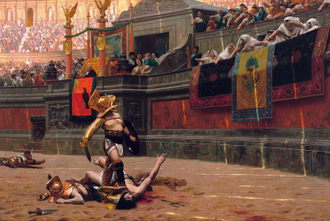
Pollice Verso, by Jean-Léon Gérôme, 1872, Oil on canvas © Phoenix Art Museum, Phoenix, Arizona
Source: Christian Art
Gospel of 1 September 2026
Luke 4:31-37
At that time: Jesus went down to Capernaum, a city of Galilee. And he was teaching them on the Sabbath, and they were astonished at his teaching, for his word possessed authority.
And in the synagogue there was a man who had the spirit of an unclean demon, and he cried out with a loud voice, 'Ha! What have you to do with us, Jesus of Nazareth? Have you come to destroy us? I know who you are - the Holy One of God.'
But Jesus rebuked him, saying, 'Be silent and come out of him!'
And when the demon had thrown him down in their midst, he came out of him, having done him no harm. And they were all amazed and said to one another, 'What is this word? For with authority and power he commands the unclean spirits, and they come out!' And reports about him went out into every place in the surrounding region.
Reflection on the painting
In today's Gospel, Jesus encounters a man whose life has become deeply troubled. He is possessed by an unclean spirit and reacts to Jesus with great hostility. He shouts at Him, challenges Him and tries to keep Him at a distance. He shouts ''Ha! What have you to do with us, Jesus of Nazareth?' Aggressive words. When we are confronted with such aggression, our instinct is often either to fight back or to walk away. We respond with anger of our own, or we retreat from what feels threatening. Jesus does neither. He first brings calm to the situation, commanding, "Be silent," and then, with quiet authority, He frees the man from the evil that has taken hold of him.
Jesus never allows Himself to be drawn into hostility, nor does He abandon those who are wounded or broken. He doesn't meet aggression with aggression; nor dos he simply walk away. Instead, He sees beyond the outward behaviour to the deeper need within. He knew that the man before Him was longing for peace, even if he could not express it. Jesus then restores that peace with compassion and authority. Jesus knows what is lacking in our own lives and gently works to heal and restore us. He wants to bring us peace. And then we can further share that peace with others.
Aggression and hostility have often been depicted over the centuries by painters. Jean-Léon Gérôme's painting Pollice Verso, painted in 1872, captures a moment charged with raw aggression. A victorious gladiator stands over his defeated opponent, awaiting the verdict of the crowd. The spectators, swept up in the excitement of the spectacle, stretch out their arms, demanding death. Gérôme paints not only the drama in the arena, but also the psychology of the crowd. Individual judgement disappears, replaced by a wave of collective emotion. In a matter of moments, thousands of people are carried along by the same cry for violence, illustrating how easily human beings can be swept up by anger and the excitement of the moment.
The painting forms a striking contrast with today's Gospel. The crowd in the Roman amphitheatre cries out for death, whereas Jesus speaks words that bring peace. He does not respond to hostility with greater hostility, but with healing. While the crowd delights in condemnation, Christ seeks restoration. Gérôme's painting reminds us how quickly our emotions can take control and how easily we can become part of a crowd that judges, condemns or excludes. The Gospel invites us to resist that temptation and instead to imitate Christ, whose authority is always exercised with mercy and compassion.
LINKS
Christian Art: www.christian.art
Today's image: https://christian.art/daily-gospel-reading/luke-4-31-37-2026/
 Facebook
 Twitter
 LinkedIn
 Print
Print Email
Email

















 Facebook
 Twitter
 YouTube
 LinkedIn
 Pinterest