


Gospel in Art: Which is the great commandment in the Law?
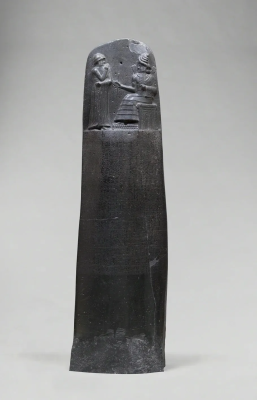
The Code of Hammurabi, Babylonian legal text 1753BC, Basalt carved stele © Louvre Museum, Paris
Source: Christian Art,
Gospel of 25 October 2026
Matthew 22:34-40
At that time: When the Pharisees heard that Jesus had silenced the Sadducees, they gathered together. And one of them, a lawyer, asked him a question to test him. 'Teacher, which is the great commandment in the Law?' And he said to him, 'You shall love the Lord your God with all your heart and with all your soul and with all your mind. This is the great and first commandment. And a second is like it: You shall love your neighbour as yourself. On these two commandments depend all the Law and the Prophets.'
Reflection on the basalt carved stele
None of us could name every law in the country where we live. There are far too many, yet we still have to find our way through daily life, drawing on our conscience, our judgement and what we have learnt about treating people fairly. The Jewish tradition at the time of Jesus identified 613 commandments in the Torah, so the question in today's Gospel is understandable: which law matters most? Matthew tells us that it is asked to test Jesus. But beneath the attempt to catch him out lies a question worth asking ourselves: what makes a life good? Simply that we abide by the law? That we have never killed anyone? That we have paid our taxes honestly? These things matter, of course, but goodness asks more of us than avoiding wrongdoing. A kind society depends on people who actively care for one another. And that is where Jesus takes the conversation: towards love.
Jesus answers with two commandments, drawing both from Scripture: love God with all your heart, soul and mind, and love your neighbour as yourself. Together, they give direction to the whole of life. Loving God involves everything we are: our thoughts, our choices, our affections and our actions. And that love finds expression in how we treat the people around us. We cannot give God our whole heart while keeping part of it firmly closed to our neighbour.
This makes the Gospel simple to understand, but very demanding to live. Our neighbour is the person who needs our patience, the colleague we find difficult, the stranger whose circumstances we barely understand. And "as yourself" reminds us that we, too, are worthy of care; we are not asked to despise ourselves in order to love others.
Our artwork today takes us back nearly 3,800 years, to the reign of King Hammurabi of Babylon. Standing over two metres tall, this imposing black basalt monument, now in the Louvre, carries one of the oldest surviving substantial collections of laws. At the top, Hammurabi stands before Shamash, the god of the sun and justice; beneath them, tightly packed cuneiform writing records 282 laws. They address surprisingly familiar concerns: wages, marriage, inheritance, property and responsibility for shoddy building work. Even then, people needed to know who should pay when things went wrong! Although some punishments seem harsh to us (lots of death sentences for small crimes), the text also expresses an ambition to prevent the powerful from oppressing the weak.
There is something moving about this ancient effort to give justice a lasting, visible form. Across the centuries, people have wrestled with the same question: how can we live well together? Even before Christianity came to the fore, these questions were asked: what makes a good, kind society. Laws remain necessary, but love asks us to take a 'personal interest' in the people those laws protect. Love moves us beyond.
LINKS
Christian Art: www.christian.art
Today's reading: https://christian.art/daily-gospel-reading/matthew-22-34-40-2026/
 Facebook
 Twitter
 LinkedIn
 Print
 Email










 Facebook
 Twitter
 YouTube
 LinkedIn
 Pinterest