


Gospel in Art: Children were brought to Jesus
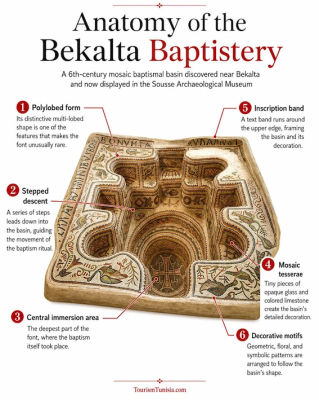
The Baptistery of Bekalta, 6th-7th century, Discovered 1993, near Bekalta, Monastir Governorate, Tunisia, Mosaic tesserae © Sousse Archaeological Museum, Tunisia and with thanks to Tourism Tunisia for use of the image
Source: Christian Art
Gospel of 15 August 2026
Matthew 19:13-15
At that time: Children were brought to Jesus that he might lay his hands on them and pray. The disciples rebuked the people, but Jesus said, 'Let the little children come to me and do not hinder them, for to such belongs the kingdom of heaven.' And he laid his hands on them and went away.
Reflection on the Baptistery
This year in England and Wales, the Solemnity of the Assumption of the Blessed Virgin Mary is transferred to tomorrow, Sunday, and will be celebrated then instead of on its usual date, 15 August.
Throughout the Gospels, there are moments when Jesus and the disciples are at odds. The disciples often struggle to understand the heart of Jesus' mission. Today's short Gospel offers one such scene. Parents bring their children to the Lord, hoping that he will place his hands upon them and bless them. Yet, instead of welcoming them, the disciples try to send them away. Jesus immediately corrects them. Far from seeing children as a distraction, he declares that they belong close to him. He then lays his hands upon them in blessing.
For this reason, this Gospel is frequently proclaimed during the celebration of Baptism. Every time parents bring a child to the font, they are responding to Christ's own invitation: "Let the children come to me." Baptism is not merely a family celebration; it is the moment when Christ welcomes a new member into his Church and begins a lifelong friendship with him or her. Children possess a remarkable openness to wonder, trust and faith. They ask questions, delight in stories, and are naturally receptive to the mystery of God. Jesus sees these qualities not as childish weaknesses but as signs of the very disposition needed to receive his Kingdom. The challenge for the Church, for parents, grandparents, teachers and all of us, is never to become obstacles to that openness. Rather, we are called to nurture it, helping young hearts discover the beauty of the Gospel.
One of the most beautiful surviving monuments to the sacrament of Baptism is the Baptistery of Bekalta, discovered entirely by chance in the spring of 1993 during quarrying work near the village of El Gaalla, on Tunisia's Mediterranean coast. Buried beneath only a thin layer of earth, the font had remained hidden for some fourteen centuries, its magnificent mosaics protected from the elements. Sadly, much of the surrounding basilica was damaged by the quarrying before archaeologists could investigate it fully, but the baptistery itself survived in an extraordinary state of preservation. It was created in the sixth century and today is one of the treasures of the Archaeological Museum of Sousse.
The font was designed for baptism by full immersion, the normal practice of the early Church, especially for adult converts. Candidates descended the steps on one side into the cross-shaped basin, were immersed in the baptismal waters, and then ascended on the opposite side as a sign of dying and rising with Christ. The rich mosaic decoration accompanies this spiritual journey: at the bottom lies a cross flanked by the Greek letters Alpha and Omega, proclaiming Christ as the beginning and the end. Around the rim are flowers, vines, birds and other symbols of new life. The eight rounded, lobed recesses around the basin are one of its most distinctive features. Scholars generally understand them as an architectural and decorative element rather than seats. The entire font beautifully expresses what every Baptism proclaims: through the waters of Christ, we leave behind the old life and emerge as a new creation.
LINKS
Christian Art: www.christian.art
Today's image: https://christian.art/daily-gospel-reading/matthew-19-13-15-2026/
 Facebook
 Twitter
 LinkedIn
 Print
Print Email
Email






 Facebook
 Twitter
 YouTube
 LinkedIn
 Pinterest