

Holy Land: When simple travel becomes an ordeal
Source: Facebook
Fr Abedrabbo, parish priest of the Latin church in Ein Arik, near Ramallah in the West Bank writes on Facebook today:
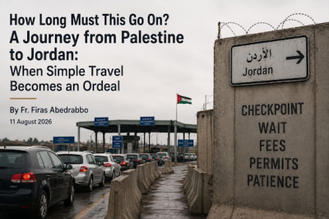
It was supposed to be an ordinary journey: leaving Ramallah in the morning, crossing the bridge into Jordan, attend the ceremony of religious vows for three dear sisters, and later returning with my mother. Geographically, it is not a long distance, and under normal circumstances, such a journey should not require so much planning, time, money, and stress. But in Palestine, distances are not measured in kilometres alone.
The complications began even before reaching the bridge. Leaving the Ramallah area took longer because one of the checkpoints along the way was closed. This is nothing exceptional in our daily lives. You may leave home knowing where you are going, but you do not know which road will still be open when you reach it, or how long it will actually take you to get there.
The situation becomes even more complicated when other roads are closed, as is happening in the Taybeh area. The closure of a single road does not affect only the residents of one village. It alters traffic throughout an entire area, increases pressure on alternative routes, and turns short distances into longer and more exhausting journeys. And so, before the actual journey has even begun, you have already gone through another journey simply to reach the crossing point.
When I finally reached the bridge, the number of travellers was overwhelming. I found myself with two choices: wait amid the crowds, with all the exhaustion and uncertainty that this entails, or use the VIP service to make the crossing easier. I chose the second option, not because I was looking for luxury, but because the crowds were more than I could manage and because I needed to travel and return with my mother.
At first, I thought the service would cost around $100. Then I discovered that I was mistaken: the actual cost was closer to $130. On top of that, there are approximately $70 in fees paid to the Israeli side upon departure. We are therefore already at around $200, and that is before even reaching Jordan, where additional fees still have to be paid.
And the expenses do not end with official fees. There are taxis, high transportation costs, and what travellers sometimes experience as exploitation by certain drivers who take advantage of their need and the lack of alternatives. When you urgently need to reach the bridge, leave it, or move from one point to another, you are not always in a position to compare prices or calmly search for a better option. You simply need to continue your journey, and that necessity itself can become an opportunity for prices to be inflated.
In the end, I found myself paying around 560 shekels instead of the roughly 250 shekels I had expected for part of this journey. The irony is that the total amount one can end up paying simply to travel from Palestine to Jordan can sometimes equal the price of a plane ticket to certain European destinations. We are talking about crossing a few dozen kilometres, not travelling between countries and continents.
Of course, I could have chosen not to use the VIP service. But that is precisely the point: sometimes all the options available to you are bad ones. Either you pay an excessive amount, or you face hours of crowds, waiting, and exhaustion, without knowing exactly when your journey will end.
The problem is not one incident, one checkpoint, or even one side. It is the daily accumulation of obstacles. An Israeli checkpoint may be closed, a road may be blocked, the bridge may be overcrowded, procedures and fees await you on both sides of the border, transportation costs are high, and some taxi drivers take advantage of the situation. At every stage, another obstacle appears, Israeli or Arab, official or unofficial.
This is sometimes difficult to explain to someone who lives in a place where they can simply get into their car and drive one or two hundred kilometres without having to think about anything beyond ordinary traffic. Here, even visiting a neighbouring country, or simply going to bring your mother home, can become an entire operation requiring calculations of time, money, checkpoints, crowds, open and closed roads, fees, and taxi fares.
And in moments of anger, you feel that everything has become difficult: because of Israelis and because of Arabs, because of occupation and because of disorder, because of checkpoints and because of the bridge, because of fees and because of exploitation. Everyone adds something to the burden, and in the end there is one ordinary human being who pays the price, financially and psychologically.
We are not asking for a privilege. We simply want something that seems perfectly ordinary in most parts of the world: to be able to go to work, visit our families, travel to a neighbouring country, and return home without every journey becoming yet another test of patience and endurance.
Today, I paid more than I wanted to pay, waited longer than I expected, and travelled a route far more complicated than it should have been. There is nothing I can change about that now. I will continue my journey, bring my mother home, and try to rest.
But the painful paradox remains: in this very small part of the world, a distance may be very short on a map, yet become extraordinarily long, complicated, and expensive in a person's life.
 Facebook
 Twitter
 LinkedIn
 Print
Print Email
Email












 Facebook
 Twitter
 YouTube
 LinkedIn
 Pinterest