

Reflection: Joy and hope as a form of resistance
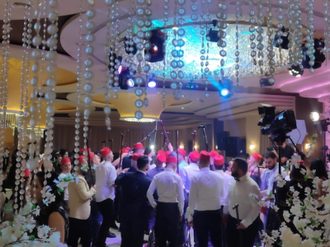
Celebration in Bethlehem
Source: Bethlehem Updates
Usama Nicola writes in Bethlehem Updates:
What does it mean to choose joy when the reality around you gives you so many reasons to be afraid?
Can joy itself become a form of resistance?
I have been thinking about this a lot recently, especially during these summer weeks when our calendars seem to be filled with weddings, engagements, graduations, family gatherings, and visits with friends. We receive invitations almost every day from relatives, neighbours, friends, and people from our wider community. Sometimes it is a wedding. Sometimes an engagement party. Sometimes a high school or university graduation.
We cannot accept every invitation. Life is busy, and sometimes the restrictions, checkpoints, economic difficulties, or the simple exhaustion of everyday life make it impossible. But whenever we can, we try to go.
I have come to believe that sometimes simply being a full human being is an act of resistance.
Resistance does not always look like a demonstration, a political speech, a protest sign, or a confrontation with soldiers. Sometimes resistance is much quieter. It can be planting an olive tree when you know that the land around you is under pressure. It can be preparing a traditional Palestinian meal and passing it around a table with family. It can be singing. It can be celebrating Christmas or Easter. It can be attending a wedding, congratulating a young couple, or watching a child graduate from school. It can be taking your children to the countryside, walking among the olive trees, laughing with friends, or telling a joke when everyone is tired.
Sometimes resistance is simply sitting with friends over coffee and talking about something completely ordinary.
These moments may seem small compared with the enormous political realities surrounding us. But I do not think they are small.
Occupation does not only affect land, movement, employment, education, and physical security. It can slowly enter the emotional life of a people. It can teach you to organize your days around fear, uncertainty, restrictions, and things you cannot control. You begin checking the news before making plans. You wonder whether a road will be open. You think about checkpoints, permits, soldiers, settler attacks, closures, and whether you will be able to reach the people or places you want to visit.
If everything in your life becomes about the occupation, then something even deeper has been taken from you.
They have not only taken land.
They have taken your emotional space.
That is why I believe protecting that emotional space matters.
When we gather around a table, laugh together, dance at a wedding, sing in church, celebrate a graduation, prepare food according to a recipe passed down through generations, or simply sit with someone we love, we are saying that our lives are bigger than the circumstances imposed upon us.
We are refusing to allow the occupation to become the center of every story we tell about ourselves.
This does not mean that we ignore reality.
Palestinians are not naive about what is happening around us. We know the difficulties we face. We know what occupation means because we live with its consequences every day. We know that a joyful evening does not make checkpoints disappear, does not return confiscated land, and does not erase the fear that many families carry.
But joy does something else.
It reminds us that we are still human.
Recently, my wife and I have attended several weddings. It is that season of the year, and the invitations keep coming. There is something deeply moving about watching a young Palestinian couple begin their married life in circumstances that are anything but easy.
At a wedding, for a few hours, people dress beautifully. Families gather. Children run around. There is music, food, laughter, dancing, photographs, embraces, and endless congratulations. Older people remember weddings from decades ago. Young people imagine their future. Someone inevitably tells a funny story. Someone else cries with happiness. People who have not seen each other for months suddenly find themselves sitting at the same table.
For those few hours, life is not reduced to headlines.
It is simply life.
And perhaps that is precisely why these celebrations matter.
The same is true of graduations. When a young person receives a university degree after years of study, the celebration is about much more than a certificate. It represents years of effort by the student and the family. It represents parents who sacrificed to provide an education. It represents a young person insisting on building a future despite uncertainty.
When we celebrate an engagement, we are celebrating love and the possibility of a shared future.
When we celebrate a wedding, we are saying that people still believe in tomorrow.
When we celebrate a graduation, we are saying that our children deserve a future worth preparing for.
And when we invite someone for coffee, we are saying, in a very ordinary way, "You are not alone."
These things may not look like political acts, but they have political meaning because they affirm life.
For me, hope is closely connected to this.
But hope is not pretending that everything is okay.
Hope is not optimism in the sense of closing your eyes to reality and convincing yourself that tomorrow will automatically be better.
Sometimes optimism is not enough.
Hope is something deeper.
Hope is being able to look directly at a difficult reality and still decide that your actions will not be determined entirely by it.
Hope says, "I know this is hard, but I am still here."
"I know the situation is difficult, but I will plant something."
"I know the future is uncertain, but I will educate my children."
"I know there are reasons to be afraid, but I will still gather my family around the table."
"I know there is darkness, but I will light a candle."
I think there is something very Palestinian in that.
Perhaps it is connected to the olive tree, which has become such a powerful symbol of Palestinian life. You plant a tree knowing that it takes years to grow. You water it. You care for it. You wait. You may never see it reach its full size, but you plant it anyway.
That is hope.
You prepare the land for someone who will come after you.
You plant something today because you believe there will be a tomorrow.
Our celebrations carry something of the same spirit.
When Palestinians continue to marry, have children, study, graduate, sing, cook, pray, tell jokes, gather with friends, celebrate Christmas and Easter, harvest olives, plant gardens, and take their children into the countryside, they are not forgetting the reality around them.
They are refusing to let that reality become the entirety of their existence.
There is a difference.
Joy does not mean that we have forgotten those who are suffering. In fact, sometimes joy gives us the strength to continue caring about them.
A wedding does not cancel the pain of another family.
A graduation does not erase the loss of someone else's child.
A cup of coffee does not make the occupation disappear.
But these moments give us breathing space. They allow us to remember that our identity is not only what has been done to us. We are also what we create, what we preserve, what we love, what we teach our children, and what we share with one another.
This is why I think joy can be a form of resistance.
Not because joy defeats oppression by itself, but because it protects something that oppression constantly tries to take away: our ability to live as human beings.
There is a temptation, especially when living through a prolonged crisis, to believe that every moment of happiness is somehow inappropriate. As though we must remain permanently serious because the situation is serious.
But people cannot live that way forever.
We need laughter.
We need music.
We need family.
We need friendship.
We need celebrations.
We need ordinary days.
We need moments when a child runs through the house, someone burns the food, an uncle tells the same story for the hundredth time, friends argue about football, and everyone laughs.
These ordinary moments are not a distraction from our struggle.
They are part of what we are struggling to protect.
So, yes, I believe joy can be resistance.
And hope can be resistance too.
Sometimes resistance is standing in a demonstration.
Sometimes it is speaking publicly.
Sometimes it is defending your land.
And sometimes it is much quieter.
Sometimes it is planting an olive tree.
Sometimes it is baking bread.
Sometimes it is singing.
Sometimes it is getting married.
Sometimes it is celebrating your child's graduation.
Sometimes it is going to church.
Sometimes it is sitting with friends over coffee at the end of a difficult day.
And sometimes, perhaps most importantly, it is waking up the next morning and deciding to live.
We cannot always control what happens around us.
But we can try to protect the spaces where fear has not yet taken everything.
We can keep making room for joy.
We can keep making room for love.
We can keep making room for hope.
Because as long as we can still celebrate life, care for one another, plant something for the future, and gather around the same table, the occupation has not taken everything from us.
There is still something deeply human left.
And we intend to keep it.
Postscript:
Through his Patreon page, Usama Nicola offers regular reflections, updates from Bethlehem, and spiritual insights, creating a worldwide community of solidarity and shared understanding. His hope is to touch hearts, gently challenge complacency, and remind people everywhere that even in places marked by sorrow, life continues to grow.
You can support Usama's writing ministry by subscribing to Bethlehem Updates as a generous supporter.
Bethlehem Updates: www.patreon.com/bethlehemupdates
 Facebook
 Twitter
 LinkedIn
 Print
Print Email
Email









 Facebook
 Twitter
 YouTube
 LinkedIn
 Pinterest