

Human beings probably wouldn't have survived were it not for grandparents
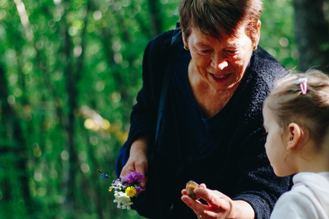
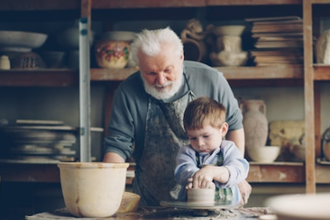
Photo by Sergiu Vălenaș on Unsplash
This is not a tautology or a platitude. Elderly people were key to ensuring that human communities thrived in prehistoric times. And there would have been a good number of them. Life was harsh, but if you survived childhood and childbirth, you had a good chance of living for decades after your own fertility declined.
In evolutionary terms, the menopause is a bit of a mystery. Why would genes that lower an individual's overall fertility have survived and become universal? The best explanation is that there comes a point when a female can do more good for the survival of her genes by helping her offspring with their children than by having more of her own. Menopause is very rare in the natural world in meaning that grand-parenting is part of what makes humans unique.
Last Sunday, 26 July - the feast of Saints Joachim and Anna, the grandparents of Jesus - was the sixth World Day for Grandparents and the Elderly.
Grandparents have always provided a lot of practical support. Childcare is the most obvious one, as well as caring for pregnant and nursing mothers. They might teach grandchildren skills that their own parents don't have time to teach them. Learning to bake with grandma or DIY with grandad are examples many of us probably recognise.
But grandparents, and older people in general, offered something more important in early human communities. They were the source of knowledge. The memory of the elders was vital for a group's survival - geographical memory (where to find water in the drought), social memory (who is related to whom), and cultural memory such as beliefs and rituals that bind a community together.
Once writing was developed these memories didn't need to be stored in an elder's head, they could be contained in books. The fact that there is a Commandment to honour parents in their old age, suggests that older people were at risk of not being valued when their role as memory-keepers became less important.
From its beginning in 2020 the focus of the World Day for Grandparents and the Elderly has not just been to care for the elderly, but to bring generations together to learn from each other. It is a chance for us to consider how older people can still contribute fully to our communities.
Many parishes have good support networks for older vulnerable people, including daytime prayer or social groups. But how many encourage older people to play their ancient role in supporting the younger generations? A non-scientific poll of my friends shows that this is rare in the Catholic church in the UK, but perhaps more common among our Anglican neighbours.
When my children were small, I sometimes went to a local Anglican church where grandparents and a couple of young adults ran a creche while the mums had talks and discussions in the next room. In my own parish I've helped run the toddler group, the children's liturgy and the youth club and volunteers have seldom come from beyond the mums and sometimes dads of those attending.
Perhaps this is understandable - it is hard for older people to identify with the young these days. Baby-boomers grew up in a world where standards of living and technical capabilities seemed to be rising endlessly. Young people are now seeing the problems that this has caused and are less hopeful about the future.
Would the youngsters at my youth club value the input of an older person? Is the wisdom of the elders still useful in a world that has changed so much?
Paleoanthropologist Ella Al-Shamahi, in a 2025 BBC documentary episode about how the first homo sapiens in Europe faced a sudden Ice Age, said:
"Imagine what it would have been like for our ancestors to live in this world where the land of their grandparents was not the land of their grandchildren… inter-generational knowledge … that's so important for survival in these environments, suddenly isn't very useful because the plants, the animals, the landscape is all different. To survive, each generation had to discover the world anew."
The change happening now is even more rapid - not just climate change, which is more extreme than anything seen before, but technological change too. It can seem like the elders no longer have any wisdom to offer.
The other day after Mass I witnessed a beautiful moment when a woman was teaching her small granddaughter the Hail Mary. Sometimes faith skips a generation, and grandparents instead of parents are the ones handing it down. We still need elders to teach us values, keep us rooted in the traditions that unite us, and offer a longer-term perspective. In a time of turbulence, this, I believe, is more important than ever.
As Pope Leo XIV said for the World Day for Grandparents and the Elderly in 2025:
"The life of the Church and the world can only be understood in light of the passage of generations. Embracing the elderly helps us to understand that life is more than just the present moment, and should not be wasted in superficial encounters and fleeting relationships. Instead, life is constantly pointing us toward the future."
Let us consider, then, how we can create more spaces for intergenerational connection in our parishes - spaces where we can still learn from the memories of older people in our communities as instructed in psalm 78:
"so the next generation would know them,
even the children yet to be born,
and they in turn would tell their children.
Then they would put their trust in God
and would not forget his deeds
but would keep his commands."
Louise Cook is a Catholic writer from South London and has covered issues relating to human evolution and the passing of the generations in her blog: https://louisemilnecook.substack.com/ . She has three teenage children and has just become a great-aunt.
 Facebook
 Twitter
 LinkedIn
 Print
Print Email
Email









 Facebook
 Twitter
 YouTube
 LinkedIn
 Pinterest