


Ian Linden: Grandparents - An example of pastoral tunnel vision?
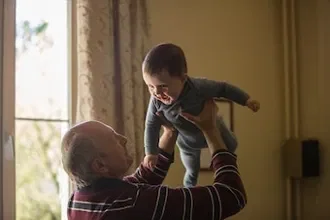
Photo by Johnny Cohen on Unsplash
Pope Leo has scheduled this Autumn what he describes as "a synodal discernment on the steps to be taken in order to proclaim the Gospel to families today". He sees families as active subjects of evangelization as well as recipients of pastoral care.
The meeting of Presidents of Bishops Conferences, and Eastern Catholic Churches, will therefore be "placing particular emphasis on listening to the families of their local churches". They will need to heed the input from different generations and not just from the 'nuclear family'.
Sadly in the UK, it is likely this will mean little happens. To date the Bishops Conference of England and Wales has not been prominent in implementing Leo's vision of a synodal Church. Sadly because at a global level in a divided world how many other organisations have the Church's capacity to listen and learn from what their members say?
Pope Francis set up The Dicastery of Laity, Family and Life in 2016 - amalgamating two Pontifical Councils, for the laity and for the family. The creation of this new body corresponded with the publication of his Apostolic Exhortation Amoris Laetitia (The Joy of Love) a blockbuster of 60,000 words, 325 substantial paragraphs. It was an outcome of what proved to be two quite contentious synods. In 2021, Francis made the fourth Sunday in July, the Feast of St Joachim and St Anne, next Sunday, World Day for Grandparents and the Elderly.
The forthcoming conference celebrates the 10th anniversary of the publication of Amoris Laetitia, a decade in which the social changes and problems it considered, amongst them economic pressures on families, declining birthrates, and increasingly temporary relationships between couples, and loneliness, have grown rapidly. The thematic framework, typical of Pope Leo's pastoral theology, has a number of headings: "reality, beauty and challenges"; signs of the times and contemporary experiences of family life; "Christian families as active subjects of the Church's mission"; "accompanying families" in their difficulties. Two themes focus on marriage: young people and the vocation of marriage, and their early years together. These fall within the wider, more comprehensive ambit of Amoris Laetitia (AL), the assumption perhaps being not that it is out-of-date - it remains notably contemporary and down to earth - but that very few will have heard of it and even less have read it. Hands up. I fell into the latter category.
It really is worth taking the trouble to read it. So is there something missing in Amoris Laetitia (AL) that needs thinking about and discussion ? Or something dealt with too briefly that could do with being fleshed out at the conference?
By way of a suggestion, in the 1960s the hierarchy's headline on the topic was that marriage was a sacrament. The emphasis was on its unusual characteristic: sacramental Grace available to, given by, the married couple to each other: not by an ordained minister (as in the Orthodox Tradition through liturgical blessing of the marriage). Only in AL paragraphs 67, 71-75, and a footnote, is the word sacrament used in relation to marriage. Though the 'symbolic' dimension of the family and marriage in the Catholic theological tradition is developed at length. In short, the sacrament of matrimony is not missing from AL, but the significance of Grace being given in this particular way could be explored much more.
The word 'Grandparent' though was missing from AL. The word used throughout is 'the elderly'; strangely, given a Catholic theological emphasis on relationships. Care for the elderly is the main emphasis. In only two paragraphs (AL 192/3) are the elderly doing something useful themselves, if a little vague: providing "continuity of generations", "bridging the gap" to the past, enabling values to be passed down. Not unimportant in the face of cultures with a "lack of historical memory" described by Pope Francis as a "serious shortcoming", and a theme taken up by Pope Leo. Music to the ears of an old historian.
I remember the now Cardinal Robert Sarah, formerly Archbishop of Conakry in French Guinea (and on President Sékou Touré's death list), addressing a meeting of European Union and African Bishops in Cape Coast on 'the family'. It was the late 1980s, AIDS was cutting a terrible sward through African societies; a parental generation was dying. Elderly grandparents were caring for many orphaned children, exhausted and penniless, at their wits end. But no mention of grandparents in Archbishop Sarah's address on the family. "The family" seemed, by default, to be the European nuclear family. Astonishing but not so surprising once the faithful are accustomed to theology and to sermons that rarely touch the ground in the real world.
Advances in medical treatment and good health systems mean there are a lot more, and will be a lot more active grandparents in the future. Demographic and cultural change should not be a 'do not collect £200 as you pass go' card for parents to exploit grandparental babysitting potential, and meeting the grandchildren at the school gate - very common in Italy - though it can be. And it certainly should not provide enhanced opportunities for dreary pensioner conversations about ailments and operations.
It can, though, be about volunteering and deploying skills built up in a lifetime, and learning new IT skills from grandchildren. It can be about social justice: advocating for decent pensions for the poorest and a civilized social care plan, peacebuilding and curbing climate change. It can be about 'finishing the race' with greater involvement in the life of the Church - even if only at at walking pace.
Grandchildren offer a window into contemporary life and a connection to the future. Grandparents can offer time, attention and support in a busy world in return. It should be a relationship entailing a mutually enriching set of conversations each learning from the other.
The non-appearance of Nonna and Nono ten years ago is being rectified. There will be families selected to attend and participate in the lasting from 17-25 October conference. One of the signs of the times in the UK is that grandparents, the elderly, outnumber other age-groups in the Catholic worshipping community. If reflection during the October Conference on the role of grandparenting, and of relationships with aunts and uncles, is the less than 1% of the attention afforded in the otherwise excellent text of Amoris Laetitia, it will be a prime example of pastoral tunnel-vision.
Professor Ian Linden is Visiting Professor at St Mary's University, Strawberry Hill, London. A past director of the Catholic Institute for International Relations, he was awarded a CMG for his work for human rights in 2000. He has also been an adviser on Europe and Justice and Peace issues to the Department of International Affairs of the Catholic Bishops Conference of England and Wales. Ian chairs a new charity for After-school schooling in Beirut for Syrian refugees and Lebanese kids in danger of dropping out partnering with CARITAS Lebanon and work on board of Las Casas Institute in Oxford with Richard Finn OP. His latest book was Global Catholicism published by Hurst in 2009.
To read Dr Linden's blog see: www.ianlinden.com/latest-blogs/
 Facebook
 Twitter
 LinkedIn
 Print
Print Email
Email











 Facebook
 Twitter
 YouTube
 LinkedIn
 Pinterest