


Holy Land: Israeli land grab is accelerating
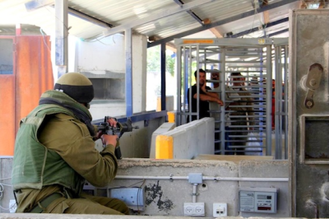
Israeli soldier faces Palestinians waiting at Huwara checkpoint, Nablus, Wiki Image: 12.06.06
Source: Blog from Bethlehem
Toine van Teeffelen writes from Bethlehem: Although we are staying in a relatively quiet part of the Bethlehem area, a steady stream of small, personal reports reaches us by phone and through social media. Together, they create a permanent sense of crisis and decline.
The army has entered one street or another. A journey from Bethlehem to Beit Safafa, only a few kilometres away, took nearly three hours. Someone in Gaza is unable to attend his mother's funeral elsewhere in the Gaza Strip. The Allenby Bridge is closed because of a strike, bringing international traffic momentarily to a standstill.
As for the West Bank, this persistent sense of obstruction and decline has three major causes.
First, Israeli settlers are seizing Palestinian land at an accelerating pace. Both Israeli politicians and the military support this expansion, including through large-scale military operations such as those currently taking place in the northern West Bank.
Second, Palestinian society is under severe economic pressure. This is partly a result of colonisation, but it is also because Palestinian labourers are now permitted to work in Israel and Jerusalem only in exceptional cases. Moreover, Israel either withholds Palestinian tax revenues from the Palestinian Authority or transfers only part of them. These revenues normally cover a large share of the Authority's budget. The Palestinian Authority is also under political pressure because it lacks legitimacy: apart from municipal elections, no presidential or parliamentary elections have been held for years.
And third, effective international pressure is lacking. Public opinion has shifted in many countries, but that change has barely translated into concrete political measures.
On 12 August 2024, genocide scholar Omer Bartov told the Dutch newspaper NRC that sanctions imposed by Western countries would cause an "earthquake" in Israeli society. He referred to the international sanctions against South Africa's apartheid regime. Bartov argued that Israel is heavily dependent on its allies, that the European Union is Israel's largest trading partner, and that substantial sums flow from Europe into Israeli technological and scientific research.
Dead Sea Scrolls
Scientific institutions do indeed provide Israel with political cover for its current genocidal policies in Gaza and its colonisation of the West Bank. One recent example is a major international research project into the origins of the Dead Sea Scrolls. According to an article published in Haaretz on 15 August 2025, the European Research Council awarded Mladen Popović, a professor at the University of Groningen, an Advanced Grant of €2.5 million for the five-year project "Tracing Scribes and Scrolls". Next to a team at the University of Groningen, as coordinator of the project, other participants include the Israel Antiquities Authority, the universities of Pisa and Naples, the University of Southern Denmark in Odense, KU Leuven, and the Egyptian museums in Berlin and Turin, whose work includes comparisons with papyri from Egypt.
ERC grants are among Europe's most prestigious research awards. They enable leading scholars to conduct innovative, large-scale research.
A bit of history. The Dead Sea Scrolls were discovered between 1947 and 1956 in the caves of Qumran and at nearby sites in the Bethlehem region of the West Bank, which was then under Jordanian rule. Until 1967, they were kept in East Jerusalem at the Palestine Archaeological Museum, better known as the Rockefeller Museum. After Israel occupied East Jerusalem, the scrolls were transferred to the Israel Museum in West Jerusalem. In light of the law of occupation, this sequence of events has obviously raised questions about the ownership of this cultural heritage for decades. The Palestinian Authority claims rights to the scrolls. Palestinian guides and researchers from the West Bank generally cannot access the Israel Museum where they are kept.
The Israeli partner in the project, the Israel Antiquities Authority, plays a central role in Israel's use of archaeology as an instrument of colonisation in the West Bank. By 2022, the occupying power had designated approximately 2,000 sites as "Israeli archaeological sites", and that number has since continued to rise.
Archeology and Colonization
Over the past several decades, settlers and settler organisations have discovered how useful archaeology can be in the seizure of land. Israel is now using archaeology more actively than ever to legitimise the colonisation and land grab of Palestinian land. Archaeological sites help settlers shape their narrative, attract tourists, and raise funds internationally. At the same time, they serve as instruments of displacement and control.
The Qumran caves, where the Dead Sea Scrolls were found, are among the best-known archaeological sites in the West Bank. Silwan in East Jerusalem is another clear example. There, the City of David archaeological and tourist complex has been expanded for decades by the settler organisation Elad, with the support of the Israeli government. Around Sebastia, the major archaeological site north of Nablus, Israel recently designated approximately 200 hectares of land as "state land" as a precursor of taking over the land for its own purposes. The site is best known for its Roman, Byzantine, and early Islamic remains. Near Herodion, east of Bethlehem, an Israeli procedure has also been under way since mid-2024 to declare 320 dunams, approximately 79 hectares, as "state land". Israel ruefully presents this measure as necessary for the "protection" of the archaeology.
Even Solomon's Pools near Bethlehem have recently been given an explicitly biblical character by settlers, although the oldest of the three reservoirs was built by the Roman governor Pontius Pilate around 30 CE. The other two date from later periods. All kinds of little-known springs in the West Bank are also suddenly being assigned a Jewish biblical significance. Traces of the Roman, Byzantine, Islamic, and other civilisations that existed in the area are conveniently forgotten. Peace Now says that "it is important to recall that nearly all Palestinian towns and villages in the West Bank are built adjacent to, or directly atop, archaeological remains, reflecting continuous settlement patterns spanning hundreds and even thousands of years."
The research led by the University of Groningen team may have scientific value in the strict sense, but it does not take place in a political vacuum. By collaborating with an Israeli government institution directly involved in the historical and ongoing appropriation and colonization of Palestinian heritage and land, European universities and museums lend legitimacy and even prestige to that policy.
LINKS
EU Funding Huge Project on the Origins of the Dead Sea Scrolls
www.haaretz.com/archaeology/2026-07-01/ty-article/eu-funding-huge-project-on-the-origins-of-the-dead-sea-scrolls/0000019f-19f3-dc51-afbf-dbf3579d0000
The Knesset Advances Legislation to Establish a Heritage Authority in the West Bank, Annexing Archaeological Activity to Israel
https://peacenow.org.il/en/heritage-authority
 Facebook
 Twitter
 LinkedIn
 Print
Print Email
Email
















 Facebook
 Twitter
 YouTube
 LinkedIn
 Pinterest