

'Friend of Israel, but a greater friend of the truth'
Source: Priests Against Genocide
Fr Rito Maresca, Coordinator of the International Network 'Priests Against Genocide' writes on "the Church of England's attempt to speak a true word about Palestine, and the Italian Church's struggle - not yet won - to do the same."
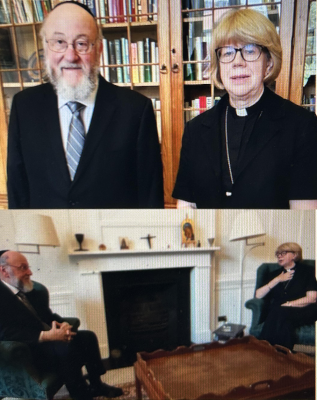
Two photographs, the same room. A dark wood bookshelf on one side, a fireplace with two green armchairs on the other. In one photo they stand side by side: a rabbi with a kippah and a white beard, a woman in a clerical collar and pectoral cross. In the other they sit facing each other, hands clasped in their laps, talking.
They are the Chief Rabbi of the United Kingdom, Sir Ephraim Mirvis, and the Archbishop of Canterbury, Sarah Mullally.
They met at Lambeth Palace in recent days, after difficult weeks. And they published, almost simultaneously, two posts recounting the same meeting in two profoundly different voices.
Mirvis speaks of "deep pain," of the Synod's "shameful decision," and calls on the Church to "repair the damage" done to Jewish-Christian relations. Mullally speaks of an "honest conversation," of wounds that need to be heard, of a bridge that still needs building.
Same room. Same fireplace. Two different languages of the heart.
To understand what happened in that room, we need to go back to what happened before - on 12 and 13 July, in the chamber of the Church of England's General Synod.
The stirring
After a debate spanning an evening and a morning, the Synod voted on a motion brought by the Diocese of Carlisle, lamenting the loss of Israeli and Palestinian lives and seeking "peace and security for all the peoples" of the Holy Land. The original text asked the Church to "receive" the Kairos Palestine documents - statements written by Palestinian Christians between 2009 and 2025, the latest of which, Kairos Palestine II - A Moment of Truth: Faith in the Time of Genocide, had reignited the dispute over the language used toward Israel.
An amendment changed that verb: no longer "receive," but "hear" - as "heartfelt expressions" of a lived experience, which do not imply agreement with every single word of those texts.
This is not a matter for philologists. It is the exact measure of how much courage the Church of England found to take a step, and how much fear it felt in taking it.
The motion, as amended, passed in all three houses of Synod - bishops, clergy and laity - by a wide margin. It condemned every form of antisemitism and anti-Muslim hostility. It acknowledged, with words of repentance, the Church's historic contribution to antisemitism. And it committed the Church to "respond to the call of Palestinian Christians to stand in solidarity with them and their fellow Palestinians in non-violent resistance to the ongoing occupation" (full text of the motion).
Archbishop Mullally, presenting the motion, said a sentence that would deserve to be carved above the door of every sacristy:
"The urgency of the situation in the Holy Land demands that we have difficult conversations. We must listen to those things that are hard to hear, and take the risk of engaging across divides." (full speech)
It is no coincidence that these words come only weeks after a pilgrimage. From 19 to 24 June, Mullally was in the Holy Land - Jerusalem, Bethlehem, Nazareth, Birzeit - together with the Anglican Archbishop of Jerusalem, Hosam Naoum, to pray and stand alongside Palestinian Christians (pastoral letter from the pilgrimage). She had seen with her own eyes, she told Synod, "how settlements are expanding at unprecedented rates": "Palestine, which the British government recognised last month, is disappearing" (The Jewish Chronicle). She was not speaking from an abstract synodal chamber. She spoke as someone who had returned with the dust of that land still on her shoes.
The wound, and its hardness
And yet, that small step - "hear," not "receive" - was not enough to calm the reaction. Chief Rabbi Mirvis called the vote "shameful," "a sad day for Jewish-Christian relations." He said Kairos II is "a document full of falsehood, which openly rejects dialogue, uses extreme rhetoric to challenge the very existence of Israel" (The Jewish Chronicle).
What strikes you, reading both texts again, is the asymmetry. On one side, the archbishop seeking dialogue, admitting her own difficulty, saying "we must listen to those things that are hard to hear." On the other, a firmness that leaves no room: accusing the other side's language of being extreme, of skirting violence, without turning that same severe gaze on its own language - nor on the language, this one openly violent, of not a few Israeli political figures, toward whom an official, unambiguous dissociation from Jewish community leaders across different nations never seems to arrive. As if one of the two parties sitting before that fireplace had permission to stand firm, and the other only permission to apologise.
Sed magis amica veritas - But truth is a dearer friend
Faced with the real threat of a deterioration in Jewish-Christian dialogue, the temptation is always the same: take a step back. Rephrase. Soften. Until it is emptied of meaning.
And yet, one is tempted to say, paraphrasing an old adage: amicus Israel, sed magis amica veritas. Israel is a friend, but truth is a dearer friend still. There can be no true dialogue without the courage of truth, even when truth carries, as Mullally herself said, the risk of "difficult conversations." A dialogue nourished only by what is comfortable to say is not dialogue: it is polite distance.
And here it must be said with equal clarity that our voice is not, and must never be, a voice against the Jewish people. We hold a deep appreciation for the Jewish tradition, from which we received the very teachings of Jesus, and we reject every form of antisemitism, just as we reject every form of Islamophobia. This is not about being against anyone. The Kairos document itself, in claiming its own voice, rejects every accusation of seeking to stir up hatred.
Another great pastor said it, in words worth hearing again: Nobel Peace laureate Desmond Tutu, who in his 2002 speech Occupation Is Oppression linked apartheid in South Africa to the Palestinian question:
"I am not pro- this people or that. I am pro-justice, pro-freedom. I am anti-injustice, anti-oppression."
And he went on: we do not criticise the Jewish people, but the political leadership of Israel, whenever it needs criticising - just as Israel's own prophets did with the unjust kings of their own people (WRMEA, full text of the speech).
The Italian mirror
And here, if you allow it, the discussion must come home.
The Italian Church, too, has just concluded its Synodal Journey with the document Lievito di pace e di speranza (Leaven of Peace and Hope), which welcomes Pope Leo XIV's invitation to Italian bishops that "every community become a 'house of peace,' where hostility is learned to be defused through dialogue, where justice is practiced and forgiveness is safeguarded" (n. 24).
A house of peace, though, is not a house of politically correct speeches that leave the world exactly as it was before anyone opened their mouth. It is the place where dialogue, justice and forgiveness are learned - in earnest, not just in words.
Last May, as the "Priests Against Genocide" Network, we wrote an open letter to the Italian bishops gathered in General Assembly, hours after the boarding of the Global Sumud Flotilla (full text on Nigrizia). We asked for a clearer word, more prophetic, more concrete. And the president of the Italian Bishops' Conference, Cardinal Zuppi, asked by a journalist, replied - as Vatican News reported - with these words: "We cannot help but be concerned about these violations of human rights. Every time rights are trampled it is troubling, but it is even more so when institutions are the ones doing it. The images of violence against the activists provoked in me a sense of refusal at the humiliation of the law" (Vatican News).
A "sense of refusal." Spoken by the man who leads the Italian Church, that is no small thing: it is a true, honest stirring, one worth gathering up and not letting fall. It is exactly the gesture we are speaking of in this text - the small stirring that is born sincere, and that waits only to be accompanied, by us and by our communities, with fraternal persistence, until it becomes a whole word. This is not a reproach. It is an encouragement: the cardinal has opened a door a crack, and we want to keep knocking - with respect, with trust, so that door stays open and swings wide.
The foundation we already had
We are not asking for something new. We are asking the Church to be faithful to what is already written in Gaudium et Spes: to read the signs of the times and "everywhere to foster justice and the love of Christ for the poor" (GS 90).
Nothing new, because "Promoting justice and peace, penetrating with the light and evangelical leaven every field of social existence, has always been a constant commitment of the Church in the name of the mandate she received from the Lord" (Paul VI, Iustitiam et Pacem, 1976).
Nothing new, so much so that Pope Francis, in reorganising the various pontifical councils into the Dicastery for Promoting Integral Human Development, had already asked, from the very first paragraph of the very first article, that it take up "the Holy See's concern for justice and peace" (Statute of the Dicastery, 2016).
So this is no recent invention. It is the compass the Church has always given herself, one we have simply chosen to remember: "Love and truth will meet, justice and peace will kiss" (Ps 85:11). There can be no peace without justice. Calling for justice is not calling for revenge, whatever certain propaganda would have us believe. It is, instead, the only viable road toward a lasting peace: creating the conditions for crimes to be acknowledged by all sides, so that forgiveness may one day be possible. Not easy. Not guaranteed. But possible - as, amid a thousand difficulties, South Africa and some still-wounded stories from Rwanda have shown us.
The courage that costs
Some, these days, speak of apocalypse - seeing all the horror, the violence, the arrogance of the powerful. And perhaps they are right. But we know well that apocalypse means revelation: it is a time of testing, but also a time when we are called to shine more brightly, not less, even when this carries the personal price of bearing witness.
The pressures faced today by those who try to tell the truth - or at least to tell another part of the story -, the killings of journalists, the smear campaigns against anyone who raises a voice outside the chorus: all of this calls to mind a story two thousand years old, the story on which we built our whole life and, before ever being priests, our choice to be disciples. A man walks the streets of Jerusalem and begins doing the most dangerous thing one can do before those who hold power: telling the truth. And power cannot bear it. It becomes an obsession: he must be silenced. You can almost see the scene. In a closed room, as they discuss what to do about this man who will not stop talking, there is always someone with the simplest and most terrible idea of all: silencing him is not enough - he must be killed.
If we were many
A small synodal amendment in London. A word of "refusal" spoken in Rome. These are true stirrings, not feigned, not for show. But they remain alone, and stirrings left alone, sooner or later, get put out by someone: by diplomatic pressure, by the accusation of breaking dialogue, by the weariness of those who prefer equidistance - which too often, we know, is simply equi-distance from the people who suffer, dressed up as prudence.
But what would happen if these stirrings were no longer alone? If behind every bishop who says "I feel a sense of refusal" there stood a thousand priests ready to say the same thing, no longer needing to search for the most cautious words possible? If our communities - yours, mine, the one next door - stopped, even for a moment, being anaesthetised by the flow of the news, and realised that what is happening in the Holy Land is still, today, crucifying someone?
We don't know yet.
And so - this is also why our network exists: so that question does not remain the question of one person alone. Our goal is to reach, by 22 September, 4,000 members - 1% of the world's Catholic clergy. A small seed. But one that can become a tree under which our bishops, too, may find shelter, and the courage for a true dialogue, with everyone.
Please share this text, and invite other deacons, priests and bishops to sign the common document.
 Facebook
 Twitter
 LinkedIn
 Print
Print Email
Email






 Facebook
 Twitter
 YouTube
 LinkedIn
 Pinterest