


Gospel in Art: Feast of Saint James, Apostle
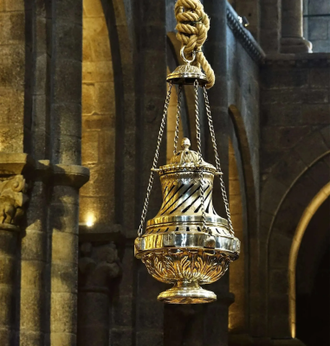
Botafumeiro, executed by Josè Losada in 1851 for the Cathedral of Santiago de Compostela, Galicia, Spain. Brass, bronze, gold plate. © Wikimedia - Santiago Cathedral
Source: Christian Art
Gospel of 25 July 2026
Matthew 20:20-28
At that time: The mother of the sons of Zebedee came up to Jesus with her sons, and kneeling before him she asked him for something. And he said to her, 'What do you want?' She said to him, 'Say that these two sons of mine are to sit one at your right hand and one at your left in your kingdom.' Jesus answered, 'You do not know what you are asking. Are you able to drink the cup that I am to drink?' They said to him, 'We are able.' He said to them, 'You will drink my cup, but to sit at my right hand and at my left is not mine to grant, but it is for those for whom it has been prepared by my Father.' And when the Ten heard it, they were indignant at the two brothers. But Jesus called them to him and said, 'You know that the rulers of the Gentiles lord it over them, and their great ones exercise authority over them. It shall not be so among you. But whoever would be great among you must be your servant, and whoever would be first among you must be your slave, even as the Son of Man came not to be served but to serve, and to give his life as a ransom for many.'
Reflection on the silver-gilt censer
Today we celebrate the Feast of Saint James the Apostle. According to the Gospels, James and his brother John, together with Peter and his brother Andrew, were the first disciples to be called by Jesus. All four were fishermen, accustomed to casting their nets into the waters of the Sea of Galilee. James became one of Christ's closest companions. Along with Peter and John, he witnessed some of the most extraordinary moments of the Lord's earthly ministry: the raising of Jairus' daughter, the Transfiguration on Mount Tabor, and Jesus' agony in the Garden of Gethsemane. Yet even this privileged intimacy did not immediately lead to a full understanding of Christ's mission. James and John, encouraged by their mother, boldly asked to sit at Jesus' right and left when He came into His Kingdom. They still imagined a kingdom of earthly honour and power, whereas Jesus came to establish a Kingdom marked by humility, sacrifice and self-giving love.
Jesus then gently challenged their ambition by asking, "Can you drink the cup that I am going to drink?" Confidently, the brothers answered that they could. At the time, they could scarcely have understood what that cup truly meant. Yet, in the years that followed, James did indeed share in Christ's suffering. As recorded in the Acts of the Apostles, King Herod Agrippa launched a persecution against the Church and had James executed by the sword, making him the first of the Twelve Apostles to give his life for the Gospel. According to ancient tradition, his disciples carried his remains from Jerusalem to the far north-west of Spain, where they were eventually laid to rest at Compostela. For more than a thousand years, countless pilgrims have made their way along the Camino de Santiago to pray at his tomb, discovering that the pilgrimage itself often becomes a metaphor for the Christian life.
The Cathedral Basilica of Santiago de Compostela, which enshrines the relics of Saint James, is renowned for one of the most extraordinary liturgical objects in the Christian world: the Botafumeiro, whose Galician name literally means "smoke expeller". This immense censer, crafted in 1851 by the silversmith José Losada, is made of silver-plated brass and bronze with a burnished gilt finish. It weighs around 80 kilograms, stands 1.60 metres high, and is suspended from the cathedral's soaring dome by a system of pulleys and a thick rope. At the end of certain liturgical celebrations, eight men known as tiraboleiros set it in motion. Gradually, the Botafumeiro gathers speed until it soars through the transept in a magnificent arc, reaching speeds of almost 70 kilometres per hour and rising to a height of over 20 metres. Watching it swing is an unforgettable sight: a great cloud of fragrant incense filling the vast cathedral, symbolising the prayers of the pilgrims rising to heaven.
The Botafumeiro originally served a practical purpose. During the Middle Ages (when a different, slightly smaller botafumeiro was used) , after weeks or even months of walking the Camino, thousands of weary pilgrims would arrive at the cathedral exhausted, dusty and often less than fragrant. The vast censer helped purify the air with clouds of incense. Today, however, it has become something far more profound than a practical solution. Its soaring movement, the sweet fragrance of the incense, and the rhythmic precision with which it is swung create an overwhelming sense of the sacred. The ropes that suspend the Botafumeiro are replaced roughly every twenty years, and the ceremony costs around €450 each time it is performed because of the specially prepared expensive charcoal and incense. I have never had the privilege of witnessing the Botafumeiro in motion, but I very much hope that one day I will stand among the pilgrims beneath its soaring flight.
LINKS
Christian Art: www.christian.art
Today's image: https://christian.art/daily-gospel-reading/matthew-20-20-28-2026/
 Facebook
 Twitter
 LinkedIn
 Print
Print Email
Email













 Facebook
 Twitter
 YouTube
 LinkedIn
 Pinterest