


Gospel in Art: Hear then the parable of the sower
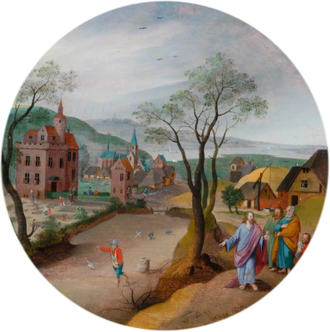
The Parable of the Sower, by Abel Grimmer, 1610 © The Bowes Museum, Barnard Castle, Durham
Source: Christian Art
Gospel of 24 July 2026
Matthew 13:18-23
At that time: Jesus said to his disciples, 'Hear then the parable of the sower: When anyone hears the word of the kingdom and does not understand it, the evil one comes and snatches away what has been sown in his heart. This is what was sown along the path. As for what was sown on rocky ground, this is the one who hears the word and immediately receives it with joy, yet he has no root in himself, but endures for a while, and when tribulation or persecution arises on account of the word, immediately he falls away. As for what was sown among thorns, this is the one who hears the word, but the cares of the world and the deceitfulness of riches choke the word, and it proves unfruitful. As for what was sown on good soil, this is the one who hears the word and understands it. He indeed bears fruit and yields, in one case a hundredfold, in another sixty, and in another thirty.'
Reflection on the painting
The parable of the sower is one of the better known parables in the Gospels. What the story does is that it gives us a very honest picture of the things that can prevent the word of God from taking root and bearing fruit in our lives. The first obstacle is a lack of understanding. We do not all need to become scholars or undertake endless courses, but we do need some living sense of who Jesus is if His word is to speak deeply to us. We need to put in some effort to learn and study the basics of our faith.
The second obstacle is shallowness. At times, we hear the word, but we do not allow it to sink deeply enough into the soil of our hearts. We may admire it, even welcome it, but if we do not ponder it and let it take root, it can easily be abandoned when faith begins to cost us something.
The third obstacle is described as the worries of this world and the lure of riches. These two often go together: anxiety about success, security, status, and possessions can slowly crowd out the voice of God. If our hearts become too occupied with worldly concerns, the Lord's word can be choked before it bears fruit. This Gospel reminds us that fruitful listening does not happen automatically. It requires attention, effort, patience, prayer, and struggle.
Abel Grimmer's The Parable of the Sower draws our eyes to the broad Flemish landscape, alive with fields, winding paths, villages, and countless tiny figures busy with the ordinary rhythms of daily life. Yet we see Christ standing upon a hill overlooking everything with his disciples. In the distance the sower walks across the fields, scattering seed with a generous sweep of his arm. Grimmer masterfully places the parable within everyday life, allowing the words of Jesus reach their visual fulfilment in a very tangible way.
Like many Flemish painters of the early seventeenth century, Grimmer delighted in filling his paintings with minute details that reward careful observation. Every tree, pathway, cottage and cultivated field has been lovingly rendered, reminding us that God speaks not only through extraordinary moments but also through the ordinary routines of everyday life. We can imagine the seed falling on the path, among the rocks, into the thorns, and finally onto the rich soil. The question the artist quietly leaves with us is not, 'What kind of seed does God sow?', but rather, 'What kind of soil am I?'
LINKS
Christian Art: www.christian.art
Today's image: https://christian.art/daily-gospel-reading/matthew-13-18-23-2026/
 Facebook
 Twitter
 LinkedIn
 Print
Print Email
Email


















 Facebook
 Twitter
 YouTube
 LinkedIn
 Pinterest