


Reflection by Canon Robin Gibbons on Feast of Saint Benedict
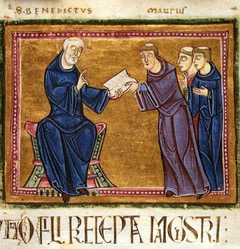
Saint Benedict delivering his rule to the monks of his order
July 11th - Feast of Saint Benedict - Father of Western Monasticism - Patron of Europe
A personal prologue
Though I moved from being part of a monastic community to serve our Eastern Catholic brothers and sisters as one of their byzantine priests, I have never lost my attachment to the spiritual tradition and basic practices of my formative years as a monk. I am also glad that links can be kept with a community through friendship and affiliation with the Oblate members of the Monastic Order, a movement which has grown in recent years. In this way the tradition of the Rule of Benedict helps me personally, as well as countless others, in providing a guide and framework to do what a monk does, 'seek God!"
There is also a deeper sense of renewed vigour in the wider Benedictine monastic and lay family as we begin a decentralised pilgrimage of faith to celebrate the 1500th anniversary of the founding of Monte Cassino in 2029, a journey we can undertake, communally or individually, externally or interiorly adapted to our circumstances.
Four Stages of the Pilgrimage
This multi-year spiritual pilgrimage follows the four key and foundational locations of St. Benedict's life, which each year are focussed on a specific location and pick up a key theme of his own journey . These four stages are:
2026: Norcia - Awaken
2027: Rome - Listen
2028: Subiaco - Grow
2029: Montecassino - Flourish
At the beginning of the Jubilee in April, the Abbot Primate of the Benedictine Confederation, Jeremias Schröder, reminded everybody of the 'inclusivity' of this pilgrimage: "Norcia brings us back to what is essential: to baptism. When we speak of family, we do not mean only our monastic community, but the universal fraternity of all Christians, the great family of God." This is an important point to make, particularly as some older communities decrease in number, newer ones start up and begin to flourish particularly, but not exclusively, outside the original heartlands of Europe, and new lay initiatives based around the Oblates and Friends emerge. It is also a reminder of the latent ecumenism of the Rule which as many Anglicans and Anabaptists know formed part of their own tradition in those early stages of the Reformation. But it is also testament to the embrace of the Rule of Saint Benedict by communities of men and women outside of the Catholic Church.
To my mind there are two key points which help us focus firstly on what is good and inspirational from our past heritage, but secondly on a renewed journey of new shared discoveries, friendships and community. As Abbot Jeremias writes: "Our theme, "Places of Hope since 529," speaks to the enduring role of monasteries as spaces of prayer, stability, hospitality, and renewal. In a time marked by uncertainty and rapid change, the Benedictine tradition continues to offer a quiet but resilient witness-grounded, human, and open to God."
I hope to share part of this journey with you over the next four years.
Gregory the Great's Dialogues Book 2
We start with Norcia and Benedict's beginnings, here his calling as monastic teacher, leader and legislator was awoken, but it was only the awakening of a journey that took a lifetime, and that is exactly the same as each one of us. What we know of Benedict the man, monk and saint, is largely taken from the work of Gregory the Great, The Dialogues Book 2. Whilst this is a piece of hagiographical, inspirational writing, produced 50 years after Benedict's death, it also contains elements that are directly attributable to those who knew Benedict in life and therefore acts as a 'primary source for the Saints biography. Gregory introduces him through these words:
"There was a man of venerable life, blessed by grace, and blessed in name, for he was called 'Benedictus' or Benedict. From his younger years, he always had the mind of an old man; for his age was inferior to his virtue. All vain pleasure he despised, and though he was in the world, and might freely have enjoyed such commodities as it yields, yet he esteemed it and its vanities as nothing.
He was born in the province of Nursia, of honourable parentage, and brought up at Rome in the study of humanity. As much as he saw many by reason of such learning fall to dissolute and lewd life, he drew back his foot, which he had as it were now set forth into the world, lest, entering too far in acquaintance with it, he likewise might have fallen into that dangerous and godless gulf.
Therefore, giving over his book, and forsaking his father's house and wealth, with a resolute mind only to serve God, he sought for some place, where he might attain to the desire of his holy purpose. In this way he departed, instructed with learned ignorance, and furnished with unlearned wisdom.
All the notable things and acts of his life I could not learn; but those few, which I mind now to report, I had by the relation of four of his disciples; namely, Constantinus, a most rare and reverent man, who was next Abbot after him; Valentinianus, who for many years had the charge of the Lateran Abbey; Simplicius, who was the third superior of his order; and lastly of Honoratus, who is now Abbot of that monastery in which he first began his holy life".
Is there anything in this 'fuga mundi' that matters to us in the 21st century? Of course there is, we are not all called to retire from the world, but we are asked to be salt, leaven , and light , for the Christian the choice is not a running way but a conscious effort to set ones face on the gospel way and determinedly live out the values of the gospel wherever we might be. To make of ourselves a monastery of the heart, where we listen to the voice of Christ, praise the Maker of All by some means during our day serve Christ, with the help of the Holy Spirit, in whatever way is our chosen route, loving our brothers and sisters in the community to which we belong by baptism with sincere and humble hearts. That's a lifetime of daily awakenings!
Some thoughts on Awakening
As we celebrate this feast of Benedict, perhaps one challenge is to ask the Spirit to awaken in us a love of the true past. Monasticism predates the major controversies of the Christian Community, Benedictine monasticism brings us back to a simplicity of vision, not of the medieval development, not the post reformation evolution nor even of the battles of the 19th or 20th centuries. The polemics we find in social media about the Latin Rite and tradition do not belong here, instead there is the voice of the Christ that needs awakening in our lives, a Christ of yesterday, but also of today and the future. On this pilgrimage we are called to awaken in ourselves a simplicity of love, an openness to the poor in spirit, and an unencumbered directness of our relationship with God.
I shall let St Benedict's own words help us as we wake into a new challenge:
"Let us arise, then, at last,
for the Scripture stirs us up, saying,
"Now is the hour for us to rise from sleep" (Rom. 13:11).
Let us open our eyes to the deifying light,
let us hear with attentive ears
the warning which the divine voice cries daily to us,
"Today if you hear His voice,
harden not your hearts" (Ps. 94[95]:8).
And again,
"Whoever has ears to hear,
hear what the Spirit says to the churches" (Matt. 11-15; Apoc. 2:7).
And what does He say?
"Come, My children, listen to Me;
I will teach you the fear of the Lord" (Ps. 33[34]:12).
"Run while you have the light of life,
lest the darkness of death overtake you" (John 12:35). ( From the Prologue of the Rule of St Benedict)
The website that gives you access to the jubilee pilgrimage may be found at: https://jubilee.osb.org/stories-media
 Facebook
 Twitter
 LinkedIn
 Print
Print Email
Email














 Facebook
 Twitter
 YouTube
 LinkedIn
 Pinterest