


Pilgrimage Through the Lost Friaries of London
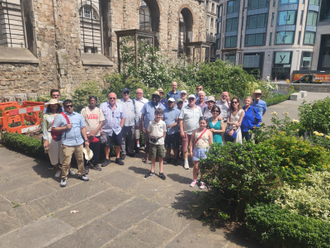
Pilgrims at Greyfriars
As an avid reader of historical novels set during the Dissolution of the Monasteries, I have often wondered what remains of the religious communities that once shaped life in the City of London. Most people know Blackfriars station, but how many know why it bears that name? What traces survive of the friars who lived, worked and prayed in the City for more than 300 years?
This question inspired Osterley Circle's Walk of Faith this year. Responding to Great Britain National President Richard Mills' invitation to undertake a pilgrimage, members set out to explore the sites of London's medieval friaries and discover the stories hidden beneath the modern city.
A pilgrimage is more than simply visiting places of religious significance. The journey itself matters. It offers time for conversation, reflection and a fresh appreciation of the people and places encountered along the way.
The day began with prayers for those who died for their faith and for Pope Leo XIV, whose Augustinian roots provided a fitting connection to the theme of the walk.
As we journeyed through the City, we explored the history of the great mendicant orders - the Augustinians, Dominicans, Carmelites and Franciscans. Unlike monks, friars lived and worked among the people, serving the communities around them while following lives of poverty, chastity and obedience.
Although the Great Fire of London destroyed much of medieval London, the City's street plan still reveals the footprint of the former friaries.
Our first stop was Austin Friars, once home to the Augustinian friars. Today, the Dutch Church occupies part of the site, but the surrounding streets still hint at the scale of what was once one of London's most important religious communities. Nearby stood the London residence of Thomas Cromwell, the man whose name remains forever linked with the Dissolution of the Monasteries.
Along the route we followed the course of London's hidden rivers, the Walbrook and the Fleet, both now buried beneath the streets. We paused at St Stephen Walbrook, famous as the birthplace of the Samaritans, and visited the remarkable London Mithraeum, a Roman temple hidden beneath Bloomberg's headquarters.
At Temple Church we reflected on the history of the Knights Templar, whose distinctive round church still stands as a reminder of the age of pilgrimage and crusade. The Temple later became home to the legal profession and remains one of London's most fascinating historic enclaves.
The walk continued through the former sites of Whitefriars, Blackfriars and Greyfriars. Each order left its mark on the City, whether through preaching, education or service to the poor. Their names survive in streets, stations and districts long after the friaries themselves disappeared.
One of the highlights of the day was St Etheldreda's Church in Ely Place. Dating from the 13th century, it is one of the oldest Catholic churches in London and a rare survivor from medieval England. Its connections to the martyrs of the Reformation provided a moving conclusion to the pilgrimage.
By the end of the day, it was clear that while London's friaries have largely vanished, their legacy remains woven into the fabric of the City. Their stories can still be found in its churches, street names and hidden corners.
For Osterley Circle, this was more than a history walk. It was a pilgrimage in the truest sense - a journey of faith, friendship and discovery, reminding us that the past still has much to teach us if we take the time to look for it.
For more information on the Catenians please see: https://thecatenians.uk/
 Facebook
 Twitter
 LinkedIn
 Print
Print Email
Email















 Facebook
 Twitter
 YouTube
 LinkedIn
 Pinterest