

Archbishop Farrell: The Irish American story was one of struggle and opportunity
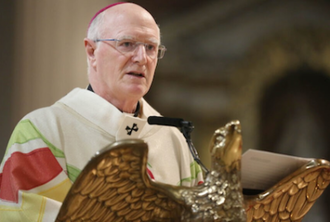
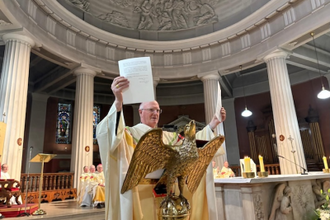
Archbishop Farrell during Mass in Saint Mary's Cathedral, Dublin. Image: CCO archive
Source: Irish Catholic Media Office
Archbishop Dermot Farrell, Archbishop of Dublin gave this homily during the 6pm Vigil Mass in Saint Mary's Cathedral, Dublin yesterday.
"Come to me, all you who labour and overburdened, and I will give you rest" (Matt 11:28).
These words of the Lord in our Gospel today express the tenderness of the love which the Lord lavishes on those whom He invites to draw closer to the source of life. God's dream for humanity is that we find true happiness, not through our own restless searching, but through centring ourselves in the relationship with the One who gave us life.
Our yearning and striving will always disappoint until we realise that true happiness comes from recognising that we are loved by God, that in the words of Saint Augustine, our hearts are restless until they rest in Him.
Christians understand that God's love for us was supremely expressed through the Incarnation, the Son of God entering our history so that in Himself "the mystery of humanity truly becomes clear": that our destiny is to become one with God as He became one with us through His life, death and resurrection (Pope Leo XIV, Magnifica Humanitas, 1; Gaudium et Spes, 22).
Just as Jesus offered Himself for all humanity, so we too are called to recognise all women and men as our sisters and brothers. Consequently, when Jesus invites those who labour and are overburdened to rest in Him, He calls us too to show compassion and solidarity with those who need our care, who are overburdened by life's struggles. In this way, we are called to cooperate in building up the Kingdom of God, through our lives as individuals but also as citizens. This Kingdom allows of no distinctions or discrimination based on external characteristics. On the contrary, at the core of Christian belief is the understanding that all women and men are created in the image and likeness of God.
As a result, human dignity does not depend on a person's external characteristics or achievements or status; it is, rather, in the words of Pope Leo, "a gift that precedes and transcends each person, endowed by God as an expression of His unfailing love" (Magnifica Humanitas, 50). For that reason, the human person must be the focus of truly authentic development, and the test of every measure adopted by societies to regulate their communal life.
Today, the people of the United States of America are marking the 250th anniversary of the Declaration of Independence. While American independence was a political project that sought to underpin religious freedom through the separation of Church and State, the Declaration of Independence recognised that the dignity of all people flowed from creation, eloquently declaring: "we hold these truths to be self - evident, that all men are created equal, that they are endowed by their Creator with certain inalienable Rights, that among these are Life, Liberty and the pursuit of Happiness."
The concept of human dignity would indeed be empty if it were not reflected in rights that are recognised and protected by society.
Over the centuries, since the Declaration of Independence was signed, there has been a necessary and noble struggle to articulate those rights and provide for their protection. Indeed, there was a great irony that, at the time of the signing of the Declaration, the status of human person was denied to those trapped in slavery and to the indigenous population of America, while equality between men and women was scarcely imagined.
While we can applaud the progress which has been made in the articulation and protection of human rights - indeed Saint John Paul II stated that the Universal Declaration of Human Rights proclaimed by the United Nations is, "a milestone on the long and difficult path of the human race" (Address of Pope John Paul II to the 34th General Assembly of the United Nations, 2 October 1979), we recognise the fragility of the protection afforded to human dignity. The basic human right to life itself is today eroded and undermined by a seeping culture of death reflected in the normalisation of abortion and assisted suicide, as well as the embracing by nations of a power paradigm that seeks to dominate through the dynamic of war and fear. A variety of social and political causes co-opt the jargon of freedom nowadays.
True freedom, however, is not expressed in a person's right to do whatever they want to do but, rather, it is in the capacity to act within a network of mutual relationships, moral depth, and public accountability. Christ brings us to a proper relationship not only with God - but with each other - not one of domination, but service.
A growing category of people whose human dignity is too often denied are those who are obliged to flee war, famine and destruction in their home countries and to seek refuge far from home. Far from being welcomed, their plight is often exploited by sinister forces who foster hate and division and stir anger and suspicion against all those who have come from overseas to seek asylum. The malign intent of those who stir up these feelings of fear and suspicion is revealed when the focus of their hatred is widened to include all those whose origins lie overseas, no matter how many generations have passed, simply because of the colour of their skin or their cultural and religious beliefs.
From Biblical times, welcoming the stranger and caring for the vulnerable have been understood as a natural consequence and expression of our common humanity (Gen 18:1-8; Lev 19:33-34; Heb 13:2 and John 4:1ff).
From the very beginnings of the Christian Church it was understood that the Good News was to be proclaimed to all people, to the ends of the earth, without distinction (Mark 16:15). The tradition of refuge and sanctuary has been a key marker of Christian civilisation. In that tradition, the Republic established on foot of the American Declaration of Independence became a beacon of hope for those who yearned for a better life, including countless thousands of Irish people. The inspiring story of the Irish in America was often the story of struggle against adversity, as well as the seizing of opportunity.
Sadly, the tradition of welcome and refuge which marked the greatness of the American dream has been repudiated in our time by many. The great motto of the Republic: "E pluribus unum" (Out of many, one), has been rejected by many through the rejection of diversity and a denial of equal human dignity. For that reason, many Americans are marking this important anniversary with sober reflection as well as appropriate celebration.
Such reflections on the United States historic anniversary prompt reflection on the situation here in Ireland.
Has our history of emigration made us sensitive to the needs of those who have immigrated from other countries to find hope and happiness here? Just as Irish emigrants have made profound contributions to the lands which received them, only a moment's reflection will tell us how great is the contribution being made by those who have made Ireland their home. Our health and social services, our high-tech industries, our food production and processing, our hospitality and service industries, all depend to a very significant degree on the presence, talents and creativity of those who made their home here. Many were driven from home to find refuge here; many more arrived having been recruited by employers who need them to generate the economic resources which underpin the prosperity of us all.
And, yet, the streets of our cities and towns have witnessed the mobilisation of hatred and rejection. Far from being welcomed as sisters and brothers with a contribution to make, migrants are too often portrayed - even in public policy - as a problem to be managed rather than, as Pope Francis said, "a living image of the People of God on the move" (Message for 110th World Day of Migrants and Refugees, 29 September 2024; also Magnifica Humanitas, 81).
That is not to say that immigration is without challenges and consequences that need to be addressed for the common good. There are legitimate concerns at the rate of population growth and the impact on availability of housing and other essential services. There is also a challenge to develop harmonious community relations and a necessary degree of social cohesion that does not seek to impose uniformity but rather creates "an opportunity for encounter and mutual enrichment among peoples" (Pope Leo XIV, Meeting with Migrants at the 'Las Raíces' Centre, 12 June 2026). For that reason it is appropriate that measures are taken to protect the integrity of the asylum system and to regulate pathways to immigration for the common good.
What distinguishes just and socially responsible approaches to immigration policy, from those which are discriminatory and repressive, is the recognition of the human dignity of the people involved, not to treat them as a statistic or a stigmatised category. The manifest injustice of requiring one category of people to live and labour under discriminatory work, housing and family conditions, cannot be disguised when we look in the eyes of the men, women and children who are the objects of such policies.
It would be almost obscene to enforce rules which force those whose labour and skills we require to live as indentured labourers, second class citizens, denied the basic requirements for human flourishing for unconscionable periods of time.
For generations so many of our people depended on finding a safe haven overseas and an opportunity to build a new life. Indeed, many of our young people still make that journey in search of a better future. How ironic, how shameful, if we create a society that denies the humanity of others who seek the same here; how blasphemous if we do so while claiming to be protecting Christianity, when the Lord offered Himself as Saviour of all humanity and instructed us to follow His example of hospitality, welcome and inclusion.
In the words of Pope Leo, "let us become 'weavers of hope' in our world, sharing who we are and what we have, so that the presence of Jesus may grow among us and his Kingdom take shape" (Pope Leo XIV, Magnifica Humanitas, 245). Amen.
 Facebook
 Twitter
 LinkedIn
 Print
Print Email
Email






 Facebook
 Twitter
 YouTube
 LinkedIn
 Pinterest