

Pope visits Montserrat, celebrates Mass in Sagrada Familia - 'a catechesis made of stone, colour, and light'
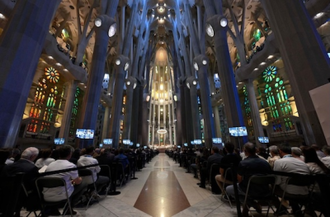
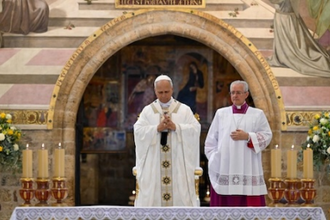
Mass in Sagrada Familia
Source: Vatican Media
Pope Leo celebrated Mass in the Sagrada Familia Basilica in Barcelona this evening, on the centenary of the architect Gaudí's death. He then blessed the Tower of Jesus Christ - the tallest church the world - which was illuminated in a blaze of fireworks.
Thousands of people had waited all day outside for this moment. Describing the Basilica as "a catechesis made of stone, colour, and light," the Pope emphasised that those who believe, "cannot kill innocent people nor abandon those who suffer, who weep, who flee from poverty."
Pope Leo XIV began his visit to the Sagrada Família by praying before the Blessed Sacrament and visiting the tomb of Antoni Gaudí, whose vision shaped the Basilica into a monumental expression of Christian faith, through architecture, light, colour, and symbolism.
In his homily, delivered in Catalan and Spanish, Pope Leo recalled a passage from the Gospel of John: "you will die in your sins unless you believe that I am He." He noted that these are strong words, but also an invitation to salvation. He stressed that you cannot believe in Jesus and wage war. We cannot believe in Jesus and kill the innocent. We cannot believe in Jesus and abandon those who suffer, who weep, who flee from poverty."
Greeting King Felipe VI and Queen Letizia, who welcomed him, alongside Spanish Prime Minister Pedro Sánchez, as well as political and ecclesiastical authorities, Pope Leo stressed that the Basilica of the Sagrada Família opens its doors like outstretched arms, inviting everyone to this altar, to listen to the Word of God, which makes us a family beloved by the Lord and nourished by His very life in the Eucharist.
Addressing civil and religious leaders, he described the Basilica as a sign of unity that gathers people around God's Word and the Eucharist. Drawing on its architecture, he compared the Church to a living structure built from many stones, with Christ as its foundation and goal. The ongoing construction of the Basilica, he said, symbolises the Christian life as a work continually being completed by God, inviting believers to cooperate in His plan.
The Pope highlighted the spiritual meaning of the Basilica's design, noting that its façades and the newly blessed Tower of Jesus Christ point to the Cross as a sign of redemption, hope, and divine love. The illuminated cross atop the tower serves as a visible witness to faith and a beacon for the city. He emphasised that art plays a unique role in expressing faith, praising Gaudí for creating a spiritual journey that leads visitors to encounter Christ.
Concluding his homily, Pope Leo thanked those who have supported the construction of the Sagrada Família and described the Basilica as an architectural masterpiece and a powerful instrument of evangelisation. He urged the faithful not only to raise their eyes toward Christ but also to uplift those who are marginalised and suffering, allowing the Basilica's message of hope and charity to guide Christian life and witness.
Watch the Mass at Sagrada Familia: www.youtube.com/watch?v=fWLEOPjBTP8
Pope Leo began his day with a visit to a prison - the Penitential Centre Brians 1. He told prisoners that life's mistakes do not define a person's identity, stressing that the Lord will never cease to show them His love, which outweighs any good or bad we have done.
"To each of you I say: God loves you just as you are, but He dreams of you being even better! The Lord allows us all to start anew, for being human and being Christian does not mean never making mistakes, but rather growing in the ability to convert, repent, make amends and, above all, to reconcile and forgive."
From here Pope Leo went to Monserrat - the 1000 year-old Benedictine monastery and shrine set high in the mountains about an hours drive from Barcelona. Here he led the Rosary and venerated the statue of Our Lady in the shrine.
See: www.youtube.com/watch?v=F3YTBU1YZtQ
Pope Leo XIV highlighted how the Virgin Mary always points to Christ, whose love can disarm the violence that can inhabit our hearts.
"Let us ask Mary, Queen of Peace, to teach us to renounce hurtful words, hasty judgment, gossip and slander," he said in his address in Spanish and Catalan. "May we also learn to cherish and nurture love within our families, among friends, in the workplace, on social media, in political debates and in Christian communities, so that hatred may give way to hope and peace."
In the afternoon the Pope met with charity and welfare organisations in Church of St Augustine "Here, truly, I feel at home," the Augustinian Pope Leo said. He mentioned that he had tried to visit the church 40 years ago - but it had been closed. He was delighted to be able to visit this time and said: "How beautiful it is to find a church with an Augustinian community and with so many people who live here, who praise God, who find community, welcome and integration through this church and its social ministry. Thank you all, truly!"
Pope Leo responded to a series of questions in a letter written by a six-year-old boy named Renzo - about his time in Peru, his enjoyment of football and tennis, and his vocation to the priesthood. "Every child is a dream of God. You are too, Renzo," he continued, suggesting that children ask themselves an important question: whether they want to be friends of Jesus.
"Friendship with Jesus gives us joy, makes us free and helps us discover, step by step, the vocation and path that God has prepared for each one of us."
He also spoke about the importance of caring for grandparents - countless numbers who care for grandchildren while parents work and who quietly transmit faith, love and values to younger generations.
"Let us not allow loneliness and abandonment to become normal in the lives of older adults. That is something very sad," the Pope said, noting that the responsibility to care extends beyond family ties and embraces every elderly person who risks being forgotten.
Responding to a question about forgiveness, the Pope recalled Jesus' teaching that Christians must forgive "seventy times seven," although "Forgiving does not mean saying that what was wrong was right," he explained, "Nor does it mean allowing someone to continue doing harm."
Forgiveness, he added, prevents hatred from taking possession of the heart and opens the way to healing and peace. "When we forgive, we imitate the example of Jesus, who forgave those who crucified Him."
The Pope then turned his attention to the mission of the charitable organisations gathered in Sant Agustí, and, thanking them for their work, he drew on the spirituality of Saint Augustine, and he reminded them that Christian life begins not with human effort but with grace.
"Being Christian is, above all, a gift, a grace," Pope Leo said.
From that grace, he explained, flows the responsibility to love others and to recognise Christ in those who suffer. "The Christian, besides being kind and gentle, must be compassionate, love selflessly and seek the good of others."
Pope Leo XIV praised the work carried out across the Archdiocese of Barcelona and stressed that the Church's charitable mission becomes especially urgent at a time when society often seems to have lost sight of the sacred dignity of the human person.
That dignity, he insisted, does not depend on wealth, ability or social status but on the fact that every human being is created in the image of God and loved by Him, adding that "The human person is at the centre of the Church's action."
While acknowledging the importance of material assistance, the Pope reiterated that those living in poverty and marginalisation also hunger for spiritual accompaniment. "They need not only material aid and moral support but also God, His friendship, His blessing, His Word, His Sacraments and a path of growth and maturation in faith."
Before meeting with the many people lined up to greet him, Pope Leo encouraged the charitable workers to continue their mission alongside their pastors, urging them to be "credible witnesses of Christian hope," and to reveal, through their service, the justice and peace of God's Kingdom.
 Facebook
 Twitter
 LinkedIn
 Print
Print Email
Email








 Facebook
 Twitter
 YouTube
 LinkedIn
 Pinterest