

Gospel in Art: Solemnity of The Most Holy Body and Blood of Christ
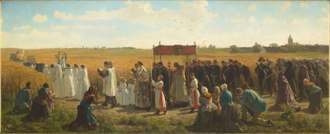
The Blessing of the Wheat in Artois by Jules Breton, painted in 1857 © Musée d'Orsay, Paris
Source: Christian Art
Gospel of 7 June 2026
John 6:51-58
At that time: Jesus said to the Jews, 'I am the living bread that came down from heaven. If anyone eats of this bread, he will live for ever. And the bread that I will give for the life of the world is my flesh.'
The Jews then disputed among themselves, saying, 'How can this man give us his flesh to eat?'
So Jesus said to them, 'Truly, truly, I say to you, unless you eat the flesh of the Son of Man and drink his blood, you have no life in you. Whoever feeds on my flesh and drinks my blood has eternal life, and I will raise him up on the last day. For my flesh is true food, and my blood is true drink. Whoever feeds on my flesh and drinks my blood abides in me, and I in him. As the living Father sent me, and I live because of the Father, so whoever feeds on me, he also will live because of me. This is the bread that came down from heaven, not like the bread the fathers ate, and died. Whoever feeds on this bread will live for ever.'
Reflection on the painting
Today the Church celebrates Solemnity of the Most Holy Body and Blood of Christ, traditionally known as Corpus Christi (Latin for "the Body of Christ"). On this feast, we celebrate one of the deepest mysteries of our faith: that in the Eucharist, Christ is truly and really present: His actual Body and Blood, Soul and Divinity. The Eucharist is not merely a symbol or a reminder of Jesus, but Christ Himself truly present among us under the appearances of bread and wine. Through the consecration, the body and bread becomes His real presence among us.
The feast itself emerged in the 13th century at a time of growing Eucharistic devotion within the Church. Saint Thomas Aquinas played an important role in shaping the celebration after Pope Pope Urban IV established the feast for the universal Church in 1264. Aquinas composed some of the most beautiful Eucharistic hymns ever written for this occasion, including Pange Lingua, Tantum Ergo, and Panis Angelicus. Corpus Christi soon became associated with great public processions in which the Blessed Sacrament is carried through streets, towns, and countryside in a monstrance. These processions are a public act of faith: Christ does not remain hidden within the walls of the church, but is carried out into the world, blessing homes, people, fields, workplaces, and daily life itself.
Our painting by Jules Breton beautifully captures such a procession moving through the wheat fields of Artois in northern France. The golden fields stretch across the canvas, glowing with summer light, while villagers gather in deep reverence as the Blessed Sacrament passes among them. Some kneel in prayer; others genuflect in adoration. Children carry the four-poled baldacchino beneath which the priest walks holding the monstrance aloft. Village officials and farmers stand side by side in devotion. The procession through the fields was not merely symbolic. In rural communities, people genuinely believed Christ's presence would bless the land and protect future harvests. Farmers wanted the procession to pass by their fields, and would ask the priests to pass by. Painted in 1857 and exhibited at the Paris Salon alongside works such as The Gleaners, Breton's monumental canvas (318 cm; 10.4 ft wide) brought dignity and spiritual beauty to ordinary rural life. It earned him major recognition and was purchased by the French state for the Musée du Luxembourg.
In the centuries following the Reformation, Corpus Christi also became a powerful affirmation of Catholic belief in the Real Presence. The Council of Trent in 1551 described the feast as a triumph over heresy because it publicly proclaimed the Church's faith in transubstantiation: that the bread and wine truly become the Body and Blood of Christ during Mass. The heart of Corpus Christi remains profoundly simple and beautiful: God chooses to stay close to His people, every day!
Click here to watch a beautiful rendition of Sweet Sacrament Divine, sung by the Choir of Westminster Cathedral. This four-minute reflection offers a prayerful accompaniment to the great feast of Corpus Christi and a wonderful opportunity to spend a few moments in quiet contemplation.
LINKS
Christian Art: https://christian.art/
Today's reading: https://christian.art/daily-gospel-reading/john-6-51-58-2026/
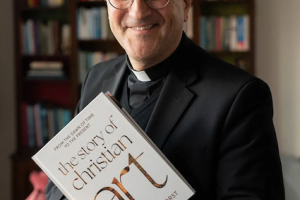
Video: How art called me to the priesthood: www.indcatholicnews.com/news/55096
 Facebook
 Twitter
 LinkedIn
 Print
Print Email
Email







 Facebook
 Twitter
 YouTube
 LinkedIn
 Pinterest