


Gospel in Art: Saint Boniface, Bishop, Martyr
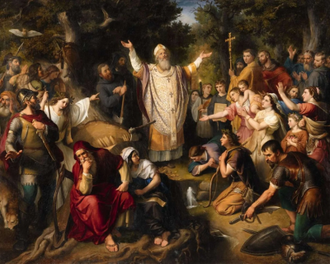
Saint Boniface Felling Donar's Oak, by Johann Michael Wittmer, 1860 © Sold Lempertz Cologne, 15 November 2014, Lot 1540, sold €34,000
Source: Christian Art
Gospel of 5 June 2026
John 10:11-16
At that time: Jesus said, 'I am the good shepherd. The good shepherd lays down his life for the sheep. He who is a hired hand and not a shepherd, who does not own the sheep, sees the wolf coming and leaves the sheep and flees, and the wolf snatches them and scatters them. He flees because he is a hired hand and cares nothing for the sheep. I am the good shepherd. I know my own and my own know me, just as the Father knows me and I know the Father; and I lay down my life for the sheep. And I have other sheep that are not of this fold. I must bring them also, and they will listen to my voice. So there will be one flock, one shepherd.'
Reflection on the painting
Saint Boniface, born around 675 in the Anglo-Saxon kingdom of Wessex, was originally named Winfrid. A Benedictine monk and scholar, he felt a strong calling to missionary work and travelled to the continent to evangelise the Germanic peoples. He was commissioned by Pope Gregory II in 719, who gave him the name Boniface, meaning "doer (facere) of good (bonus)". Over the years, Boniface became a key figure in the Christianisation of what is now Germany, founding monasteries, reforming the local Church, and working closely with the Frankish rulers. He was eventually made Archbishop of Mainzand and became known as the "Apostle of the Germans". His mission was marked by diplomacy, as he worked to bring the Gospel to deeply pagan regions with great respect for local traditions, gently introducing the faith.
One of the most famous episodes in his life is the felling of Donar's Oak (also the title of our painting), also known as Thor's Oak, near the town of Geismar in modern-day Hesse. This sacred tree was revered by the local Germanic tribes as dedicated to the god Thor (or Donar). To demonstrate the powerlessness of the pagan gods and the truth of Christianity, Boniface boldly took an axe and, in front of a gathered crowd, began cutting down the oak. According to tradition, as he struck the tree, a sudden wind blew it down entirely, stunning the onlookers who expected Thor to retaliate. Instead of punishment, they witnessed Boniface unharmed, which led many to convert to Christianity on the spot. The wood from the tree was then used to build a church dedicated to Saint Peter, symbolising the triumph of Christian faith over pagan superstition. We see the tree to the left of Boniface in our painting.
In his later years, Saint Boniface continued his missionary efforts, journeying to Frisia (part of modern-day Netherlands), where he hoped to strengthen the young Church. On 5 June 754, while preparing to confirm new converts near Dokkum, he and his companions were ambushed and killed by a group of pagan raiders. He famously told his fellow clergy not to resist, embracing martyrdom with peace and dignity. His body was eventually brought back to Fulda, where a great monastery he had founded became the centre of devotion. Saint Boniface's legacy remains foundational to the Christian history of Europe; an Englishman who became a saint, bishop, and martyr in the heart of the continent.
LINKS
Christian Art: https://christian.art/
Today's reading: https://christian.art/daily-gospel-reading/john-10-11-16-2026/
Video: How art called me to the priesthood: www.indcatholicnews.com/news/55096
 Facebook
 Twitter
 LinkedIn
 Print
Print Email
Email









 Facebook
 Twitter
 YouTube
 LinkedIn
 Pinterest