


Gospel in Art: Which commandment is the most important of all?
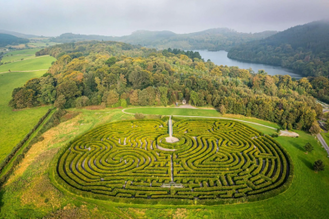
Castlewellan Peace Maze, Castlewellan Forest Park, Mourne Mountains, County Down, Northern Ireland. Officially opened in 2001 © Alamy
Source: Christian Art
Gospel of 4 June 2026
Mark 12:28b-34
At that time: One of the scribes came up to Jesus and asked him, 'Which commandment is the most important of all?'
Jesus answered, 'The most important is, "Hear, O Israel: The Lord our God, the Lord is one. And you shall love the Lord your God with all your heart, and with all your soul, and with all your mind, and with all your strength." The second is this: "You shall love your neighbour as yourself." There is no other commandment greater than these.'
And the scribe said to him, 'You are right, Teacher. You have truly said that he is one, and there is no other besides him. And to love him with all the heart, and with all the understanding, and with all the strength, and to love one's neighbour as oneself, is much more than all whole burnt offerings and sacrifices.'
And when Jesus saw that he answered wisely, he said to him, 'You are not far from the kingdom of God.' And after that no one dared to ask him any more questions.
Reflection on the garden maze
In the time of Jesus, Jewish tradition held that the Law contained 613 commandments drawn from the Torah, traditionally counted as 365 prohibitions and 248 positive commands. Beyond these, there were also many additional interpretations and applications developed by teachers of the Law over the centuries, which could make religious observance feel highly complex and detailed. It is within this context that the scribe approaches Jesus. He is asking Jesus to identify the commandment that lies at the very heart of the Law. 'Which commandment is the most important of all?' he asks. In many ways, he is asking Jesus to lead him through what could feel like a maze of regulations and obligations.
Jesus gives him exactly what he is seeking... and even more. He names not only the greatest commandment (to love the Lord your God with all your heart), but immediately joins it to the second most important commandment: the love of neighbour. For Jesus, these two commandments are inseparable. One cannot truly claim to love God while failing to love one's neighbour, who is made in the image of God. Yet although the two belong together, they are not identical. The love of God comes first and remains foundational. Only God is worthy of our whole heart, our whole soul, our whole mind. It is from this total love of God that genuine love of neighbour flows.
Laws and teachings can indeed feel at times like a maze. We know where we are starting from, and we know where we long to arrive, yet the road between the two can seem winding, confusing, and difficult. In the life of faith, we know that our ultimate destination is God. Yet the journey is rarely straightforward. We take wrong turns, become distracted, lose confidence, and at times feel as though we are walking in maze in circles. So for today;'s artwork we look at a garden maze, a work of art it itself. The tradition of mazes and labyrinths stretches back thousands of years. In the ancient world, labyrinth patterns already appeared in Greek mythology, most famously in the story of the Minotaur and the great labyrinth of King Minos on Crete. Yet garden mazes as we know them today began to flourish much later, especially during the Renaissance and Baroque periods in Europe. Wealthy aristocrats and royal courts created elaborate hedge mazes within their formal gardens, not only as entertainment, but also as symbols of intellect. Walking through a maze became a playful exercise in discovery: one could lose oneself, become disoriented, and then finally emerge into clarity again.
Among the most famous mazes in the world is the maze at Hampton Court Palace, planted around 1700 for King William III and still one of the best-known hedge mazes in the world. Italy's Villa Pisani contains a magnificent and highly complex maze with a central tower from which visitors can look down upon those still wandering through its pathways. Even medieval cathedral labyrinths, such as the famous floor labyrinth explored maze-patterns.
The maze illustrated here is the Peace Maze at Castlewellan Forest Park, set against the beautiful backdrop of the Mourne Mountains in Northern Ireland. Opened in 2001, it is one of the largest permanent hedge mazes in the world. What makes it especially moving is its symbolism: it was planted as a sign of hope and reconciliation following decades of conflict in Northern Ireland. Thousands of yew trees were planted by people from different communities and backgrounds, creating a living monument to peace. At the centre of the maze stands a bell, symbolising the joy and relief of finally finding one's way through confusion and being able to ring the bell.
LINKS
Christian Art: https://christian.art/
Today's reading: https://christian.art/daily-gospel-reading/mark-12-28b-34-2026-2/
Video: How art called me to the priesthood: www.indcatholicnews.com/news/55096
 Facebook
 Twitter
 LinkedIn
 Print
Print Email
Email










 Facebook
 Twitter
 YouTube
 LinkedIn
 Pinterest