


Gospel in Art: Render to Caesar the things that are Caesar's
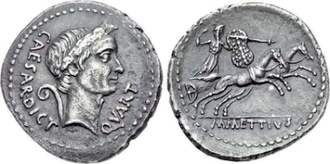
First Portrait Denarius of Julius Caesar, Jan 44 BC © Image courtesy Classical Numismatic Group
Source: Christian Art
Gospel of 2 June 2026
Mark 12:13-17
At that time: They sent to Jesus some of the Pharisees and some of the Herodians, to trap him in his talk. And they came and said to him, 'Teacher, we know that you are true and do not care about anyone's opinion. For you are not swayed by appearances, but truly teach the way of God. Is it lawful to pay taxes to Caesar, or not? Should we pay them, or should we not?' But, knowing their hypocrisy, he said to them, 'Why put me to the test? Bring me a denarius and let me look at it.' And they brought one. And he said to them, 'Whose likeness and inscription is this?' They said to him, 'Caesar's.' Jesus said to them, 'Render to Caesar the things that are Caesar's, and to God the things that are God's.' And they marvelled at him.
Reflection on the Roman Silver Coin
Julius Caesar was the first Roman politician to strike coins bearing his own portrait during his lifetime. Before him, such self-promotion was widely regarded in Rome as an act of dangerous political arrogance. Yet by the time of Caesar's assassination in 44 BC, silver denarii carrying his image were circulating widely throughout Rome and across the empire. Our illustration above shows precisely the kind of coin Jesus refers to in today's Gospel reading when He says: "Hand me a denarius and let me see it," before continuing, "Render to Caesar the things that are Caesar's."
One side of the coin depicts Julius Caesar crowned with a laurel wreath, a symbol of triumph and victory. The reverse shows him riding in a chariot, celebrating his military successes. Earlier Roman coins had often featured chariots too, but these were usually driven by the supreme god Jupiter, often accompanied by the winged figure of Victory. Caesar, however, boldly replaces Jupiter with himself. Clothed in the draped Roman toga, the political dress of the age, he presents himself with an almost divine authority. The coin is therefore more than currency: it is propaganda in silver, proclaiming Caesar's power wherever the coin travelled.
In our Gospel reading, although the Pharisees approached Jesus with flattering words, He immediately recognised that He was being tested. Yet Jesus responds with extraordinary wisdom. He begins His argument strategically by asking for a coin: "Hand me a denarius and let me see it." Probably Jesus Himself carried no such coin. That may well have been the case. But by asking one of His challengers to produce a Roman denarius from his own purse, Jesus subtly exposes something important: those questioning Him were already deeply entangled with the Roman system. They benefited from the very imperial economy they outwardly resented. In simply producing the coin, they revealed their own collaboration with the earthly powers of Rome.
For collectors today, ancient coins hold a unique fascination. Long before the coins of Julius Caesar circulated through the Roman Empire, early forms of money already existed in the ancient world. Civilisations in Mesopotamia and Egypt often traded using weighed amounts of silver, barley, or other valuable goods, but these were not yet true coins. The first real coins are generally believed to have appeared in the kingdom of Lydia, in western Asia Minor (modern-day Turkey), around the 7th century BC. These small stamped pieces of electrum (a natural alloy of gold and silver) carried official marks guaranteeing their value. The Greeks quickly adopted and refined the practice, producing beautifully designed coins bearing gods, animals, and civic symbols. The Romans later inherited and expanded this tradition, eventually creating a vast monetary system that spread across their empire.
LINKS
Christian Art: https://christian.art/
Today's reading: https://christian.art/daily-gospel-reading/mark-12-13-17-2026/
Video: How art called me to the priesthood: www.indcatholicnews.com/news/55096
 Facebook
 Twitter
 LinkedIn
 Print
Print Email
Email


















 Facebook
 Twitter
 YouTube
 LinkedIn
 Pinterest