


Gospel in Art: Saint Justin Martyr
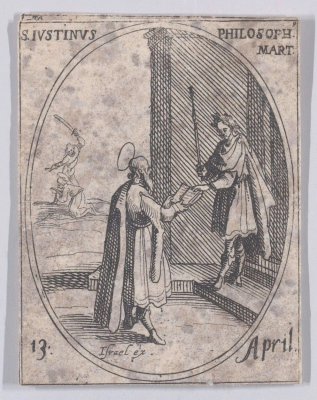
A bearded Justin Martyr presenting an open book to a Roman emperor, etching by Jacques Callot, publisher Israël Henriet, 1632-1635 © Alamy
Source: Christian Art
Gospel of 1 June 2026
Matthew 5:13-19
At that time: Jesus said to his disciples, 'You are the salt of the earth, but if salt has lost its taste, how shall its saltiness be restored? It is no longer good for anything except to be thrown out and trampled under people's feet.
'You are the light of the world. A city set on a hill cannot be hidden. Nor do people light a lamp and put it under a basket, but on a stand, and it gives light to all in the house. In the same way, let your light shine before others, so that they may see your good works and give glory to your Father who is in heaven.
'Do not think that I have come to abolish the Law or the Prophets; I have not come to abolish them but to fulfil them. For truly, I say to you, until heaven and earth pass away, not an iota, not a dot, will pass from the Law until all is accomplished. Therefore whoever relaxes one of the least of these commandments and teaches others to do the same will be called least in the kingdom of heaven, but whoever does them and teaches them will be called great in the kingdom of heaven.'
Reflection on the etching
Saint Justin Martyr was one of the most important thinkers of the early Church, a man who helped Christianity find a language to speak to the intellectual world of the Roman Empire. Born around AD 90-100, probably in Flavia Neapolis in Samaria (modern Nablus), he was raised in a pagan environment and spent much of his youth learning philosophy. He studied especially the Greek philosophers. One day, while walking by the sea, he encountered an elderly Christian who challenged him. The old man told him that the prophets of Israel and the teachings of Christ revealed a wisdom greater than that of the Greek philosophers. Justin later wrote that after this conversation, "a fire was kindled in my soul." It was a turning point in his life. A simple, old man had touched his heart with only few words. He converted to Christianity, yet continued to wear the philosopher's cloak, seeing Christianity not as the rejection of reason, but as its fulfilment.
Justin became immensely important for the development of Christian theology because he was among the very first Christians to explain the faith systematically using the language of philosophy. At a time when Christians were often mocked as irrational or dangerous, he argued that Christianity was the true philosophy. One of his greatest contributions was his teaching on the Logos - the divine "Word." Drawing on both the Gospel of John and Greek philosophical ideas, Justin taught that Christ is the eternal Logos through whom all truth is known. He even suggested that seeds of truth could be found in pagan philosophy because every human being participates instinctively yet imperfectly in the divine Logos. This was revolutionary. It allowed Christianity to engage with culture rather than simply reject it, and it laid foundations for later theologians such as Saint Augustine of Hippo and the great Cappadocian Fathers.
Justin is also enormously valuable because his writings give us one of the earliest descriptions of Christian worship. In his First Apology, written around AD 155, he describes Christians gathering on Sunday, reading the memoirs of the apostles, listening to a homily, praying together, exchanging the kiss of peace, and celebrating the Eucharist with bread and wine. Reading his words today is astonishing, because the structure he describes is recognisably the Mass still celebrated in the Catholic Church. In this sense, Justin becomes a precious witness to the continuity of Christian worship from the earliest centuries until today.
His courage eventually led him to martyrdom. Moving and living in Rome, Justin openly debated pagan philosophers and defended Christians before the authorities. According to tradition, he was denounced by a rival philosopher named Crescens, who resented Justin's influence. When ordered to sacrifice to the Roman gods, Justin refused. The Roman prefect threatened him with death, but Justin answered calmly: "Our desire is to suffer for Our Lord Jesus Christ, and so to be saved." Around AD 165 he was scourged and beheaded with several companions.
Our small etching by Baroque engraver Jacques Callot, depicts Saint Justin Martyr standing before the Roman authorities, not with weapons or political power, but with a book in his hands. Around AD 155, Justin wrote his First Apology, a courageous defence of Christianity addressed to the Roman Emperor Antoninus Pius, as well as to the Roman Senate. In this work, he pleaded for justice for Christians, who were being persecuted simply for bearing the name "Christian." He is handing over this First Apology in our engraving.
LINKS
Christian Art: https://christian.art/
Today's reading: https://christian.art/daily-gospel-reading/matthew-5-13-19-2026/
Video: How art called me to the priesthood: www.indcatholicnews.com/news/55096
 Facebook
 Twitter
 LinkedIn
 Print
Print Email
Email











 Facebook
 Twitter
 YouTube
 LinkedIn
 Pinterest