

Sunday Reflection with Canon Robin Gibbons: June 7th 2026
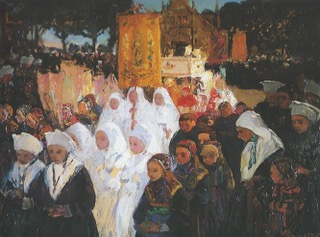
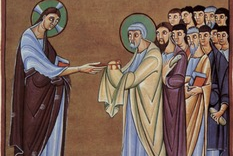
Charles Cottet Jour de Fete-Dieu a Plougastel
Solemnity of the Holy Body and Blood of Christ
It is quite exciting and wonderful how familiar passages from the Scriptures can suddenly open themselves out to us, and help us focus in a different way, by causing us to reflect in a deeper and more thoughtful way and make connections that enrich our faith journey! And so I found that this verse from our first reading caught my attention and struck me as containing something important for my own journey into this great feast of Corpus Christi:
" He therefore let you be afflicted with hunger, and then fed you with manna, a food unknown to you and your ancestors, so you might know that it is not by bread alone* that people live, but by all that comes forth from the mouth of the LORD". (Deut 8:3) At first glance it is an obvious statement of fact, the People of Israel on their travels and travails through the desert, met with all kinds of difficulties, hunger and thirst being part of them, and the story of food in the appearance of manna, which helped nourish them at a critical point on their journey is well known.
Yet for some reason, my mind focused on three connecting points which have helped me penetrate, in a more personal way, the mystery of the Holy Eucharist. The first is that manna was a food unknown and unfamiliar, but became by faith the Israelites sustenance. The second is that remark that we 'do not live by bread alone', an implication that food belongs to a much deeper and wider context of human life, in which bread, for instance, is an end product of an enormous number of creative actions involving nature and human endeavour. What we eat is so dependent on our earth and on others care! Then the third point is that another kind of food comes from the mouth of the Lord, for me that is the Word,a nourishment which is also the Christ.
So these three things, firstly, the nourishment from God to us as a food that is unknown yet is both edible and satisfies hunger's needs, is a tangible mystery. Then secondly, that deep context of creation and life as a basis for existence, exemplified for instance in the journey of seed to grain, to harvest and milling, then baking into bread for food, is all dependent on the work and good will of others-in other words community and communion together. Thirdly the Word is part of that divine food, remember that at Creation the spoken Word and the breath of the Spirit called into life that which was created, and in the context of the Holy Eucharist opens out, at least it does for me, another way into that great mystery which Jesus declares of himself in the gospel:" I am the living bread that came down from heaven; whoever eats this bread will live forever; and the bread that I will give is my flesh for the life of the world."(Jn 6:51) This promise is what we know in faith takes place whenever we celebrate the Eucharist.
The Holy Eucharist is both word and action, and we notice this in the words of the Eucharistic Prayer but also the symbols, particularly of food, real bread and wine, and the actions that accompany the great thanksgiving, particularly of the lifting up of gifts in offering and of hands imposed over the elements, the epiclesis, the invocation of the Spirit. This is the work of the Divine Word-made-flesh, which with that gifted help of the `Holy Spirit through word and action utterly transforms earthly matter into the food of heaven. It becomes the living bread and the blood of salvation, that we may have eternal life.
As Jesus expresses it in today's gospel: "Whoever eats* my flesh and drinks my blood has eternal life, and I will raise him on the last day".(Jn 6:54) The Eucharist is also profoundly Trinitarian, the Creator of All, that is the One we call Father/abba, gives us our daily bread, and the prayer of the Thanksgiving is addressed to Him, but the gifts are transformed by the Word and Spirit into the hidden mystery of the abiding nourishment of Christ. But there is a little more, receiving the Body and Blood of Christ in the form of bread and wine helps us grow together in the communion of faith, a movement towards unity, not causing any division, healing not hurting, for our reception of the body and blood of Christ, and the reverence we show towards this great sacrament in this feast draws us further into membership of the Mystical Body of Christ: 'Because the loaf of bread is one, we, though many, are one body, for we all partake of the one loaf."
(I Cor 10:17)
On this feast let us leave aside quarrels over doctrine and fine tuned sacramental debate,b ecause this feast is one in which we become part of the Lord's life. The Anglican poet John Betjeman in his poem about Christmas, the birth of the Word made flesh, gives us his simple but comfortingly faltering insight of how Corpus Christi is a feast another incarnation of divine love given for us in the humble symbols of bread and wine, then transformed to share with each other and partake of heaven.
'No love that in a family dwells,
No carolling in frosty air,
Nor all the steeple-shaking bells
Can with this single Truth compare -
That God was man in Palestine
And lives today in Bread and Wine'.
Lectio
St Irenaeus
Against Heresies (CE 180)
If our flesh is not saved, then the Lord has not redeemed us with his blood, the eucharistic chalice does not make us sharers in his blood, and the bread we break does not make us sharers in his body. There can be no blood without veins, flesh and the rest of the human substance, and this the Word of God actually became: it was with his own blood that he redeemed us. As the Apostle says: In him, through his blood, we have been redeemed, our sins have been forgiven.
We are his members and we are nourished by creatures, which is his gift to us, for it is he who causes the sun to rise and the rain to fall. He declared that the chalice, which comes from his creation, was his blood, and he makes it the nourishment of our blood. He affirmed that the bread, which comes from his creation, was his body, and he makes it the nourishment of our body. When the chalice we mix and the bread we bake receive the word of God, the eucharistic elements become the body and blood of Christ, by which our bodies live and grow.
How then can it be said that flesh belonging to the Lord's own body and nourished by his body and blood is incapable of receiving God's gift of eternal life? Saint Paul says in his letter to the Ephesians that we are members of his body, of his flesh and bones. He is not speaking of some spiritual and incorporeal kind of man, for spirits do not have flesh and bones. He is speaking of a real human body composed of flesh, sinews and bones, nourished by the chalice of Christ's blood and receiving growth from the bread which is his body.
Sir John Betjeman's description of his faith
From an article in The Spectator 1954
I have no memory of a blinding light striking me at the corner of a street, or of a fit of the shudders while people knelt around me in prayer. I cannot point to a date, time and place and say, 'That was when I was converted'. I cling to the sacraments and live for the day, have many moments of doubt when the only thing that buoys me up is the thought that I would sooner the Incarnation were true than that it were not. This, at its lowest ebb, is my faith; but frequent confession and communion have proved to me, unwilling though I sometimes am to believe, that prayer works, that Christ is God, and that He is present in the Sacraments of the Church.
 Facebook
 Twitter
 LinkedIn
 Print
Print Email
Email





 Facebook
 Twitter
 YouTube
 LinkedIn
 Pinterest