


Mining and Mammon
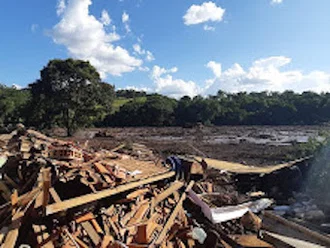
Brumadinho Dam, Brazil - toxic sludge covered homes, farmland, livestock and people.
Spring is the season of mining company Annual General Meetings (AGMs) in London, when shareholders gather to hear from Boards of Directors about how much money they have made over the past year, and how, and why.
Given that very little mining takes place in Britain any more, you may be surprised at the number of mining companies headquartered here or listed on the London Stock Exchange - that is, selling their shares there. But London has for a long time been one of the major world centres of mining finance.
I worked for over fifteen years as Co-ordinator of London Mining Network (LMN), a coalition of groups concerned about the human rights and environmental impacts of London-linked mining companies. LMN has, over the years, included a number of Church-linked organisations, including the Columbans, and been funded by others, including the Jesuits and the Passionists. And it works with other Church organisations overseas, such as the Red Iglesias y Mineria (Churches and Mining Network) in Latin America.
Over the past three weeks I have had the joy of accompanying my former colleagues, together with community representatives from Peru and the USA, to two major mining company AGMs - Anglo American and Rio Tinto.
Many issues were raised at these meetings.
At Anglo American's AGM on 29 April, we heard about the dangers posed by the tailings (fine wastes) dams at mining operations; the slow pace of compensation for former mineworkers in dying of silicosis or TB as a result of their work in South Africa; legal action over the legacy of mass lead poisoning at a mine in Kabwe, Zambia; the effects on local people of Anglo American's use of water at Quellaveco in Peru; tensions over land use in Chile; and sever water pollution in Brazil.
Anglo American's prepared responses to the questions submitted in advance were at times helpfully factual, sometimes vacuous, and once in a while introduced by a phrase which company Chairman Stuart Chambers seemed to like: "I repeat what I said before..." We were also repeating what we, and the communities with whom we work, have said many times before. What is required of the company is effective action to redress the injustices to which the Board's attention has repeatedly been drawn.
At the Rio Tinto AGM on 6 May, Stephen Power SJ noted that Jesuits in Britain had engaged with Rio Tinto for three or four years, particularly on its operations in Madagascar. He said that Jesuits in Britain are now considering divesting from the company because of several issues that they found problematic. Engagement on Madagascar had been over water and water supply. Company spokespeople had been very polite in responding to questions and had issued invitations to meetings, but key information on water reports had regularly come late and without the detail required or not at all. Concern on the water contamination remain and conflict around the mine has yet to be resolved. There is also concern about development of iron ore mining at Simandou in Guinea. The company itself saw its involvement as a very big investment, and this necessarily involves considerable ecological damage and displacement of of people. This is in the context of fragile government. And he said he would also like to discuss scope 3 emissions (the carbon emissions linked to use of a company's products), which seem very unlikely to be subject to realistic targets, mostly because of iron ore processing in China.
Stephen explained that the Jesuit position was based on a broad assessment of mining contained in a document the Jesuits had put together and launched in Rome a few months earlier, Catholic Approaches to Mining, which he hoped would become better known in the future.
The response from the Board to Stephen's concerns was an unhelpful mix of clear contradiction of what Stephen had said and unclear statements of intent to do better. Two other speakers raised the issue of water pollution in Madagascar and received similarly unhelpful responses. And it was much the same with concerns raised about Rio Tinto's operations in Australia, Bougainville, Chile and the USA - just as it had been at the Anglo American AGM the week before.
One particularly striking aspect of the Rio Tinto AGM was a result of the meeting being held in both London and Perth, Australia, at the same time. The Directors were all in Perth, with a video link to London. So the meeting began - rightly, in my view - with an Aboriginal ceremony acknowledging Aboriginal sovereignty over the land on which the meeting was being held and welcoming everyone to that country on behalf of local Aboriginal elders and communities.
But this show of respect for Indigenous rights is not reflected in the company's behaviour towards other Indigenous communities affected by its operations. Despite the company's public penitence after the destruction in 2020 of the 46,000 year old Juukan Gorge Aboriginal sacred site in Puutu Kunti Kurrama Pinikura Country in Western Australia, it is still failing to respect repeatedly expressed Indigenous decisions at Robe River in Australia, Oak Flat in the USA and Salar de Maricunga in Chile, or to do what is necessary to make good once and for all the damage done at the Panguna copper mine in Bougainville or the QMM mineral sands operations in Madagascar, or to withdraw from its Jadar lithium operations in Serbia despite overwhelming opposition from local agriculturalists and their allies.
This is why London Mining Network and the communities with which it works recently protested outside Rio Tinto's office, telling the company they are 'blue in the face' repeating the same demands while the company either fails to respond at all or responds inadequately. This AGM was another example of the company treating its critics with great politeness while failing to make good on many commitments already made, or to make commitments where they are still lacking, or even, in some cases, to answer straightforward questions at all. Which makes LMN's perseverance in continually speaking truth to power all the more important.
LMN's next activity will be a protest outside the London offices of Glencore plc on Thursday 28 May, while the company holds its AGM in the tax haven of Zug, Switzerland. See https://londonminingnetwork.org/2026/05/join-our-demonstration-outside-glencores-hq/.
FURTHER LINKS
Report: Catholic Approaches to Mining
London Mining Network: https://londonminingnetwork.org/
Anglo American AGM protest: https://londonminingnetwork.org/2026/04/join-our-demonstration-outside-the-anglo-american-agm/
Rio Tinto protest: https://londonminingnetwork.org/2026/05/campaigners-stage-protest-at-rio-tinto-hq-demanding-answers-on-global-environmental-concerns/
 Facebook
 Twitter
 LinkedIn
 Print
Print Email
Email















 Facebook
 Twitter
 YouTube
 LinkedIn
 Pinterest