


Statement of Holy See to UN on Nuclear Non-Proliferation Treaty
Source: Holy See at UN
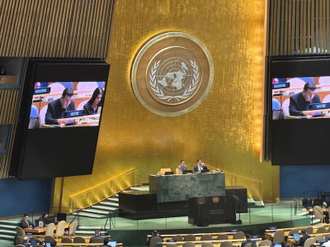
On 29 April 2026, in New York, the Delegation of the Holy See to the Eleventh Review Conference of the Parties to the Treaty on the Non-Proliferation of Nuclear Weapons (NPT) delivered a statement in the General Debate.
Delivering the statement as Head of Delegation of the Holy See, Mgr Robert D Murphy expressed deep concern over the current deterioration of global security, including renewed rhetoric about the use and testing of nuclear weapons, attacks on nuclear facilities, and the integration of emerging technologies into military systems.
Reaffirming the central importance of the NPT and its three interdependent pillars, Mgr Murphy called for renewed commitment to concrete disarmament steps, strengthened non-proliferation measures, and responsible cooperation on the peaceful uses of nuclear energy.
Finally, citing Pope Leo XIV's appeal for a "peace that is disarmed and disarming," the Holy See encouraged States to advance security based not on fear, but on dialogue, trust, and a commitment to the common good.
The fiull text of the statement follows:
Statement of the Permanent Observer Mission of the Holy See to the United Nations at the General Debate of the Eleventh Review Conference of the Parties to the Treaty on the Non-Proliferation of Nuclear Weapons.
New York, 29 April 2026
Mr President,
The Eleventh Review Conference of the Treaty on the Non-Proliferation of Nuclear Weapons convenes at a moment of profound gravity for the international community.
As Pope Leo XIV observes: "In our time, the weakness of multilateralism is a particular cause for concern at the international level. A diplomacy that promotes dialogue and seeks consensus among all parties is being replaced by a diplomacy based on force, by either individuals or groups of allies. War is back in vogue and a zeal for war is spreading."[1]
The implications of this broader trajectory are deeply concerning within the context of nuclear warfare. Not only has rhetoric contemplating the use of nuclear weapons re-emerged, but so too has the idea of contemplating their testing, accompanied by explicit and implicit threats. Recent attacks on nuclear facilities have further exposed the erosion of norms that have long been considered as essential to international security.
At the same time, nuclear arsenals are being modernized and emerging technologies, including artificial intelligence, are being increasingly integrated into military and nuclear systems, the implications of which are not yet fully understood.
There is also a growing tendency to reinterpret deterrence in ways that risk broadening its scope and reducing long-standing thresholds of restraint.
In such a climate, the very foundations of security are placed under strain.
For this reason, the Treaty on the Non-Proliferation of Nuclear Weapons remains an essential framework. Its three mutually reinforcing pillars provide a legal structure and a coherent approach through which the international community can responsibly and carefully respond to current threats while reaffirming its commitment to the common good.
Disarmament
The Holy See recalls that the obligation enshrined in Article VI is a binding commitment to pursue concrete and verifiable progress towards nuclear disarmament in good faith.
In the current context, this obligation has taken on a new sense of urgency. The continued modernization of nuclear arsenals and the reliance on deterrence in security doctrines risks entrenching a paradigm that is already strategically and morally questionable.
Pope Leo XIV argues that, "far beyond the principle of legitimate defense, such confrontational logic now dominates global politics, deepening instability and unpredictability day by day."[2] In this context, reliance on nuclear deterrence reflects an approach to security that is based more on the acceptance of mutual vulnerability sustained by the threat of force than on law and trust.
This concern is further intensified by the ever-evolving technological landscape. Integrating advanced systems, including artificial intelligence, into nuclear decision-making processes introduces new layers of complexity, reducing the time available for deliberation and increasing the risk of miscalculation. At the same time, the opacity of such systems may obscure the basis on which critical assessments are made, thereby undermining the conditions necessary for clear and accountable human judgement.
Decisions of such gravity must be firmly rooted in human responsibility; otherwise, instability and ethical concerns will worsen. Bearing this in mind, progress in disarmament must not be delayed and requires a renewed commitment to concrete, mutually reinforcing steps.
In this regard, advancing risk-reduction and de-escalation measures assume particular importance, especially in a context marked by heightened tensions and diminished trust. Efforts to reduce the role of nuclear weapons in military doctrine, and to enhance transparency and predictability, remain essential steps in this direction.
At the same time, the revitalization of arms control remains indispensable. The entry into force of the Comprehensive Nuclear-Test-Ban Treaty is of central importance, as it is a key step toward limiting the development of nuclear weapons and strengthening the norm against nuclear testing. Progress towards negotiating a Fissile Material Cut-off Treaty is also essential.
At the same time, the Treaty on the Prohibition of Nuclear Weapons makes a significant and valuable contribution to the implementation of Article VI. By placing the catastrophic humanitarian consequences of nuclear weapons at its center, it reinforces the normative framework guiding nuclear disarmament and re-anchors it in the protection of human beings. At the same time, it provides a concrete means of achieving the ultimate goal enshrined in Article VI: the total elimination of nuclear weapons.
A security architecture that relies on the credible threat of catastrophic and indiscriminate destruction leaves humanity in a permanent state of vulnerability. This approach risks normalizing what cannot be accepted and undermining the foundations upon which lasting peace must be built.
Non-Proliferation
Mr President,
The Holy See reaffirms the central role of the NPT as the cornerstone of the global non-proliferation regime.
In this regard, it is essential that all its provisions are implemented fully and balanced in order to preserve the integrity of the Treaty and foster confidence and responsibility among States.
Strengthening the safeguards system of the International Atomic Energy Agency (IAEA), including through the universalization of the Additional Protocol, remains an important element in ensuring transparency and accountability.
At the same time, however, non-proliferation cannot rely on verification mechanisms alone. Instead, it requires sustained efforts to address the root causes of insecurity through dialogue and responsible engagement.
In this regard, Nuclear-Weapon-Free Zones continue to be a tangible regional expression of a shared commitment to peace and security. The establishment of such a zone in the Middle East remains of particular importance and requires renewed engagement in a spirit of responsibility and mutual respect.
Confidence-building measures, such as transparency and security assurances, can strengthen the effectiveness of the non-proliferation regime.
Disarmament and non-proliferation remain closely interrelated. Progress in one area reinforces the other, while stagnation in one field inevitably affects both.
Peaceful Uses
Mr President,
The Holy See reaffirms the inalienable right of all States to develop the peaceful use of nuclear energy, in full compliance with their non-proliferation obligations.
When pursued responsibly, nuclear technologies can contribute in meaningful ways to human wellbeing in medicine, agriculture, food security, water management, and environmental protection, demonstrating how scientific progress can be placed at the service of life and human dignity.
At the same time, such activities demand the highest safety, security and environmental responsibility standards. Protection of nuclear facilities, especially in situations of armed conflict, is an urgent concern for the international community.
In this regard, international cooperation, especially through the International Atomic Energy Agency (IAEA), remains essential. It enables capacity building, supports sustainable development and promotes the equitable sharing of benefits, particularly with developing countries.
In this way, the peaceful use of nuclear energy contributes not only to development, but also to fostering relationships of trust and cooperation, which are placed at the service of human dignity and the common good.
Mr President,
The present moment undoubtedly poses serious challenges. However, this does not relieve the international community of its responsibility, nor does it extinguish hope. If fear is allowed to underpin security, it could become a permanent feature of international relations.
Pope Leo XIV strongly affirms the need to work towards a "peace that is disarmed and disarming."[3] This is a peace that does not rest on balancing mutual fears. It is built upon trust, dialogue, and the recognition of our shared humanity.
The NPT continues to offer a way forward. Not only is its full and balanced implementation a legal obligation, it is also a responsibility toward present and future generations. This means choosing a path that affirms that security can be based not on fear, but on responsibility, cooperation, and hope.
Thank you, Mr President.
[1] Pope Leo XIV, Address to the Members of the Diplomatic Corps Accredited to the Holy See, 9 January 2026.
[2] Pope Leo XIV, Message for the LIX World Day of Peace, 1 January 2026.
[3] Pope Leo XIV, Urbi et Orbi, 8 May 2025.
 Facebook
 Twitter
 LinkedIn
 Print
Print Email
Email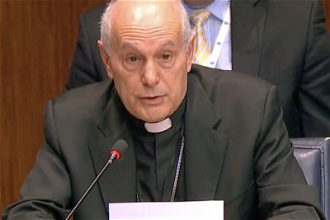















 Facebook
 Twitter
 YouTube
 LinkedIn
 Pinterest