


Gospel in Art: Two of the disciples were walking to a village named Emmaus
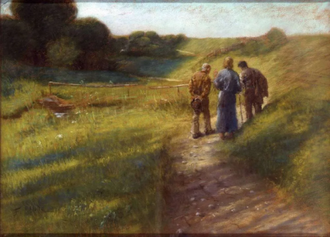
Walking to Emmaus by Fritz von Uhde, 1891 © Gemäldegalerie Alte Meister, Dresden
Source: Christian Art
Gospel of 8 April 2026
Luke 24:13-35
On the first day of the week, two of the disciples of Jesus were going to a village named Emmaus, about seven miles from Jerusalem, and they were talking with each other about all these things that had happened. While they were talking and discussing together, Jesus himself drew near and went with them. But their eyes were kept from recognising him. And he said to them, 'What is this conversation that you are holding with each other as you walk?' And they stood still, looking sad. Then one of them, named Cleopas, answered him, 'Are you the only visitor to Jerusalem who does not know the things that have happened there in these days?' And he said to them, 'What things?' And they said to him, 'Concerning Jesus of Nazareth, a man who was a prophet mighty in deed and word before God and all the people, and how our chief priests and rulers delivered him up to be condemned to death, and crucified him. But we had hoped that he was the one to redeem Israel. Yes, and besides all this, it is now the third day since these things happened. Moreover, some women of our company amazed us. They were at the tomb early in the morning, and when they did not find his body, they came back saying that they had even seen a vision of angels, who said that he was alive. Some of those who were with us went to the tomb and found it just as the women had said, but him they did not see.' And he said to them, 'O foolish ones, and slow of heart to believe all that the prophets have spoken! Was it not necessary that the Christ should suffer these things and enter into his glory?' And beginning with Moses and all the Prophets, he interpreted to them in all the Scriptures the things concerning himself.
So they drew near to the village to which they were going. He acted as if he were going further, but they urged him strongly, saying, 'Stay with us, for it is towards evening and the day is now far spent.' So he went in to stay with them. When he was at table with them, he took the bread, and blessed, and broke it, and gave it to them. And their eyes were opened, and they recognised him. And he vanished from their sight. They said to each other, 'Did not our hearts burn within us while he talked to us on the road, while he opened to us the Scriptures?' And they rose that same hour and returned to Jerusalem. And they found the Eleven and those who were with them gathered together, saying, 'The Lord has risen indeed, and has appeared to Simon!' Then they told what had happened on the road, and how he was known to them in the breaking of the bread.
Reflection on the pastel on paper
The Lord's encounter with the two disciples on the road to Emmaus reveals something of how he accompanies each one of us. They were heading away from Jerusalem, moving in the wrong direction, and yet he comes alongside them. He does immediately interject and tells them they are heading in the wrong direction. No, he walks with them first and listens. Same with us, he invites us to speak, to share what is on our hearts, and he listens with patience. Then, gently, he opens up a wider horizon, helping us to notice what we may have overlooked, to understand more deeply, and to see the path ahead more clearly, and that maybe we have taken a wrong turn and are heading in the wrong direction. He then quietly guides us back towards where we are meant to be walking.
In Walking to Emmaus, painted in 1891 by Fritz von Uhde, this quiet, attentive companionship of Christ is rendered with beautiful tenderness. The choice of pastel on paper gives the whole scene a softness, with edges gently dissolving. It is the perfect medium for a moment that is not dramatic but deeply, softly intimate. Jesus is depicted in the centre, clothed in blue, while the two disciples walk beside him. Seen from behind, their faces are hidden from us. And that is precisely the point. They are not meant to be fixed individuals; they become every disciple. In their anonymity, we are invited to step into the scene ourselves, to imagine that it is we who walk with Christ, sharing our story as he listens.
The journey to Emmaus has long captivated artists throughout all of art history because it speaks to one of the most universal experiences of faith: that God meets us not in spectacle, but on the road. He meets us in confusion, in conversation, in the ordinary rhythm of life. Artists return to it again and again because it allows them to depict a God who does not impose himself, but gently accompanies; a God who does not overwhelm, but reveals himself gently over time. In Uhde's work, that gentleness is almost tangible.
LINKS
Christian Art: https://christian.art/
Today's reading: https://christian.art/daily-gospel-reading/luke-24-13-35-2026/
 Facebook
 Twitter
 LinkedIn
 Print
Print Email
Email














 Facebook
 Twitter
 YouTube
 LinkedIn
 Pinterest