


Gospel in Art: Jesus overturned the tables of the money-changers
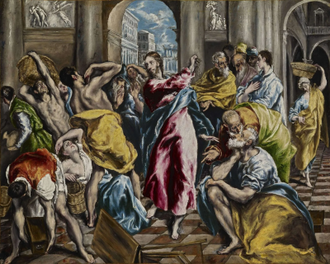
The Purification of the Temple, by El Greco, 1600, © The Frick Collection, New York
Source: Christian Art
Gospel of 29 May 2026
Mark 11:11-26
With the acclamation of the crowd, Jesus entered Jerusalem and went into the Temple. And when he had looked around at everything, as it was already late, he went out to Bethany with the Twelve.
On the following day, when they came from Bethany, he was hungry. And seeing in the distance a fig tree in leaf, he went to see if he could find anything on it. When he came to it, he found nothing but leaves, for it was not the season for figs. And he said to it, 'May no one ever eat fruit from you again.' And his disciples heard it.
And they came to Jerusalem. And he entered the Temple and began to drive out those who sold and those who bought in the Temple, and he overturned the tables of the money-changers and the seats of those who sold pigeons. And he would not allow anyone to carry anything through the Temple. And he was teaching them and saying to them, 'Is it not written, "My house shall be called a house of prayer for all the nations"? But you have made it a den of robbers.' And the chief priests and the scribes heard it and were seeking a way to destroy him, for they feared him, because all the crowd was astonished at his teaching. And when evening came they went out of the city.
As they passed by in the morning, they saw the fig tree withered away to its roots. And Peter remembered and said to him, 'Rabbi, look! The fig tree that you cursed has withered.' And Jesus answered them, 'Have faith in God. Truly, I say to you, whoever says to this mountain, "Be taken up and thrown into the sea", and does not doubt in his heart, but believes that what he says will come to pass, it will be done for him. Therefore I tell you, whatever you ask in prayer, believe that you have received it, and it will be yours. And whenever you stand praying, forgive, if you have anything against anyone, so that your Father also who is in heaven may forgive you your trespasses. But if you do not forgive, neither will your Father who is in heaven forgive your trespasses'.
Reflection on the painting
In today's Gospel from the Gospel, Jesus enters the Temple in Jerusalem and performs one of the most dramatic actions of His public ministry. Overturning tables and driving out the merchants, He cries out with words taken from the prophet Isaiah: "My house shall be called a house of prayer for all peoples." Those final words are deeply important: "for all peoples". The Temple was never meant to belong only to one group alone. Within the Temple complex there was even a special outer court reserved for the Gentiles, for non-Jews, for foreigners, for those standing at the edges seeking God. Yet this very space had been overtaken by noise, commerce, bargaining, and distraction. The place where outsiders were meant to pray had become a marketplace.
That is why Jesus reacts so fiercely. His anger is not random outrage; it is born from love for the Father and love for those being excluded. The Temple had begun serving human interests rather than divine purpose. And perhaps this remains a warning for every generation of believers. Religious institutions, however sacred, can always risk becoming too occupied with power, systems, money, reputation, or self-preservation. When that happens, they cease to reflect the heart of God. Christ reminds us today that the Church, like the Temple, must always remain a place where people can truly encounter God, open to all, a house of prayer, welcome, mercy, silence, and openness for all who seek Him.
Our painting today, Purification of the Temple by El Greco, is one of the most electrifying depictions of Christ cleansing the Temple. El Greco returned to this subject many times throughout his life, especially during the Counter-Reformation, when the scene came to symbolise the purification of the Church from corruption. At the centre of the composition stands Christ, tall and commanding, His arm sweeping dramatically through the air as He drives out the merchants and money changers. Around Him the scene erupts into chaos. Bodies twist violently. Traders stumble backward in fear. Tables collapse. Movement surges across the canvas like a storm. Yet Christ Himself remains strangely calm amid the turmoil, almost like the still centre of a whirlwind. El Greco intensifies the drama through daring colour contrasts: acid yellows, deep reds, greens, and burning oranges.
The painting is filled with symbolic detail. On one side are the frightened sinners and merchants being driven away; above them El Greco includes a sculpted relief of Adam and Eve expelled from Paradise. On the opposite side stand quieter believers observing the scene, above whom appears the Sacrifice of Isaac. These Old Testament scenes deepen the meaning of the painting: sin leads to exile, sacrifice leads toward redemption.
What is extraordinary is how many people tell me how much they love El Greco. It is true, El Greco feels very contemporary to us today, even though these paintings were created more than four hundred years ago. Part of this comes from the radical distortion of his figures and space. Bodies elongate unnaturally; proportions stretch; light behaves strangely; colours burn with emotional intensity rather than realism. In many ways, he anticipates modern expressionism centuries before it existed. Pablo Picasso and many later modern artists saw in El Greco a painter who dared to distort reality in order to reveal deeper truths.
LINKS
Christian Art: https://christian.art/
Today's reading: https://christian.art/daily-gospel-reading/mark-11-11-26-2026/
Video: How art called me to the priesthood: www.indcatholicnews.com/news/55096
 Facebook
 Twitter
 LinkedIn
 Print
Print Email
Email








 Facebook
 Twitter
 YouTube
 LinkedIn
 Pinterest