


Gospel in Art: 'Woman, why are you weeping?'
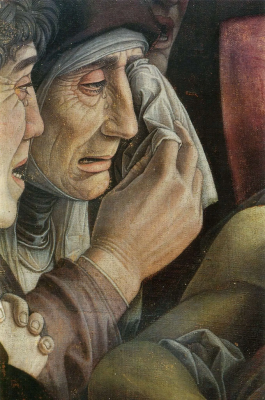
The lamentation over the dead Christ (detail), by Andrea Mantegna,1475-1478 © Pinacoteca di Brera, Milan
Source: Christian Art
Gospel of 7 April 2026
John 20:11-18
At that time: Mary stood weeping outside the tomb, and as she wept she stooped to look into the tomb. And she saw two angels in white, sitting where the body of Jesus had lain, one at the head and one at the feet. They said to her, 'Woman, why are you weeping?' She said to them, 'They have taken away my Lord, and I do not know where they have laid him.' Having said this, she turned round and saw Jesus standing, but she did not know that it was Jesus. Jesus said to her, 'Woman, why are you weeping? Whom are you seeking?' Supposing him to be the gardener, she said to him, 'Sir, if you have carried him away, tell me where you have laid him, and I will take him away.' Jesus said to her, 'Mary.' She turned and said to him in Aramaic, 'Rabboni!' (which means Teacher). Jesus said to her, 'Do not cling to me, for I have not yet ascended to the Father; but go to my brothers and say to them, "I am ascending to my Father and your Father, to my God and your God." ' Mary Magdalene went and announced to the disciples, 'I have seen the Lord' - and that he had said these things to her.
Reflection on the painting
There is a strong focus in this morning's Gospel on the tears of Mary Magdalene. She stands outside the tomb, weeping. She is asked the same question twice in our short reading. First the angels ask her, "Woman, why are you weeping?" and then Jesus himself repeats the very same question: "Why are you weeping?" She weeps because she cannot find the one she loves. We recognise that experience: when someone dear to us has died or is alive but feels lost, distant, or beyond our reach, grief rises within us. We, like Mary at the tomb, weep.
Yet Mary's story does not end in loss. In her searching, something unexpected happens. The Lord she is seeking finds her. He calls her by name, "Mary," and in that moment everything changes. This is the quiet promise at the heart of the Gospel: while we may not always succeed in finding those we long for, but the Lord is never beyond reach... always there, always already seeking us even before we seek him.
There is something, dare I say, sacred about weeping. We do not cry for what means little to us; we weep for those we love. Tears are love made visible, the heart overflowing when words are no longer enough. They come when bonds are stretched by distance, by loss, by misunderstanding, or by the quiet ache of seeing a loved one maybe make wrong choices. In those moments, tears are not a sign of weakness, but of depth and love. The tears are a testimony that we have allowed others into our lives, that we have cared, that we have loved. And perhaps that is why they hold such dignity: every tear carries within it a story of relationship, a silent prayer rising from the heart, reminding us that where there are tears, there is love.
Today I am sharing a detail of The Lamentation over the Dead Christ by Andrea Mantegna. The weeping woman stands on the left of the painting, leaning over the lifeless body of Christ, her face contorted with sorrow, her mouth open in a cry that we can almost hear. These are not gentle tears; they are raw, unrestrained, almost violent in their honesty. Mantegna does not soften grief, he exposes it. Also look at the wrinkles on her face, it is as if the woman's anguish is etched into every line of her face. This weeping woman is one of the most haunting expressions of mourning in all of art. And yet, precisely in that, it is also one of the most beautiful expressions of love... a love that must weep because it has loved so deeply...
LINKS
Christian Art: https://christian.art/
Today's reading: https://christian.art/daily-gospel-reading/john-20-11-18-2026/
 Facebook
 Twitter
 LinkedIn
 Print
Print Email
Email














 Facebook
 Twitter
 YouTube
 LinkedIn
 Pinterest