


Gospel in Art: Saint Philip Neri, Priest
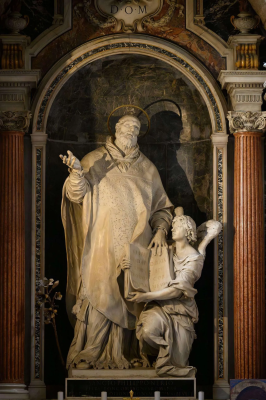
Saint Philip Neri, Sculpture by Alessandro Algardi, carved marble, gilt-bronze halo © Santa Maria in Vallicella, Rome
Source: Christian Art
Gospel of 26 May 2026
John 17:20-26
At that time: Jesus lifted up his eyes to heaven, and praying said, 'Holy Father, I do not ask for these only, but also for those who will believe in me through their word, that they may all be one, just as you, Father, are in me, and I in you, that they also may be in us, so that the world may believe that you have sent me. The glory that you have given me I have given to them, that they may be one even as we are one, I in them and you in me, that they may become perfectly one, so that the world may know that you sent me and loved them even as you loved me. Father, I desire that they also, whom you have given me, may be with me where I am, to see my glory that you have given me because you loved me before the foundation of the world. O righteous Father, even though the world does not know you, I know you, and these know that you have sent me. I made known to them your name, and I will continue to make it known, that the love with which you have loved me may be in them, and I in them.'
Reflection on the sculpture
Saint Philip Neri (1515-1595), often lovingly called the "Apostle of Rome," was born in Florence but spent most of his life in Rome, where he became one of the most beloved figures of the Catholic Reformation. Arriving in Rome as a young man, he embraced a simple and deeply prayerful life, dedicating himself to study, care for the poor, and long hours of prayer in the catacombs and churches of the city. He was ordained relatively late in life, around the age of thirty-five, unusual for his time, yet this only deepened the maturity of his priestly ministry. Philip became especially renowned for the confessional, where countless people sought his spiritual guidance. He possessed a remarkable warmth and joy that drew people to him naturally, especially the young. Rather than harshness or severity, he believed that holiness could flourish through friendship, laughter, music, conversation, and genuine human affection. Around him gathered groups of young people for prayer, spiritual conversations, pilgrimages, and music, eventually leading to the foundation of the Congregation of the Oratory.
Saint Philip Neri also understood something important about beauty and the arts. He recognised that music, painting, architecture, and drama could open the human heart toward God in ways argument alone often could not. His Oratory became a vibrant centre of sacred music in Rome, helping give birth to the musical form later known as the "oratorio," which would eventually influence composers such as George Frederic Handel and Joseph Haydn. For Philip, beauty was never merely decorative. Art could evangelise. I wholeheartedly agree!
This spirit is captured magnificently in the marble sculpture of Saint Philip Neri by Alessandro Algardi in the sacristy of Santa Maria in Vallicella, the great Oratorian church in Rome. Algardi, one of the leading sculptors of the Roman Baroque alongside Bernini, possessed a very different artistic temperament from his more theatrical contemporary. Whereas Gian Lorenzo Bernini often filled his works with explosive movement and dramatic emotion, Algardi tended toward restraint and dignity. This made him especially suited to depicting Saint Philip Neri, whose holiness radiated personal warmth rather than grand spectacle.
The over life-size figure of Saint Philip stands in quiet humility within the intimate setting of the sacristy. Philip appears approachable, almost conversational. With one hand he gestures outward in offering, while his gaze lifts gently upward toward the ceiling where Pietro da Cortona painted the instruments of Christ's Passion. His other hand points toward a text held by a kneeling angel beside him, words connected to the offertory of his feast day. Algardi succeeds in making sanctity feel humanly attractive. Looking at the sculpture, one senses why so many people were drawn toward Philip Neri during his lifetime. Holiness here is not cold or distant. It smiles. It invites. It welcomes.
LINKS
Christian Art: https://christian.art/
Today's reading: https://christian.art/daily-gospel-reading/john-17-20-26-2026-2/
 Facebook
 Twitter
 LinkedIn
 Print
Print Email
Email













 Facebook
 Twitter
 YouTube
 LinkedIn
 Pinterest