


Gospel in Art: Mary, Mother of the Church
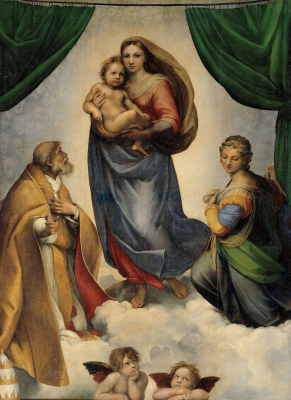
The Sistine Madonna by Raphael © Gemäldegalerie Alte Meister, Dresden
Source: Christian Art
Gospel of 25 May 2026
John 19:25-34
At that time: Standing by the cross of Jesus were his mother and his mother's sister, Mary the wife of Clopas, and Mary Magdalene. When Jesus saw his mother and the disciple whom he loved standing nearby, he said to his mother, 'Woman, behold, your son!' Then he said to the disciple, 'Behold, your mother!' And from that hour the disciple took her to his own home.
After this, Jesus, knowing that all was now finished, said (to fulfil the Scripture), 'I thirst.' A jar full of sour wine stood there, so they put a sponge full of the sour wine on a hyssop branch and held it to his mouth. When Jesus had received the sour wine, he said, 'It is finished', and he bowed his head and gave up his spirit.
Since it was the day of Preparation, and so that the bodies would not remain on the cross on the Sabbath (for that Sabbath was a high day), the Jews asked Pilate that their legs might be broken and that they might be taken away. So the soldiers came and broke the legs of the first, and of the other who had been crucified with him. But when they came to Jesus and saw that he was already dead, they did not break his legs. But one of the soldiers pierced his side with a spear, and at once there came out blood and water.
Reflection on the painting
Today the Church celebrates the feast of the Virgin Mary under the beautiful title 'Mother of the Church'. Although this feast was formally added to the universal Roman Calendar only in 2018 by Pope Francis (to be celebrated each year on the Monday after Pentecost), the title itself is deeply rooted in early Christian tradition. Already in the writings of early Church Fathers such as Saint Ambrose, Mary was described as the model and image of the Church itself: the one who receives Christ, bears Christ, and offers Him to the world. Pope Francis explained that he wished this feast to encourage within the Church "a maternal sense", a reminder that the Church is not merely an institution or structure, but a mother who nourishes, protects, consoles, and gathers her children together in faith.
The title Mother of the Church received particular emphasis during the Second Vatican Council. On 21 November 1964, during the Council, Pope Paul VI solemnly proclaimed Mary as Mater Ecclesiae, Mother of the Church, declaring her to be the spiritual mother of all Christian people. The bishops, gathered from across the world, were reflecting on the mystery of the Church itself, and they recognised that Mary stands at the very heart of that mystery. Just as she stood beside Christ at the Cross and was present with the apostles at Pentecost awaiting the coming of the Holy Spirit, so too she continues spiritually to accompany the Church through history.
Our painting today, Sistine Madonna by Raphael, painted around 1512-1513, is one of the great masterpieces of the High Renaissance. Commissioned by Pope Julius II for the Benedictine monastery of San Sisto in Piacenza, the painting originally stood above the high altar. At the centre stands Mary holding the Christ Child, stepping forward upon clouds as though emerging from heaven itself into our world. Around her drift countless cherubic faces dissolving into mist, creating the sense that heaven is alive with unseen presence. To one side stands Saint Sixtus gesturing outward toward us, while Saint Barbara bows her head in contemplative humility. Yet despite the grandeur of the scene, Mary remains deeply approachable: barefoot, gentle, maternal.
And then!... at the very bottom of the painting, are perhaps the most famous little angels in all of art history: the two reclining cherubs, or putti, resting their chins upon their hands. They look upward with expressions that are strangely human: somewhere between boredom, curiosity, wonder, and dreamy contemplation. Over the centuries these little figures have almost escaped the painting entirely, reproduced endlessly on postcards, mugs, stamps, calendars, and greeting cards. Yet their popularity can sometimes make us forget how brilliant they are within the composition itself. While the heavenly figures above move within divine mystery, these two little cherubs ground the scene in childlike humanity. They invite us to look upward with the same innocent wonder. There is something almost amusingly familiar about them: even in the presence of heaven's glory, they seem quietly relaxed and chilled, like children lingering beneath a great mystery they do not fully understand. And perhaps that is precisely the point. Before the mysteries of God, all of us remain children gazing upward in wonder.
LINKS
Christian Art: https://christian.art/
Today's reading: https://christian.art/daily-gospel-reading/john-19-25-34-2026/
 Facebook
 Twitter
 LinkedIn
 Print
Print Email
Email













 Facebook
 Twitter
 YouTube
 LinkedIn
 Pinterest