


France: Trappist mother house facing closure after 900 years
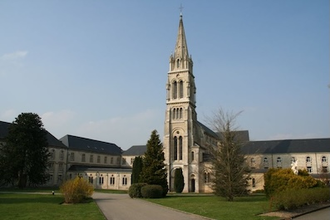
Abbey of La Trappe - Wiki Image
Pope Leo XIV received Dom Thomas Georgeon, abbot of the Abbey of La Trappe in France, in a private audience on 18th March, along with members of his community.
The visit came as the Trappist monks of La Trappe continue to ponder a probable departure from their historic monastery by 2028, citing ongoing challenges such as "the scarcity of vocations and the increasingly heavy burden of land ownership." There are now just 12 monks left in the vast enclosure.
La Trappe Abbey is the mother house of the Trappist Order, from which the community takes its name. It is both the birthplace of the Trappist reform and has been a significant centre of contemplative monastic life in France and beyond.
The history of the La Trappe site, 100 miles to the west of Paris, began in the early twelfth century. The place most probably derived its name from the traps once used for hunting in this wooded region of the Perche. These lands then belonged to Rotrou III, the Count of Perche.
In 1120, a ship carrying many English nobles was wrecked, causing the death of approximately three hundred people. Among the victims was Matilda, daughter of King Henry I of England and Rotrou's wife. In her memory, the Count had an oratory dedicated to the Virgin Mary built at La Trappe. Around 1140, he had a monastery built nearby - the first monastic community of La Trappe.
In 1147, the abbey came under the jurisdiction of the recently established Cistercian Order. After a period of prosperity, the abbey was struck by the violence of the Hundred Years' War.
In 1636, during the reign of Louis XIII, the young nobleman Armand de Rancé was appointed commendatory abbot of La Trappe. The commendatory system allowed members of the nobility to receive the revenues of monasteries without entering religious life, while the monastic community itself was governed by its prior.
For years de Rancé lived a decadent life, enjoying the financial spoils of his position. However, he experienced a significant conversion following the death of his mistress, the Duchess of Montbazon, in 1657. Shortly afterwards he gave up all his possessions except that of the abbey of La Trappe, which he visited for the first time in 1662.
Becoming the regular abbot in 1664, he took on the work of reforming the abbey into a more austere expression of Benedictine life, emphasising strict poverty, manual labour, continual penance, silence and renunciation of intellectual and worldly ambition. Founding the Order of Cistercians of the Strict Observance, Rancé and his monks quickly became known as "Trappists", after the abbey itself, and the movement spread to other Cistercian houses.
Like many religious houses in France, La Trappe was suppressed during the French Revolution. The monks were dispersed but under the leadership of Dom Augustin de Lestrange, some of them found refuge in Switzerland. They were able to return to France in 1815, but the abbey was almost entirely in ruins. It was slowly rebuilt in the nineteenth century. The current buildings, in the Neo-Gothic style, largely date from this period.
The exile of Trappist monks during the revolutionary period helped spread the reform beyond France. Some communities eventually settled elsewhere in Europe, including at Koningshoeven Abbey in the Netherlands, where monks later began brewing what is now known as "La Trappe" beer.
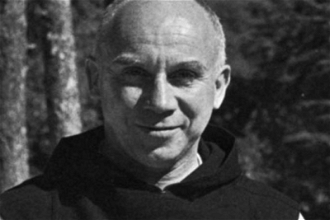
The Order of Cistercians of the Strict Observance now has houses throughout the world, including the Abbey of Our Lady of Gethsemani in Kentucky, where in 1941 the Anglo-American spiritual writer Thomas Merton arrived as a postulant.
Merton's works introduced many readers to the contemplative tradition from which La Trappe itself emerged. His spiritual autobiography, The Seven Storey Mountain, published in 1948, details his restless search for meaning before entering Gethsemani. It captured the attention of readers far beyond the abbey walls and inspired a generation of young people to consider the religious life.
Regarding the next steps, the monks "are currently in discussions with other communities to find more suitable solutions, more economically and spiritually relevant. The situation has been difficult for several decades now, and many other abbeys have changed hands."
 Facebook
 Twitter
 LinkedIn
 Print
Print Email
Email













 Facebook
 Twitter
 YouTube
 LinkedIn
 Pinterest