


Gospel in Art: The Healing of the Officer's Son at Cana
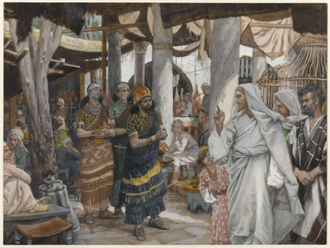
The Healing of the Officer's Son. Painting by James Tissot, 1886-1894 © Brooklyn Museum, Purchased by public subscription
Source: Christian Art
Gospel of 16 March 2026
John 4:43-54
At that time: Jesus departed Samaria for Galilee. (For Jesus himself had testified that a prophet has no honour in his own hometown.) So when he came to Galilee, the Galileans welcomed him, having seen all that he had done in Jerusalem at the feast. For they too had gone to the feast.
So he came again to Cana in Galilee, where he had made the water wine. And at Capernaum there was an official whose son was ill. When this man heard that Jesus had come from Judea to Galilee, he went to him and asked him to come down and heal his son, for he was at the point of death.
So Jesus said to him, 'Unless you see signs and wonders you will not believe.' The official said to him, 'Sir, come down before my child dies.' Jesus said to him, 'Go; your son will live.' The man believed the word that Jesus spoke to him and went on his way. As he was going down, his servants met him and told him that his son was recovering. So he asked them the hour when he began to get better, and they said to him, 'Yesterday at the seventh hour the fever left him.' The father knew that was the hour when Jesus had said to him, 'Your son will live.' And he himself believed, and all his household. This was now the second sign that Jesus did when he had come from Judea to Galilee.
Reflection on the gouache on paper work
In John's Gospel there are two major events that take place at Cana. The first is well known: Jesus turning water into wine at the wedding feast. Today's Gospel reading presents a second event that took place at Cana, which is perhaps less familiar: the healing of the royal official's son. In the first Cana scene, the mother of Jesus shows remarkable trust in her Son. She simply tells the servants, "Do whatever he tells you." Her faith rests entirely on Jesus' word. In this second Cana scene, we see that same kind of trust in the royal official. When Jesus tells him, "Go home, your son will live," the evangelist notes something very striking: "The man believed the word that Jesus spoke to him and started on his way." He does not insist on proof. He does not wait for any signs. He simply trusts the promise and begins the journey home.
Earlier in the Gospel, Jesus had said that many people would not believe unless they saw signs and wonders. Yet here is a man who believes before seeing anything at all. He simply trusts Jesus at his word. Only afterwards does he witness the miracle of his son's healing. His faith is built not on spectacle, but on trust in Christ's words. That is the same faith the mother of Jesus encouraged at Cana when she told the servants to follow whatever Jesus said. And it is the faith we are invited to have as well: a faith that takes the Lord at His word, that trusts His promises even before we see the outcome.
The healing of the royal official's son has not been depicted very frequently in the history of Christian art. Unlike other miracles of Jesus, artists rarely chose this scene, perhaps because the miracle itself happens at a distance, through Jesus' word rather than through a dramatic physical gesture. One of the best-known visual representations is this small but expressive gouache by James Tissot. In the image we see the moment of encounter: the royal official approaches Christ in deep anxiety for his dying child, while Jesus calmly speaks the word that will bring healing.
This work belongs to Tissot's great late-life project, The Life of Our Lord Jesus Christ (La Vie de Notre-Seigneur Jésus-Christ). After a profound spiritual conversion in the 1880s, Tissot devoted the final years of his life almost entirely to illustrating the Gospel story. He travelled to the Holy Land to study the landscapes, architecture, and customs of biblical times, striving for historical accuracy. The result was an extraordinary series of hundreds of gouache illustrations, more than 350 scenes from the New Testament. A couple of days ago we looked at another of these remarkable gouaches. All of these paintings on paper were eventually published in a richly illustrated book in the 1890s and became widely known as the "Tissot Bible."
LINKS
Christian Art: https://christian.art/
Today's reading: https://christian.art/daily-gospel-reading/john-4-43-54-2026/
 Facebook
 Twitter
 LinkedIn
 Print
Print Email
Email







 Facebook
 Twitter
 YouTube
 LinkedIn
 Pinterest