


Gospel in Art: As Jesus passed by, he saw a man blind from birth
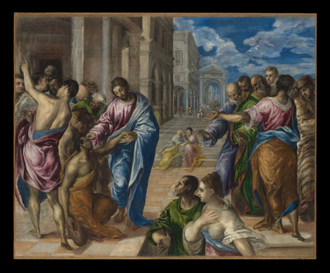
Christ Healing the Blind,by El Greco, 1570 © Metropolitan Museum of Art, New York
Source: Christian Art
Gospel of 15 March 2026
John 9:1, 6-9, 13-17, 34-38
At that time: As Jesus passed by, he saw a man blind from birth. He spat on the ground and made mud with the saliva. Then he anointed the man's eyes with the mud and said to him, 'Go, wash in the pool of Siloam' (which means Sent). So he went and washed and came back seeing.
The neighbours and those who had seen him before as a beggar were saying, 'Is this not the man who used to sit and beg?' Some said, 'It is he.' Others said, 'No, but he is like him.' He kept saying, 'I am the man.'
They brought to the Pharisees the man who had formerly been blind. Now it was a Sabbath day when Jesus made the mud and opened his eyes. So the Pharisees again asked him how he had received his sight. And he said to them, 'He put mud on my eyes, and I washed, and I see.' Some of the Pharisees said, 'This man is not from God, for he does not keep the Sabbath.' But others said, 'How can a man who is a sinner do such signs?' And there was a division among them. So they said again to the blind man, 'What do you say about him, since he has opened your eyes?' He said, 'He is a prophet.' They answered him, 'You were born in utter sin, and would you teach us?' And they cast him out.
Jesus heard that they had cast him out, and having found him he said, 'Do you believe in the Son of Man?' He answered, 'And who is he, sir, that I may believe in him?' Jesus said to him, 'You have seen him, and it is he who is speaking to you.' He said, 'Lord, I believe', and he worshipped him.
Reflection on the painting
In the Gospels, Jesus is usually shown responding to those who actively want something. Yet there are moments when he takes the first step, acting without being asked. In today's passage, he notices a man blind from birth and approaches him of his own accord. Without any request, Jesus makes mud with his saliva, places it on the man's eyes, and sends him to wash in the Pool of Siloam. The man had not cried out or prepared himself in any way; he simply became the recipient of Christ's attentive and compassionate gaze.
This scene reminds us that grace often comes to us in a similar, unexpected way. At times, we receive blessings we have done nothing to earn or initiate. A person may enter our life unexpectedly and alter its course for the better; or an unforeseen opportunity may arise that opens new paths before us. Like the blind man, we can find ourselves led from darkness into light, not through our own efforts, but through gifts freely given. These are moments when God quietly takes the initiative and transforms our lives.
El Greco painted Christ Healing the Blind around 1570, when he was approximately 29 years old, still in his formative Italian period before moving to Spain. This makes the work especially important: it shows a young artist absorbing the lessons of the Venetian Renaissance (dramatic colour and theatrical, complex architecture), while already experimenting boldly with his own innovative compositions. The scene shows Christ at the centre-left, surrounded by animated figures who react with astonishment to the miracle. What makes this painting particularly 'ahead of its time', is the daring inclusion of two large figures in foreground, which are partially cropped by the edge of the canvas. Such cropping was highly unusual in the sixteenth century, where compositions were typically balanced and contained figures without cropping them. Here, however, El Greco creates the sense that the scene spills into our own space, as if we are standing among the crowd witnessing the miracle. This bold visual device anticipates later developments in Baroque painting, where the viewer is drawn into the action rather than kept at a distance.
LINKS
Christian Art: https://christian.art/
Today's reading: https://christian.art/daily-gospel-reading/john-9-1-6-9-13-17-34-38-2026/
 Facebook
 Twitter
 LinkedIn
 Print
Print Email
Email









 Facebook
 Twitter
 YouTube
 LinkedIn
 Pinterest