


Gospel in Art: The Parable of the Pharisee and the Tax Collector
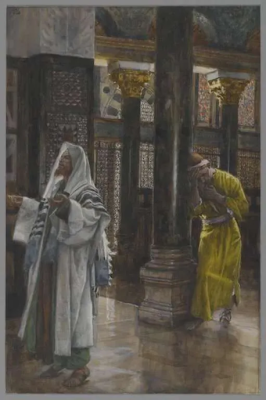
The Pharisee and the publican by James Tissot, painted1886-94 © Brooklyn Museum, New York
Source: Christian Art
Gospel of 14 March 2026
Luke 18:9-14
At that time: Jesus told this parable to some who trusted in themselves that they were righteous, and treated others with contempt: 'Two men went up into the Temple to pray, one a Pharisee and the other a tax collector. The Pharisee, standing by himself, prayed thus: "God, I thank you that I am not like other men, extortioners, unjust, adulterers, or even like this tax collector. I fast twice a week; I give tithes of all that I get." But the tax collector, standing far off, would not even lift up his eyes to heaven, but beat his breast, saying, "God, be merciful to me, a sinner!" I tell you, this man went down to his house justified, rather than the other. For everyone who exalts himself will be humbled, but the one who humbles himself will be exalted.'
Reflection on the Gouache Painting
In today's Gospel reading, we hear of two people who went up to the Temple to pray... but only one of them truly prayed. Outwardly, both 'seemed' to be praying. The Pharisee offers a prayer of thanksgiving, beginning, "I thank you, God…", while the tax collector prays a simple plea: "God, be merciful to me, a sinner." Both use familiar religious language, yet only the tax collector's prayer is received as genuine before God.
What makes the difference is not the words, but the heart behind them. The Pharisee's prayer springs from pride and comparison; he measures himself against others and finds himself superior. The tax collector, however, stands in humility, aware of his need and his dependence on God's mercy. In truth, both men stand equally in need before God... but only one recognises it.
And that is where authentic prayer begins: not in self-sufficiency, but in honesty. Our gouache on paper by James Tissot presents the parable with striking clarity. Two figures stand in the Temple, placed side by side yet worlds apart. On the left, the Pharisee stands upright, dressed in bright, almost luminous garments, his head lifted and his gaze directed upwards, as if confident in his own righteousness. On the right, the tax collector is at a slight distance, in yellow garments, his head bowed, his hand striking his chest in a gesture of repentance. What is so powerful in Tissot's composition is that nothing dramatic seems to happen outwardly. There are no grand gestures, and yet everything is expressed through posture and attitude. The Pharisee appears composed, controlled, even dignified; but there is a distance in him, a self-containment. The tax collector, by contrast, is almost collapsed inward, unable to even lift his eyes. Their bodies convey a theological message: pride stands tall; humility bends low.
LINKS
Christian Art: https://christian.art/
Today's reading: https://christian.art/daily-gospel-reading/luke-18-9-14-2026/
 Facebook
 Twitter
 LinkedIn
 Print
Print Email
Email











 Facebook
 Twitter
 YouTube
 LinkedIn
 Pinterest