


Gospel in Art: I have not come to abolish the Law or the Prophets
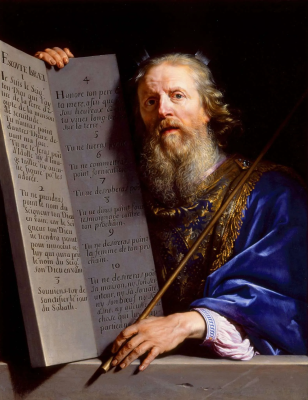
Moses Presenting the Tablets of the Law by Philippe de Champaigne, 1648 © Milwaukee Art Museum
Source: Christian Art
Gospel of 11 March 2026
Matthew 5:17-19
At that time: Jesus said to his disciples: 'Do not think that I have come to abolish the Law or the Prophets; I have not come to abolish them but to fulfil them. For truly, I say to you, until heaven and earth pass away, not an iota, not a dot, will pass from the Law until all is accomplished. Therefore whoever relaxes one of the least of these commandments and teaches others to do the same will be called least in the kingdom of heaven, but whoever does them and teaches them will be called great in the kingdom of heaven.'
Reflection on the painting
When we hear the word 'Law' as in today's reading, we tend to react immediately in a negative way. The 'law of God' sounds as if it is a set of rules that would restrict us, curb our freedom and tell us what to do. That is of course true in the strictest sense, but it is also true that when we try to live according to the truth it holds, that very law creates this huge freedom for us. The law of God doesn't restrict us but sets us free. Think of sports. A football game wouldn't be a proper game if it had no rules or boundaries. The game is enjoyable and beautiful precisely because it has rules!
The commandments of the Old Law, including the Ten Commandments (illustrated here in Philippe de Champaigne's 1648 painting depicting Moses holding the tablets of the Law), are basic commandments to be followed. Jesus doesn't abolish these, but he builds on them. In a way, we could say that these commandments were more 'external' commandments, as they refer almost entirely to external actions towards other people. Christ now expands further on these old laws. But his own commandments (to forgive, to love, to hear, to help the poor…) are more subtle, 'internal' and appeal more to the heart.
Brussels-born artist Philippe de Champaigne enjoyed a 40-year career painting for French aristocracy, including King Louis XIII and Cardinal Richelieu. In this magisterial composition, he depicts Moses presenting the Ten Commandments. Moses' hand and the stone tablets rest directly on a stone plinth and appear to hang over the edge; they seem so close, as if we could touch them. Champaigne used a technique called trompe-l'oeil, or "fool the eye" in French, to heighten the feeling that Moses is a real person, coming into our space. With dirt beneath his fingernails and wrinkles in his skin, Moses is further portrayed as a real person. The rich blue colour of Moses' robe, adorned with gold embroidery, is a royal colour. The text on the tablets is in French instead of Latin, which was very unusual for the time this was painted. Moses is also depicted with a rod, symbol of authority, as the tool used by a shepherd to guide his flock. Moses, in fact, initially carried his rod while tending his sheep, and it later became to represent his authority over the Israelites.
LINKS
Christian Art: https://christian.art/
Today's reading: https://christian.art/daily-gospel-reading/matthew-5-17-19-2026/
 Facebook
 Twitter
 LinkedIn
 Print
Print Email
Email














 Facebook
 Twitter
 YouTube
 LinkedIn
 Pinterest