


Play: Donbas
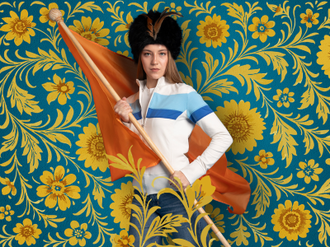
Donbas feature image by Helen Murray
As we pass the fourth anniversary of the war in Ukraine, Olga Braga's award-winning wartime domestic tragedy Donbas provides a fascinating and searing response.
As you enter the diminutive Theatre 503 above the Latchmere Pub, you are confronted by a claustrophobic scene. Two pro-Russian snipers are hunkered down in a tumbledown dwelling. One, Dmitry (Philippe Spall) is a surly veteran of the Soviet incursion into Afghanistan. The other, Alexei (Jack Bandeira) is a green youth fiddling with a Kalashnikov. Behind them on the wall, is an image of Our Lady of the Protective veil (the Pokrov) revered among the slavic peoples. Cruciform tape keeps the wallpaper from peeling away and Orthodox prayerbeads (komboskini) are hooked to one of the other walls.
A minimal scene-change later, with the very same religious icons still in position, we are in the spartan house of unsmiling Seryoga which crackles with tension upon the return of his outspoken Ukrainian nationalist son Sashko from Russian detention. Seryoga and Sashko are also played by Spall and Bandeira, respectively. The quickfire and assured doubling between pro-Russian and pro-Ukrainian roles serves to emphasise the cruel, and deeply contextualized, nature of fratricidal conflict.
The Donbas oblast (region) could not be more riven between those showing loyalty towards East and West. (Right now, invading Russian forces occupy around 85 per cent of the territory.)
Braga's play comes exactly 100 years after the staging of O'Casey's great play The Plough and the Stars about another complex conflict - the Irish war of independence against the British state. Both plays, with some injections of humour, foreground the suffering of ordinary people in the cruel and murderous folly of war, passionately debate opposing perspectives, and interrogate myth-making and inflexible ideologies.
Smiles come from two older neighbours: flirtatious babusia Vera (Liz Kettle) romantically imagines herself as Scarlett O'Hara from Gone With The Wind and is gifted supermodel hair-dye by the gallant Ivan (Steve Watts). With age comes lived experience and Ivan regrets past Soviet-era certainties and a sense of unity. He keeps his parents' Order of the Red Star medals close to his heart.
Intransigent Sashko, who insists upon using his Ukrainian name and Ukrainian words, blasts Seryoga, his grimly pragmatic father, who has taken a Russian passport so he can work and receive insulin for his diabetes. Sashko is an idealistic artist-disturber who resolutely fails to find work. Instead, he presents Marianca (Sasha Syzonenko) a Moldovan war-refugee and mother who pines for her young son - whom his father has taken in, on, it would appear, grim transactional terms - with a portrait he has sketched of her.
Romance blossoms between the two. Seryoga catches them mid-embrace without their knowing and a subsequent scene in which he cruelly pours borsch upon the floor is deeply painful.
He is not the only one to be disturbed by the liaison. So is Nadya (Ksenia Devriendt), Vera's 15 year-old elective mute grand-daughter. She too has feelings for Sashko who presented her with a portrait of Bohdan Khmelnytsky, the Cossack and Ukrainian national hero, along with a stirring nationalist narrative which leads her to re-find her voice.
Three different members of the excellent six-strong cast come on stage at various moments as Bohdan Khmelnytsky - phantoms of a romantic liberation akin to Yeats's famous imagining of the spirit of mythological warrior Cuchulain stalking the GPO in Dublin in 1916.
The play shifts between the microcosm of suffering in the household and the snipers' den, where those in the house and its surroundings are observed from afar, shorn of their individual humanity and through the implacable lens of martial law. The mangled and mistaken shooting in the stomach of a long-absent family figure by the diminished sniper Dimitry recalls the similar tragic shooting of Bessie Burgess in The Plough and the Stars by a British sniper. The arbitrary cruelty of war never goes away.
In O'Casey's great Irish Civil War play Juno and the Paycock, Juno cries out: 'O Blessed Virgin, where were you when me darlin' son was riddled with bullets! … Sacred Heart of the Crucified Jesus, take away our hearts o' stone - an' give us heart o' flesh! Take away this murdherin' hate - an' give us Thine own eternal love!'
In Donbas too, as the arrival of full-scale war brings further bloodshed and death, Our Lady's Protective Veil, it seems, has been torn asunder. Nadya states she called out to God but received no answer, only silence. As for the phantasmagorical inspiration of Bohdan, Seryoga harshly counters his son's romantic evocations by pointing out that the Cossack leader perpetrated appalling pogroms against the Jews. While he liberated his people from the Polish-Lithuanian commonwealth, he massacred tens of thousands and sold huge numbers into slavery before accepting Russian suzerainty. For this reason, the final singing of Grygoriy Trukh's stirring Oi u luzi chervona kalyna (Oh, the Red Viburnum in the Meadow) in the manner of a Cossack song by the ensemble is unsettling.
Acutely directed by Anthony Simpson-Pike and imaginatively designed by Niall McKeever, the Ukrainian Olga Braga's Donbas is a worthy winner of Theatre503's International Playwriting Award. The play depicts the harshness of human suffering in war. It warns against blinkered abstraction and mythologizing: far better human warmth, engagement and a striving towards capacious understanding than flint-like hearts.
Donbas continues all this week at Theatre503,The Latchmere Pub, Battersea, from Tuesday 3rd March until Saturday 7th March.
Box Office: 020 7978 7040 - 503 Battersea Park Road, London, SW11 3BW
LINK
Theatre503: www.theatre503.com
 Facebook
 Twitter
 LinkedIn
 Print
Print Email
Email














 Facebook
 Twitter
 YouTube
 LinkedIn
 Pinterest