


Gospel in Art: Love your enemies and pray for those who persecute you
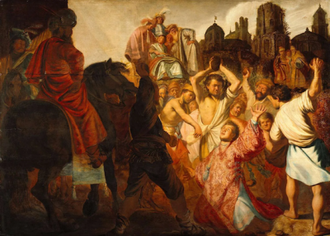
The Stoning of Saint Stephen by Rembrandt , 1625 © Musée des Beaux-Arts de Lyon, Lyon
Source: Christian Art
Gospel of 28 February 2026
Matthew 5:43-48
At that time: Jesus said to his disciples: 'You have heard that it was said, "You shall love your neighbour and hate your enemy." But I say to you: Love your enemies and pray for those who persecute you, so that you may be sons of your Father who is in heaven. For he makes his sun rise on the evil and on the good, and sends rain on the just and on the unjust. For if you love those who love you, what reward do you have? Do not even the tax collectors do the same? And if you greet only your brothers and sisters, what more are you doing than others? Do not even the Gentiles do the same? You therefore must be perfect, as your heavenly Father is perfect.'
Reflection on the painting
The demands of the Gospel are often difficult, and today's passage from the Sermon on the Mount is maybe among the most demanding of all. Jesus does not simply repeat the ancient command to love one's neighbour. The Old Testament speaks plenty to that effect. Yet Jesus goes much further, he stretches it beyond familiar boundaries and now asks us: to love our enemies. That was never spoken ion in the Old Testament. This is new. Radically new. His request goes further than anything in the old law. We may hesitate to say we have "enemies," yet most of us can name someone who has wounded us, disappointed us, annoyed us or perhaps caused harm. Naturally, warm feelings do not arise easily in such situations.
But when Jesus speaks of loving our enemies, he is not speaking about emotion or warm feelings. He is speaking about the will... about choosing the good of the other, even when affection is absent. To love is to will the good of the other. And we can very well 'will the good of the other', even for people we don't particularly like. At the very least, it means desiring that good things come to them, that grace touches their lives. One concrete way to do this, Jesus tells us, is prayer: "Love your enemies and pray…" To pray for someone who has hurt us is not weakness; it is strength. It is participation in God's own generosity. In that act, our hearts begin to resemble the heart of the Father, who lets his light fall on literally everyone, rich, poor, just, unjust, heathy, sick, etc... That is our call: to shape our hearts to the heart of the Father.
Our painting is the first signed painting by Dutch artist Rembrandt, made in 1625 at the age of 19. Rembrandt captures the very heart of loving one's enemies. Stephen, the first Christian martyr, is being violently attacked. Stones are mid-air. Faces are twisted with anger. Yet Stephen's expression is not one of hatred or revenge: it is prayer. In the biblical account he cries out, "Lord, do not hold this sin against them." He does not feel warmth; he chooses mercy. He wills their good even as they take his life. It is a powerful painting because it shows that loving one's enemies is not sentimental, it is costly! Stephen mirrors Christ on the Cross. And in a remarkable detail, a young Saul (the future Saint Paul) is present at the scene. The man for whom Stephen prays will one day become an apostle. That is precisely what Jesus means: love is an act of the will that leaves space for grace to work. It is strength, not weakness. It is the heart of the Father shining even into violence.
LINKS
Christian Art: https://christian.art/
Today's reading: https://christian.art/daily-gospel-reading/matthew-5-43-48-2026/
 Facebook
 Twitter
 LinkedIn
 Print
Print Email
Email











 Facebook
 Twitter
 YouTube
 LinkedIn
 Pinterest