


Sunday Reflection with Canon Robin Gibbons - 2nd February 2026
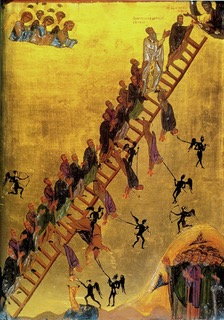
The Ladder of Divine Ascent. St Jacob's Monastery, Sinai. 12th c.
Fourth Sunday in Ordinary Time
In our first reading this Sunday, the prophet Zephaniah gives us the two core requirements of humility and justice that he suggests will help us live the life that God wants for us. He is not alone in marking these out as important, we find them throughout the scriptures, for instance Micah in a passage we know so well, gives us a descriptive way in which we can integrate them into our own way of life: God 'has shown you, O man, what is good; and what does the LORD require of you but to do justice, and to love kindness, and to walk humbly with your God?' (Micah 6:8)
I imagine that most of us are able to distinguish between a false type of humility from something more true, closer to the scriptural meaning of that which the Lord asks of us, but it is difficult! Trying to be humble in a positive sense, requires an effort at first as it touches all aspects of our lives and personalities. It tends to go against the grain of what we consider success, taking a step back to let others go forward isn't easy, legitimate ambition in our chosen field of work , the leadership qualities of our professions and jobs, all demand an edge of self worth. This is where justice plays its part in life, especially when it becomes fully integrate into our manner of living and being as a way of loving service. Our second reading from I Corinthians gives us the setting and purpose of these virtues-reminding us of their origin as divine gifts to be used by us :'Rather, God chose the foolish of the world to shame the wise, and God chose the weak of the world to shame the strong, and God chose the lowly and despised of the world, those who count for nothing, to reduce to nothing those who are something, so that no human being might boast before God.(I Cor I:27-29)
From our gospel we discover that the Beatitudes also help us enlarge our understanding of humility and justice. Often we see each blessing as an isolated element, as if one cannot practice or be several at the same time, those who hunger and thirst for righteousness will also mourn, and if they are sincere will try to be merciful and meek. They are all aspects of the calling we have from the Lord and useful indicators of where we are on our journey. Jesus does not expect us to be perfect at once, but to work actively towards the perfection that will come when we are complete, whole, at one with him in the Kingdom. Until that time, imperfect though we might be, we learn something important. That the gifts of humility and justice grow in us through the grace and love of God-that is if we learn to let God into our lives, working with Christ in the Spirit. It is as the great doxology of our Eucharistic prayer puts it: 'Through him, with him, in him, in the unity of the Holy Spirit, all glory and honour is yours, almighty Father, for ever and ever'. And to that prayer we say, Amen!
Lectio
The Beatitudes in Matthew's Gospel
"Blessed are the poor in spirit,
for theirs is the kingdom of heaven.
Blessed are they who mourn,
for they will be comforted.
Blessed are the meek,
for they will inherit the land.
Blessed are they who hunger and thirst for righteousness,
for they will be satisfied.
Blessed are the merciful,
for they will be shown mercy.
Blessed are the clean of heart,
for they will see God.
Blessed are the peacemakers,
for they will be called children of God.
Blessed are they who are persecuted for the sake of righteousness,
for theirs is the kingdom of heaven.
Blessed are you when they insult you and persecute you
and utter every kind of evil against you falsely because of me.
Rejoice and be glad,
for your reward will be great in heaven". (Mt 5:2-12a)
From: The Rule of St Benedict
Chapter Seven
On Humility
'Holy Scripture cries to us, saying: "For everyone who exalts himself will be humbled, but the one who humbles himself will be exalted" (Lk 14:11). By these words it declares to us that all exaltation is a kind of pride, which the Prophet shows must carefully be avoided when he says: "LORD, my heart is not proud; nor are my eyes haughty. I do not busy myself with great matters, with things too sublime for me" (Ps 131:1). But why? "Rather, I have stilled my soul, hushed it like a weaned child. Like a weaned child on its mother's lap, so is my soul within me" (Ps 131:2).
Accordingly, brothers and sisters, if we are going to reach the highest summit of humility, and speedily reach that heavenly exaltation that is won through the lowliness of this present life, our ascending actions must set up a ladder, such as the one that appeared to Jacob in his sleep when he saw Angels descending and ascending. That descent and ascent signifies nothing else other than that we descend by exalting, and ascend by humbling ourselves.
The ladder reaching up, then, represents our life here in this world, which through humility of heart is lifted up to heaven by our Lord. The sides of this ladder represents our body and soul, into which our Divine Vocation has fitted different degrees of humility and discipline, which we must ascend'.
 Facebook
 Twitter
 LinkedIn
 Print
Print Email
Email











 Facebook
 Twitter
 YouTube
 LinkedIn
 Pinterest