


Don't Burn Anyone At The Stake Today
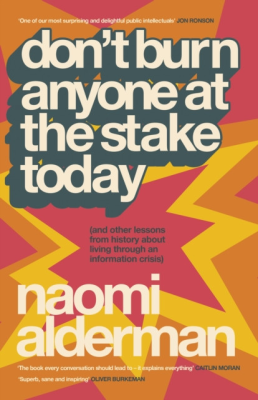
Image: Penguin Books
Naomi Alderman's book has surely one of the most arresting names to appear in bookshops in the last year. However, the full title indicates why it is not just eye-catching but also has important things to teach us a quarter of the way through the twenty-first century: Don't Burn Anyone At The Stake Today (And Other Lessons From History About Living Through An Information Crisis).
Her basic thesis is that we are undergoing an information crisis because of the emergence, firstly, of the internet over the course of a generation and now, in a matter of a very few years, the explosion of AI into our lives. And these changes cause major difficulties both for individuals and for society itself: 'In an information crisis, because you're learning to treat more and more symbols as if they were people, it's easier to treat people as if they were symbols.' (p. 30) The human brain and body are not naturally equipped to deal with either such a sudden information overload or the depersonalising of knowledge. We can see the consequences of these psychological and social shocks all around us today in heightened levels of personal anxiety, mental health difficulties (especially among the young) and social strife, with the spread of conspiracy theories and algorithm-driven factionalism. There is much to concern - and depress us - in these developments, as is widely observed.
Alderman's response to this defensive pessimism is a repeated 'Yes, but …' The web and AI are both good and bad. You can't have the advantages without concomitant risks and dangers. But you can take note of the negatives and begin not only to adapt (which the human brain does over time) but also to mitigate. The book's most practical section is her series of proposals (personal and legislative) under the heading: 'All right, but what am I supposed to do about all this?' (pp.123-135)
She notes that this is not the first 'information crisis' in human history and she draws lessons from those previous culture-shocks. There have been two previous epoch-making innovations which also led to information overload, a vast increase in human technocratic capacity and a remaking of our conceptions and expectations: the invention of phonetic script and the invention of the Gutenberg printing press with its movable type.
Drawing notably on the studies by Walter Ong (Orality & Literacy. The Technologising Of The Word) and Elizabeth Eisenstein (The Printing Revolution In Early Modern Europe), she points out the deep social and psychological consequences of these changes. Thus: 'Writing, printing and the internet encourage us to rely on them and not on the people around us …Writing, then printing, then the internet make us need the contents of everyone's brains less. So it encourages us to respect each other less, talk deeply to each other less, trust each other less.' (p.99) And the risk is that our information technologies which offer 'super-normal stimuli' to the brain (a substitute for real-time human interaction) may ultimately become 'so good that they make us turn away from actual people and moment-to-moment experience of life itself.' (p.100) So for every upside (gain of knowledge and capacity) there's a downside (including a loss of trust, the likelihood of conflict and, perhaps most painfully, the experience of loneliness, since knowledge no longer depends on relationship).
In a series of brief chapters (the whole work comprises only 130 pages of prose) she shows how the development of written texts changed the function of story in society and diminished the role of elders as custodians of memory. Interpersonal relations begin to become impersonal, mediated by a third party (first manuscript, then print, then the web). She points to the loss of 'the right to be forgotten' as foolish youthful indiscretions are set to follow us through life and, indeed, outlast us. And, like wealthy merchants who bought 'box-pews' during the post-reformation period so that others wouldn't distract them from their prayers, we find ourselves locked in our own frames of reference with no external adjudicator of truth and reliability.
Alderman asks awkward questions about power and control: 'What large trying-to-be-helpful-but-sometimes-failing associations would various rulers like to break up and destroy because it represents an alternative source of authority to their own narrative …?' (To which she answers 'I think in the UK it's the BBC' - p.65) And in a final 'Afterword' she tackles the unexamined question of the financial clout behind our screens: 'An hour of your time on Facebook is worth about 24.6 cents to Mark Zuckerberg. That's 20p. Is an hour of your time worth just 20p to you?' (p.144)
It seems that we're currently involved in 'a wonderful catastrophe' right now, but we've been there twice before: 'We made a wonderful, catastrophic thing with writing. With printing. With the internet. It's a kind of raising of the dead. A kind of telepathy. A kind of heaven, where we see each other as thoughts and character, not bodies, wealth or birth. We are making our minds do something they never evolved to do. It's hard, and painful, and often makes us angry and afraid. And yet … every time we end by seeing each other more clearly, understanding more, working together. Here we go again.' (p.139)
I thoroughly recommend engaging with this little book so that we can enter our AI-driven future with our eyes open and some understanding of how best to navigate an information crisis - together, rooted in history and with a fierce determination to build community, here in God's Creation, a world which is meant to be experienced as cosmos, not chaos.
Don't Burn Anyone At The Stake Today is published by Penguin, 2025.
Canon Rob Esdaile is parish priest of Woking & Knaphill Catholic Community
 Facebook
 Twitter
 LinkedIn
 Print
Print Email
Email










 Facebook
 Twitter
 YouTube
 LinkedIn
 Pinterest