


Gospel in Art: Saint Agnes, Virgin, Martyr
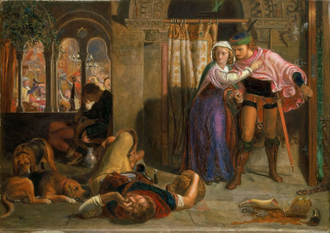
The Eve of St Agnes (The flight of Madeline and Porphyro), by William Holman Hunt, 1847 - 1857 © Alamy / National Museums fo Liverpool, UK
Source: Christian Art
Gospel of 21 January 2026
Matthew 13:44-46
At that time: Jesus said to the crowd: 'The kingdom of heaven is like treasure hidden in a field, which a man found and covered up. Then in his joy he goes and sells all that he has and buys that field.
'Again, the kingdom of heaven is like a merchant in search of fine pearls, who, on finding one pearl of great value, went and sold all that he had and bought it.'
Reflection on the painting
Yesterday, we celebrated the feast of Saint Sebastian, and today we honour Saint Agnes (291-304 AD), another martyr who was killed in Rome during the persecution under Emperor Diocletian in 304 AD. A native of Rome, Saint Agnes is still deeply venerated in the city. Tradition describes Saint Agnes as a beautiful young woman from a wealthy Roman family, whose hand in marriage was highly sought after. Her suitors, angered by her steadfast devotion to God (she is said to have replied to their advances with the words, "Jesus Christ is my only Spouse") reported her to the Roman authorities as a Christian. At just 13 years old (!), she died a virgin-martyr on 21 January 304 AD, leaving behind a legacy of courage and faith.
Despite threats of torture and death, Agnes remained steadfast in her youthful courage, astonishing even her executioners. Legend says that when she was sentenced to die, the flames of the stake parted around her, leaving her untouched, until she was ultimately martyred by the sword. Her name, which sounds like agnus (Latin for "lamb"), lends her being depicted in art often holding a lamb. To this day, a lamb is blessed in her honour in Rome each year.
Our painting is an oil sketch for William Holman Hunt's major painting The Eve of St Agnes, completed in 1848 and now in the Guildhall Art Gallery, London. Hunt returned to this version a decade later, completing it in 1857 for his Liverpool patron, the merchant John Miller (c. 1796-1876). Both paintings draw on John Keats' romantic poem, itself inspired by the old belief that on the eve of St Agnes' feast, a young woman who prayed faithfully might glimpse in her dreams the man she was destined to marry. Hunt portrays the poem's central lovers, Madeleine and Porphyro, whose love is forbidden by their feuding families. On St Agnes' Eve, Porphyro slips into Madeleine's bedchamber disguised as a dream vision; when he reveals himself proving it is not a mere vision, he urges her to flee her father's house so they may begin a life together in defiance of danger and division.
Hunt's painting illustrates the penultimate verse of the poem, in which the two lovers are described as escaping. The following lines from Keats's poem were included in the catalogue of the 1848 Royal Academy Exhibition when the larger version was first shown:
'They glide, like phantoms into the wide hall;
Like phantoms, to the iron porch they glide;
Where lay the Porter, in uneasy sprawl,
With a huge empty flagon by his side:
The wakeful bloodhound rose, and shook his hide,
But his sagacious eye an inmate owns;
By one, and one, the bolts full easy slide:-
The chains lie silent on the footworn stones
The key turns, and the door upon its hinges groans.'
LINKS
Gospel in Art: https://christian.art/
Today's Reflection: https://christian.art/daily-gospel-reading/matthew-13-44-46-2026/
 Facebook
 Twitter
 LinkedIn
 Print
Print Email
Email
















 Facebook
 Twitter
 YouTube
 LinkedIn
 Pinterest