


Justice and the Prince of Peace: A Christian witness against tyranny
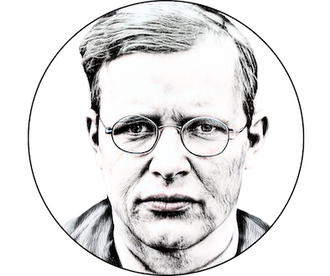
Dietrich Bonhoeffer - Wiki Image
With Trump's quasi-invasion of Venezuela and removal of the President from Office, Pope Leo XIV spoke with vigour on 4th January whilst delivering the Angelus prayer for paths which, ' lead to the overcoming of violence and to the pursuit of paths of justice and peace, guaranteeing the sovereignty of the country, ensuring the rule of law enshrined in its constitution'. His voice is richly informed by the Magisterial Teaching of The Church through the ages. In Rerum Novarum (1891), his namesake, Leo XIII condemns any system in which the powerful exploit or dominate those who cannot defend themselves. Though he speaks about labour, the principle is universal: "To exercise pressure upon the indigent and the destitute for one's own profit is condemned by all laws, human and divine." We can legitimately extend this to nations: exploitation, coercion, or domination of a weaker people is morally indefensible.
Judea in the first century was not a free nation. It lived under the shadow of Roman occupation; taxed, monitored, and controlled by an empire that saw its provinces not as communities but as assets. The historical Jesus lived, taught, and suffered within this machinery of domination. He was arrested, tried, and executed by Roman authorities. His ministry unfolded in a land whose autonomy had been stripped away, whose leaders were often imperial appointees, and whose people longed for liberation. Isaiah names the Messiah as "Prince of Peace" (Isaiah 9:6), but this peace is not the peace of empire ; the pax Romana enforced by the sword. It is the peace rooted in justice, dignity, and restored humanity. Jesus Himself announces His mission in Nazareth with words that are unmistakably political in their implications: "He has sent me to proclaim release to the captives… to let the oppressed go free" (Luke 4:18).
It is neither a stretch of imagination nor an act of political projection to say that the One who proclaimed freedom for the oppressed would stand against the subjugation or annexation of any people. The Prince of Peace does not sanctify conquest.
Across the centuries, Christians have recognised that peace is not passive. When Hitler came to power, Bishop Clemens August von Galen stood in the pulpit and condemned the machinery of death that targeted the vulnerable. Dietrich Bonhoeffer wrestled with the cost of discipleship in a world where evil had become systematised. Their witness reminds us that the Prince of Peace does not call His followers to quiet compliance, but to a justice that protects the dignity of every human life. Tyranny is not merely a political problem; it is a theological one, because it denies the image of God in the other.
Some point to St Paul's instruction that Christians should "be subject to the governing authorities" (Romans 13:1). But Paul's words were never intended as a blank cheque for tyranny. His teaching assumes that authority serves the common good, protects the vulnerable, and reflects God's justice. When authority becomes a tool of domination or persecution, the Gospel itself provides the counterbalance. The apostles themselves declare, "We must obey God rather than any human authority" (Acts 5:29). Christ proclaims release to the captives, dignity for the oppressed, and freedom from every form of subjugation. Obedience to authority cannot override obedience to the Kingdom.
The biblical story is saturated with God's resistance to domination. Israel's liberation from Egypt begins with the divine command, "Let my people go" (Exodus 5), a declaration that God does not bless the enslavement of any people. The prophets continue this witness with unflinching clarity. Isaiah condemns rulers who twist justice for their own ends: "Woe to those who decree unjust decrees" (Isaiah 10:1). Their voices echo across the centuries, reminding us that political power is accountable to God and that injustice is never morally neutral. Even in exile, God instructs the people not to surrender to despair but to seek the flourishing of the place where they dwell: "Seek the welfare of the city… for in its welfare you will find your welfare" (Jeremiah 29:7). This is not quietism but a call to constructive, courageous engagement. A reminder that God's people are never absolved from the work of justice, even under foreign rule.
Jesus Himself announces a Kingdom that breaks the chains of oppression. His ministry is a direct confrontation with the forces that diminish human dignity, whether spiritual, social, or political. The early Church understood this clearly. They refused to worship the emperor, insisting that "Jesus is Lord" was not merely a spiritual confession but a public truth that relativised all earthly power. The martyrs carried this conviction to its ultimate conclusion, choosing fidelity over fear, and witnessing with their lives that no empire has the final word over the human conscience. To proclaim Christ as the Prince of Peace is to recognise that peace is not the absence of conflict but the presence of justice. It is the refusal to accept the humiliation of the weak by the strong. It is the courage to say that the sovereignty of peoples and the dignity of nations matter because they reflect the dignity of the human person.
International law exists for this very reason. It is not a bureaucratic formality but a moral safeguard; a recognition that no people may be stripped of their agency, their land, or their leaders without grave injustice. History shows us that the subjugation of one nation by another, whether through coercion, annexation, or the silencing of legitimate authority, is always a violation of human dignity. The Gospel cannot bless such acts. Christ stands with the oppressed, not the oppressor; with the vulnerable, not the violent; with those whose sovereignty is threatened, not those who threaten it. The quasi- invasion of Venezuela violates International law, yet the potential annexation of Greenland using military force would be even more heinous as there are no violations of international law on human rights, nor is the leader a dictator.
Micah's ancient command still speaks with prophetic clarity: "What does the Lord require of you but to do justice, and to love kindness, and to walk humbly with your God?" (Micah 6:8,). To proclaim Jesus as the Prince of Peace is to say, with courage and clarity, that domination is never the way of the Kingdom. The Church's prophetic task is not to mirror the rhetoric of the age but to speak the truth that power often prefers not to hear that peace without justice is not peace at all, and that the God who speaks still calls His people to defend the dignity of every nation, every community, and every human life.
James Gordon Reid Haveloch-Jones is an educational consultant and applied theologian with a background in History and Theology. Honorary Associate Fellow of St George's House, Windsor Castle, and Contributing Writer for The God Who Speaks initiative by the Catholic Bishops' Conference of England and Wales. Trustee of the Heythrop Association, University of London.
Visit his website: www.jamesgordonreid.co.uk
 Facebook
 Twitter
 LinkedIn
 Print
Print Email
Email












 Facebook
 Twitter
 YouTube
 LinkedIn
 Pinterest