

Minority groups felt fearful and unwelcome after 2024 summer riots new research shows
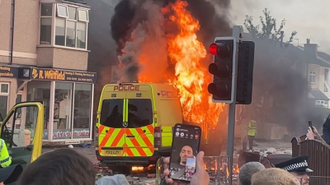
Van on fire during 2024 Southport Riots 30 July 2024 Wiki Image StreetMic LiveStream
New research has revealed the impact of the 2024 riots on minority groups in the UK, showing that it made people feel unwelcome and fearful in their own communities and that they modified their daily lives to feel safe.
Experts from the University of Nottingham's School of Psychology undertook a qualitative study to explore the lived experiences of ethnic and religious minority groups during and after the 2024 Summer Riots.
The results, published in the Journal of Community and Applied Social Psychology, highlight how deeply minority groups were impacted by the riots and how online and offline environments intertwine to organise everyday life during unrest and suggest implications for platform governance, community safety planning and culturally responsive mental-health support.
The study focuses on unrest following the Southport stabbings on 29 July 2024. Within hours, false claims on social media misidentified the suspect as a Muslim refugee. Police later confirmed the suspect was born in the UK, and fact-checkers traced prominent rumours to fabricated names and misleading posts that were widely shared. In the days that followed, far-right mobilisations and counter-protests occurred across towns and cities in England and Northern Ireland.
In the digital era, social media shapes how unrest is experienced, interpreted and shared. Online spaces extend the reach of collective violence beyond physical sites, making it possible to witness hostility in real time.
Participants in the study took part in semi-structured interviews describing how the riots and subsequent coverage of them impacted their daily lives. Across interviews, respondents reported sustained emotional strain, cautious behavioural change and identity work structured by recognition and visibility.
Dr Cecilie Lolansen from the School of Psychology led the research, she said: "In moments of heightened division, it can feel alarmingly easy for people to say extreme things and become emboldened in crowds or online. But there are actual human beings on the receiving end of that hostility, and the impact it can have on them is painfully real.
"The people we spoke to outlined clearly how the riots and subsequent discourse around them affected them emotionally, mentally and practically. Many spoke about having to change how they went about their daily lives and felt like they were in a constant state of hyper-vigilance and fear, wondering whether people were rioters or secretly hated them because of their minority identity or what they were perceived to represent.
"There were also some really interesting findings around how some people, especially British minorities, felt a tension between how they saw themselves as British and how they were made to feel unwelcome and like targets, despite having lived here their entire lives, and how shocking it was to realise some people may have secretly been resenting them the entire time."
The research also showed how for some the fear they or their families felt was very much shaped by how 'visible' their minority status was, for example wearing a hijab could make you feel like much more of a target and incredibly unsafe during the riots. Some people also spoke about broader issues relating to biased media coverage and the role of the media in stoking anti-immigration hate, and also what they felt was a disinterest from the police in protecting certain communities or counter-protestors.
Participants also described a form of belonging that remained in place while being managed carefully in public. Britishness was not rejected, but expressions of national pride were filtered through concern about how symbols were being used and read. One participant quoted in the paper set out the tension directly: "They have turned that flag into such a racist thing… you feel kind of ashamed to be waving a flag because… it is like you are supporting the racist because that is how it has been turned."
Dr Lolansen added: "It's clear that the riots caused a ripple effect that was far reaching with opinions and false information shared across various media and social media. All of this had a negative impact on the wellbeing of minority groups during that time and created profound feelings of non-belonging and fear. To prevent this, there needs to be better governance of social media platforms, fact checking, and improved support for minorities to help navigate difficult or potentially volatile events. It is also vital to give a voice to those who are most affected, which is what we hope this research has achieved."
Responding to the report, Fr Phil Sumner, Vice Chair of the Catholic Association for Racial Justice (CARJ) told ICN: "Immediately after the killing of the three children in Southport in late July 2024, we heard of messages on social media not only encouraging people to join protests against asylum seekers or mosque communities but also making threats that acid would be thrown at Muslim women wearing hijabs in the street.
"The tensions in many areas of the country were significantly raised. One of our Catholic priest members was invited to speak after Friday prayers in a nearby mosque to persuade those present that the Christian symbolism being used in some protests did not mean that the sentiments expressed were representative of the Christian communities. The Catholic and Anglican bishops of Portsmouth issued, at that same time, a joint statement saying that they were ashamed of the intimidation and scapegoating of asylum seekers and refugees. They went further stating that they were 'horrified' when protestors used Christian language to justify their divisive chants."
In November last year, Kings College London published a report claiming that the sense of division in the UK had reached a new high. Perceived tension between people born in the UK and immigrants had risen from 74% in 2023 to 86% in 2025. It's the rise of populism worldwide, and in this country too, employing simplistic analyses of events to scapegoat particular communities or groups of people, blaming them unfairly for the problems of society, that encourages this sense of division and drives the wedge in even further. It is worryingly reminiscent of the 1930's in Germany, when the Nazi party there scapegoated the Jews for the problems in the German economy and for the failure of Germany to win World War One."
Commenting on this new report Fr Phil said "Dr Lolansen is right to say: 'In moments of heightened division, it can feel alarmingly easy for people to say extreme things and become emboldened in crowds or online.'"
He continued: "Pope Francis referred to racism being like a virus that mutates and we are surely witnessing one such mutation now. Those of us involved in addressing racism need to be aware of this rising threat but all of us need to be aware of how we can be manipulated by those who want to divide us.
"We also recognise that British society has been significantly enriched by the diverse faith communities and ethnic groups that form part of our national life. We remain committed to ensuring that individuals from every background can take pride in their identity and feel safe-whether on our streets, in their homes, or within their places of worship."
LINK
CARJ: www.carj.org.uk/
Journal of Community and Applied Social Psychology: https://onlinelibrary.wiley.com/doi/10.1002/casp.70244
 Facebook
 Twitter
 LinkedIn
 Print
Print Email
Email













 Facebook
 Twitter
 YouTube
 LinkedIn
 Pinterest