


Israel bans 37 aid agencies from working in Gaza
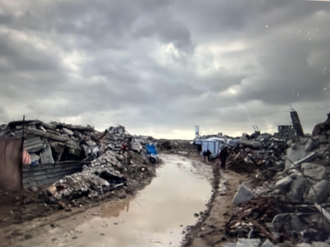
River of sewage flooding by already-wrecked tents in Gaza refugee camp - Screenshot 28/12/25
Shortly before Christmas, Israel announced that it will ban 37 major aid organisations working in Gaza from tomorrow, January 1, 2026. The ban is being introduced because Israel allege the organisations failed to meet 'new and stringent requirements', including disclosing staff details and complying with new registration rules.
Over the last few weeks, heavy rains and floods in Gaza have inundated displacement camps and shelters, damaging tents, wrecking buildings, threatening health with disease and hypothermia, and leaving hundreds of thousands at risk. Much humanitarian aid and shelter materials was already being blocked from entering Gaza. This new ban could have a catastrophic impact on many thousands of vulnerable people living in appalling conditions.
The 37 organisations are:
Caritas Internationalis
Caritas Jerusalem
DanChurchAid
Near East Council of Churches
Action Against Hunger
ActionAid
Alianza por la Solidaridad
Campaign for the Children of Palestine
CARE
Handicap International: Humanity & Inclusion
Japan International Volunteer Center
Medecins du Monde France
Medecins du Monde Switzerland
Medecins Sans Frontieres Belgium
Medecins Sans Frontieres France
Medecins Sans Frontieres Netherlands
Medecins Sans Frontieres Spain
Medicos del Mundo
Mercy Corps
Norwegian Refugee Council
Oxfam Novib (Oxfam's Dutch affiliate)
Premiere Urgence Internationale
Terre des hommes Lausanne
International Rescue Committee
WeWorld-GVC
World Vision International
Relief International
Fondazione AVSI
Movement for Peace-MPDL
American Friends Service Committee
Medico International
Palestine Solidarity Association in Sweden
Defense for Children International
Medical Aid for Palestinians UK
Oxfam Quebec
War Child Holland
The United Nations and non-governmental organisations (NGOs) issued the following joint statement, urging the international community to take immediate and concrete actions to press the Israeli authorities to lift all impediments, including the new INGO registration process, that continue to undermine humanitarian operations in the Occupied Palestinian Territory or risk the collapse of the humanitarian response, particularly in the Gaza Strip.
They said: "INGOs, working in close partnership with the UN and Palestinian organisations, are central to humanitarian operations in the OPT, collectively delivering approximately US$1 billion in assistance each year.
In March, the Israeli authorities introduced a new INGO registration system that fundamentally jeopardises the continuation of humanitarian operations throughout the OPT. The system relies on vague, arbitrary, and highly politicised criteria and imposes requirements that humanitarian organisations cannot meet without violating international legal obligations or compromising core humanitarian principles. Under the current framework, dozens of INGOs face deregistration by 31 December 2025, followed by the forced closure of operations within 60 days.
While some INGOs have been registered under the new system, these INGOs represent only a fraction of the response in Gaza and are nowhere near the number required just to meet immediate and basic needs. The ongoing re-registration process and other arbitrary hindrances to humanitarian operations have left millions of dollars' worth of essential supplies - including food, medical items, hygiene materials, and shelter assistance - stuck outside of Gaza and unable to reach people in need.
Pressing ahead with this policy will have far-reaching consequences on the future of the OPT, in addition to threatening a fragile ceasefire and putting Palestinian lives at imminent risk, particularly during winter. The work of INGOs cannot be replaced, especially after Israeli restrictions imposed on UNRWA have already pushed the humanitarian response inside Gaza to a breaking point. The UN will not be able to compensate for the collapse of INGOs' operations if they are de-registered, and the humanitarian response cannot be replaced by alternative actors operating outside established humanitarian principles.
The deregistration of INGOs in Gaza will have a catastrophic impact on access to essential and basic services. INGOs run or support the majority of field hospitals, primary healthcare centres, emergency shelter responses, water and sanitation services, nutrition stabilisation centers for children with acute malnutrition, and critical mine action activities. For example, all five stabilization centers for children with severe acute malnutrition are supported by INGOs, representing 100 per cent of the in-patient capacity to treat children with life-threatening malnutrition in Gaza. If INGOs are forced to stop operations, one in three health facilities in Gaza will close.
Since the announcement of this new process, the UN and INGOs have consistently engaged in good faith with the Israeli authorities to highlight aspects of the registration process with which INGOs cannot comply and to look for actionable and acceptable solutions that would ensure the continuity of life-saving operations. The humanitarian impact in Gaza if INGOs can no longer operate has been directly communicated to the Israeli authorities on multiple occasions as part of these ongoing efforts to find a solution before it is too late.
However, there has been no adjustment from the Israeli authorities on these issues. Humanitarian access continues to be obstructed, including through the imminent dismantlement of INGO operations.
UN agencies and NGOs reiterate that humanitarian access is not optional, conditional or political. It is a legal obligation under international humanitarian law, particularly in Gaza where Israel has failed to ensure that the population is adequately supplied. Israeli authorities must allow and facilitate rapid, unimpeded passage of humanitarian relief. They must immediately reverse policies that obstruct humanitarian operations and ensure that humanitarian organizations are able to operate without compromising humanitarian principles. Lifesaving assistance must be allowed to reach Palestinians without further delay."
 Facebook
 Twitter
 LinkedIn
 Print
Print Email
Email















 Facebook
 Twitter
 YouTube
 LinkedIn
 Pinterest