


Gospel in Art: Ash Wednesday
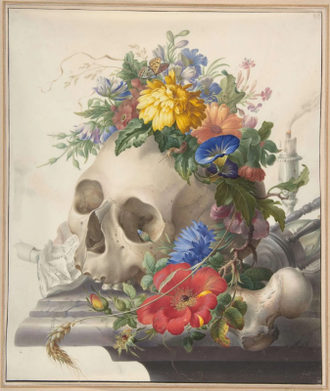
Vanitas Still Life, by Herman Henstenburgh, 1700 © Metropolitan Museum, New York. Watercolour, gouache on parchment
Source: Christian Art
Gospel of 18 February 2026
Matthew 6:1-6, 16-18
At that time: Jesus said to his disciples: 'Beware of practising your righteousness before other people in order to be seen by them, for then you will have no reward from your Father who is in heaven.
'Thus, when you give to the needy, sound no trumpet before you, as the hypocrites do in the synagogues and in the streets, that they may be praised by others. Truly, I say to you, they have received their reward. But when you give to the needy, do not let your left hand know what your right hand is doing, so that your giving may be in secret. And your Father who sees in secret will reward you.
'And when you pray, you must not be like the hypocrites. For they love to stand and pray in the synagogues and at the street corners, that they may be seen by others. Truly, I say to you, they have received their reward. But when you pray, go into your room and shut the door and pray to your Father who is in secret. And your Father who sees in secret will reward you.
'And when you fast, do not look gloomy like the hypocrites, for they disfigure their faces that their fasting may be seen by others. Truly, I say to you, they have received their reward. But when you fast, anoint your head and wash your face, that your fasting may not be seen by others but by your Father who is in secret. And your Father who sees in secret will reward you.'
Reflection on the gouache and watercolour painting
Ash Wednesday confronts us, with striking honesty, with the fragility of life and the reality of our mortality. Putting ashes on our forehead can't be anymore visual. We literally show how we believe in mortality. Lent begins by remembering that we are dust. It is a moment that strips away illusion and self-importance, reminding us how transient all things are. And yet, we do not gather on this day simply to dwell on decay or endings. The ashes we receive are not just a sign of what fades; they carry a much deeper story within them.
Those ashes come from the palms of Passion Sunday of last year that we burn. It comes thus from the memory of Christ's suffering, death, and burial. Jesus entered fully into the realm of dust and death, only to rise from it into new life. Ash Wednesday therefore points beyond itself. Our final destiny is not ashes, but resurrection, sharing in the risen life of Christ. Lent is the journey towards that transformation. The ashes mark our desire to turn again towards the risen Jesus. So how do we do this? The gospel reading puts before us three ways: prayer, fasting, and almsgiving. In a way these corresponds to the three loves at the heart of the Christian life: love of God (prayer), love of neighbour (almsgiving), and a truthful love of self (fasting). On this day, we begin again... choosing to build our lives on these foundations, so that new life may slowly take shape within us.
Life is indeed transient. Before we know it, we leave these earthly shores. This very thought led to a whole style of genre paintings, emerging in the 17th century: vanitas paintings. At a time of great mercantile wealth and military conflicts in Europe, paintings and drawings were made to remind the viewer of the transience of life. These vanitas paintings were filled with symbolic references. Our highly detailed watercolour on paper by Dutch artist Herman Henstenburgh depicts music sheets (giving the earthly pleasure of listening and the ephemerality of human existence), a flute (whose sounds would seduce people), a blown-out candle, a knocked-over hourglass, and blossoming but ultimately withering flowers, all surrounding a skull. Together, these symbols speak quietly but insistently: earthly pleasures, achievements, and distractions cannot last. However full or successful our lives may seem, they remain incomplete if they end only with what we can see and hold.
LINKS
Christian Art: https://christian.art/
Today's reading: https://christian.art/daily-gospel-reading/matthew-6-1-6-16-18-2026/
 Facebook
 Twitter
 LinkedIn
 Print
Print Email
Email












 Facebook
 Twitter
 YouTube
 LinkedIn
 Pinterest