

Anglican Archbishop says he was 'intimidated' by Israeli army in Holy Land
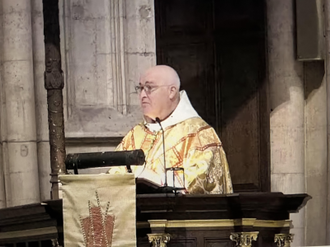
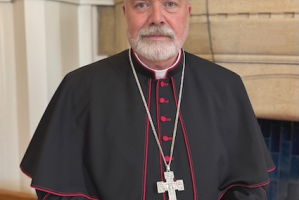
Archbishop Stephen Cottrell. Screenshot
The Archbishop of York, the Most Rev Stephen Cottrell says he was 'intimidated' by Israeli militias during his recent visit to the Holy Land. During his Christmas Day sermon yesterday at York Minster, Archbishop Cottrell revealed he was stopped at checkpoints and that militias told him he could not visit Palestinian families in the West Bank.
His full homily text follows:
"The true light, which enlightens everyone, was coming into the world. He was in the world, and the world came into being through him; yet the world did not know him. He came to what was his own, and his own people did not accept him."
- John 1. 9-11
On the road out of Chelmsford towards where I used to live in a place called Margaretting, there is a very long dual carriageway. Several miles long. Therefore, if you want to go anywhere, you have to travel in the direction of the traffic on your side of the road. Which sometimes means going a mile or two in the wrong direction.
At one end of this dual carriageway was the house where I used to live. At the other end was a large Tesco superstore. At Christmas a few years ago, well a few days before Christmas, my wife and I were shopping in the said branch of Tesco's. Later that same afternoon I was presiding at Nine Lessons and Carols in Chelmsford Cathedral. I needed to get home before the service to change into clerical attire and collect my robes. We had plenty of time. Or so we thought. When we came out of Tesco's, the car park was completely gridlocked. There had been an accident on the exit slip road, and none of the cars that day were going anywhere. Once I had worked this out, Rebecca stayed with the car and I had either to walk to the cathedral, sans robes, or walk home to collect them. And, I still thought I had enough time to do this but underestimated the length of the dual carriageway I now had to walk down. And about halfway, realising I was probably going to be late for the Service, I saw a couple coming out of their house to get into their car. I knew that they had to drive in the same direction as I was going and therefore had to almost go pass my front door. Smiling, and looking as cheerfully unintimidating as I could muster, I gestured to them in what I thought was a friendly way, and began to ask them whether they might be able to help me.
Written on their faces was blind panic and terror. A stranger is talking to us. They couldn't get into their car fast enough. They drove away quickly, honking their horn at me. I wouldn't be surprised if they dialled 999.
Let's be clear, I don't really hold it against them. They didn't know who I was. My 'day-off' attire is, I admit, moderately scruffy. And the mantra 'stranger danger' is drilled into us from a very young age for good reasons.
But I am still troubled by the experience. What does it tell us about ourselves? Especially at Christmas, where at the heart of the nativity and the gospel that flows from it, there are so many stories of exile and welcome, in the letter to the Hebrews there is even the injunction that in welcoming strangers we might be entertaining angels (see Hebrews 13. 2) or then Jesus' stern warnings about what we do or don't do to those we encounter who are in need.
We have become, I can think of no other way of putting it, we have become fearful of each other, and especially fearful of strangers, or just people who aren't quite like us. We cannot see ourselves in them. And we, therefore, spurn a common humanity. Yes, of course, it is good and sensible for us to warn our children against the fearful strangers they do not know, and I really don't blame that couple for feeling a bit frightened of me that day, but I do worry, when our first instinct on encountering someone we don't know, is fear, and when, in order to keep the fear at bay, we build walls around ourselves, trying to secure a world where no stranger can get in, so that even when Jesus himself knocks at the door, like the good sensible people of Bethlehem itself, we politely refuse him. There is only room for us. For the medicine we so need in our world today to overcome this fear is Christ. And we know as we come close to him, we also come closer to each other. And we see and experience each other differently. We discover a common humanity in all our rich diversity. And then, and only then, we find a way of living in peace.
I visited Bethlehem this year. It was very quiet. Too quiet, because there just aren't pilgrims visiting at the moment; and the Christian communities who live there, and who rely on the income that pilgrims bring, are really struggling. Representatives of the local YMCA who do amazing work with persecuted Palestinian communities in the West Bank gave me a present as I left. It was a beautiful olive wood carving of the nativity scene: Mary, Joseph and Jesus in the stable on one side of the carving; the three Kings making their journey to Bethlehem on the other.
But a large grey wall bars their way, separates them from Christ. They are prohibited from entry. They can't get to Jesus. They are being turned away.
It was sobering to see this wall for real on my visit to the Holy Land and we were stopped at various checkpoints and intimidated by Israeli militias who told us that we couldn't visit Palestinian families in the occupied West Bank.
But this Christmas morning, here in York, as well as thinking about the walls that divide and separate the Holy Land, I'm also thinking of all the walls and barriers we erect across the whole of the world and, perhaps, most alarming, the ones we build around ourselves, the ones we construct in our hearts, and of how our fearful shielding of ourselves from strangers, the strangers we encounter in the homeless on our streets, refugees seeking asylum, young people starved of opportunity and growing up without hope for the future, means that we are in danger of failing to welcome Christ when he comes.
We don't mind kneeling at the representations of the Manger that we make in our churches and in our homes, like the beautiful nativity scene here in York Minster, but we don't kneel and adore his presence in others, especially the poor and the excluded, the vulnerable and the abused. Worse, we often end up blaming the poor for their poverty the jobless for their lack of work, the homeless for their lack of shelter, and the refugee for the war that forced them from their home or the climate change that devastated their land. Even in the Church which bears Christ's name, we have not always put the needs of the vulnerable first.
Therefore, this Christmas and especially at Christmas, we must find ways of balancing the needs of keeping everyone safe and yet at the same time seeing and adoring the face of Christ in the face of strangers, and especially in the faces of those who are in need; and then, dismantle, tear down the walls, which in keeping strangers out, keep Christ out as well. Then see and celebrate that in finding and seeing Christ and coming to the manger we see ourselves and our world as it is meant to be. Please make no mistake about it, Christmas is worth celebrating. I have a very big and lovely turkey waiting to go in the oven when I get home and lots of other lovely things on ice, and I will be rejoicing on this happy day. But I will also be trying to remember what this day means for me, for you, for our troubled, fearful and confused world. The God who makes himself vulnerable in the gift of this vulnerable child places the smallest, the least, the most fragile at the centre of his kingdom. He is the God who welcomes strangers - shepherds, magi, why even thee and me.
The doors to the Church of the Holy Nativity in Bethlehem are very small. It is impossible, and I mean quite literally impossible, to step inside that Church without bending low. It's as if the entrance itself is saying, in order to enter here you must be smaller and you must be humbler and you must be ready to receive the gifts of this Christ as yourself, as a little child and with a trust that is all so easily lost to us.
But this child, this Christ-child, this beautiful Saviour, our dear Lord Jesus Christ, has come to find us. To show us our true humanity. To lift us up, and to help us see each other and smile in loving recognition.
Oh, come let us adore him.
Amen
Watch the whole service on York Minster's YouTube channel: www.youtube.com/live/JYZfMbQDszQ
 Facebook
 Twitter
 LinkedIn
 Print
Print Email
Email








 Facebook
 Twitter
 YouTube
 LinkedIn
 Pinterest