

Dr Francis Davis: Something hopeful happened last Friday
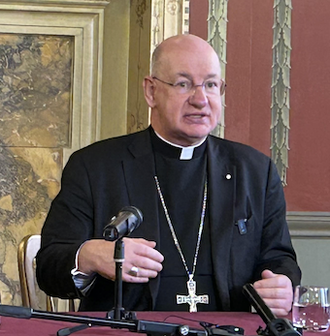
Archbishop-elect Moth
At a time of enduring national crisis, often emerging from public leadership built on straw, something hopeful happened last Friday: There was a recalibration of depth into and across the foundations and mission of the Bishops' Conference of England and Wales. Let me explain.
Over the years I have enjoyed working alongside a number of Bishops: As a teenager Bishop Anthony Emery of Portsmouth inspired me with his tears, upon hearing from Cardinal Hume of the then war induced famine in Ethiopia.
The future Bishop Declan Lang was our inspirational youth minister and now a friend. Archbishop Denis Hurley OMI of Durban introduced me to Laborem Exercens while Archbishop of Mbala in Zambia, Adolf Furstenberg MAfr, first explained Lake Tanganyika and its communities to me with such enthusiasm that I have remained a regular visitor.
During the wars in Bosnia and Croatia, working with Bishop Crispian Hollis, I raised over a million pounds in today's money for refugees in that region spending time with the great Cardinal Franjo Kuharic of Zagreb along the way. In Brazil I stayed with an Augustinian Bishop with a Diocese as large as Holland but only traversable by river boat. More recently I have spent time in South Asia and other contexts alongside (Arch)Bishops whose parishes are constantly at risk from human rights abuses or political insecurity.
Despite all these gifts in all this time however I do not think we have had a crystallisation of talents such as those now emerging at the same time in the English and Welsh Bishops Conference.
First, as we all know, Richard Moth was appointed to Westminster last week. For those of us who have had to both navigate and govern our crisis ridden mental health system this was a moment of light. Moth was the first British or Irish Bishop to initiate a national project of support in these realms where so many parishes, let alone failing NHS and social care systems, do not tread. I was a near neighbour of his when he oversaw the Diocese for the Forces and, working with veterans still, know the importance of this ministry to so many young military families and older survivors of conflict. More than this his commitment to Pluscarden Abbey's comparatively austere account of the Benedictine charism has been long standing, deeply rooted, and foundational to his outlook. Character traits of loyalty, decency, honour, and contemplative prayerfulness are important places from which to build a new ministry.
Second, and just as significantly, a deep pool of Archiepiscopal talents is now in place around Bishop Moth. By multiple frames of reference this flock of shepherds is important: Archbishop Bernard Longley, consistently and assiduously kind, is making globally important contributions to ecumenism and inter-religious dialogue both in his own Archdiocese and beyond. Archbishop John Sherrington has been a dedicated advocate for life, and an educator. Archbishop Mark O Toole sustains the Irish familial links so integral to our history with dedicated service in Wales. Archbishop John Wilson, the first Bishop to establish a Diocesan Commission to ensure Racial Justice in what is now our very internationalised British Catholic community, is a brilliant speaker supporting evangelistic ministries and catechetical innovation with zeal. In a break from the past none of these able men attended an English Public School, and all of them are graduates of at least two important Schools of Music or universities. There is merit in their presence.
More than this though the emerging Bishops' Conference can look to further depth still. Bishop Mark Davies of Shrewsbury is said to be conservative but there is nothing backward in his ability to connect with the young. I have seen him do this with some genius in a preaching tent on the rainiest of Walsingham days. Bishop Marcus Stock brings gravitas to the work of sustaining our schools while the developments he has enabled to make choral music accessible to children of all backgrounds is now being emulated by other churches. Bishop Alan Williams of Brentwood understands education too and brings important insight as a former Religious Superior. Bishop Nicholas Hudson is now at work in Plymouth while Westminster is benefitting from Bishop Jim Curry's huge experience. Among the Auxiliaries Timothy Menezes of Birmingham brings lived experience of Catholicism's diversity and service based on a successful spell as Dean of St Chad's Cathedral. There are many more I could mention.
It is not that I expect these pastors to launch a high profile public campaign , or to announce that they will be at the vanguard of a 'revival' based on a war of engagement with secularism, nor expect them to be out on the BBC's Question Time slugging it out with Nigel Farage or Tommy Robinson.
The sense of new depth comes from seeing that they are the kind of people who would see that good pastoral work, sacrificial service and deliberate bridge building across the theological, social and civic siloes that are wrenching us apart are at this time more crucial than ever. It comes from a glimpse of the potential they could make such concrete bridge building and caring communication the shared heart of future trajectories. It emerges from a perception that unlocking all their community's gifts will be important to this task - not least the gifts of still dedicated clergy and Religious.
Upon being appointed the future Archbishop of Westminster Richard Moth spoke of intense contemplative prayer, the care of prisoners, the needs of the mentally ill, great English counties, education, hospitals, parishes and good relations with Muslim communities. He said that 'rushing fences' when involved in rural pursuits usually ends in disaster.
He set the tone for a for a New Year in which a recalibrated and renewed Bishops Conference can signal hope. It can also model leadership in public inalienably more rooted than the straw upon which so much our present crisis relies.
Francis Davis is a Visiting Fellow at Kellogg College, University of Oxford and Honorary Professor at Queen Mary, University of London. He was previously a trustee of Portsmouth Catholic Diocese.
 Facebook
 Twitter
 LinkedIn
 Print
Print Email
Email







 Facebook
 Twitter
 YouTube
 LinkedIn
 Pinterest