


Gospel in Art: The angel Gabriel was sent from God to a virgin
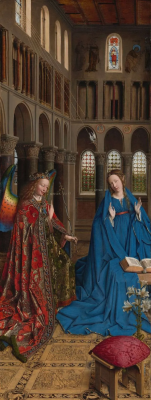
The Annunciation by Jan Van Eyck,1434-1436 © National Gallery of Art, Washington
Source: Christian Art
Gospel of 20 December 2025
Luke 1:26-38
In the sixth month, the angel Gabriel was sent from God to a city of Galilee named Nazareth, to a virgin betrothed to a man whose name was Joseph, of the house of David. And the virgin's name was Mary. And he came to her and said, 'Hail, full of grace, the Lord is with you!' But she was greatly troubled at the saying, and tried to discern what sort of greeting this might be. And the angel said to her, 'Do not be afraid, Mary, for you have found favour with God. And behold, you will conceive in your womb and bear a son, and you shall call his name Jesus. He will be great and will be called the Son of the Most High. And the Lord God will give to him the throne of his father David, and he will reign over the house of Jacob for ever, and of his kingdom there will be no end.'
And Mary said to the angel, 'How will this be, since I am a virgin?' And the angel answered her, 'The Holy Spirit will come upon you, and the power of the Most High will overshadow you; therefore the child to be born will be called holy - the Son of God. And behold, your relative Elizabeth in her old age has also conceived a son, and this is the sixth month with her who was called barren. For nothing will be impossible with God.' And Mary said, 'Behold, I am the servant of the Lord; let it be to me according to your word.' And the angel departed from her.
Reflection on the painting
The Annunciation is one of the most beloved subjects in Christian art. Artists across every century have returned to this moment because, in many ways, it is the turning point of salvation history: the instant when heaven bends toward earth, when God's eternal plan becomes flesh. In a way it is a very simple scene: just a young girl, an angel, and a word that changes everything. It is very beautiful in its simplicity; yet awesome in its repercussions. Artists love the Annunciation because it offers endless possibilities for colour, gesture, architecture, light, to depict the invisible becoming visible, and the divine interrupting the ordinary.
The earliest known depiction of the Annunciation appears in the Catacomb of Priscilla in Rome, dating to the early 3rd century. It is a humble fresco, simple and unadorned, yet already expressing the essential truth: Mary seated, the angel before her, simply saying 'yes'. However for me (born in Bruges, Flanders), I simply love the early Flemish primitive paintings depicting the Annunciation. A couple of months ago was the first time I saw this painting by Jan Van Eyck. It is soooo beautiful! Mary stands in a richly detailed interior that evokes both a simple domestic space and a sacred temple. She wears a deep blue cloak (the colour of heaven and the most expansive pigment at the time this was painted), while the red of her undergarment quietly hints at the Passion she will one day witness. Her hands are raised in a gesture of humble acceptance, as she receives Gabriel's greeting inscribed in gold letters "Ave gratia plena", almost functioning as 'speech bubbles' avant-la-lettre. Gabriel, dressed in magnificent liturgical robes, bows before her. His wings shimmer like colourful peacock feathers, a symbol of immortality.
Above them, the Holy Spirit in the form of a dove descends in a cascade of golden light, entering through a closed window: a subtle symbol of the Incarnation taking place without violating Mary's virginity. The rays fall precisely upon Mary, marking the moment the Word becomes flesh. At her feet stands a vase of lilies, the ancient emblem of purity and the traditional flower of the Annunciation. Even the objects around them teach theology: the open book signals Mary's meditation on Scripture, the very Word she is about to bear; the three small windows at the back suggest the Trinity; and the discarded stool alludes to the humility with which God enters human history.
Van Eyck's floor tiles deepen the symbolism further: they are decorated with scenes from the Old Testament: David slaying Goliath, Samson tearing apart the lion... all stories of God intervening in human weakness with divine strength. These foreshadow Christ's victory over sin and death, linking the entire sweep of salvation history to this single quiet moment in Mary's life.
LINKS
Gospel in Art: https://christian.art/
Today's Reflection: https://christian.art/daily-gospel-reading/luke-1-26-38-2025-4/
 Facebook
 Twitter
 LinkedIn
 Print
Print Email
Email










 Facebook
 Twitter
 YouTube
 LinkedIn
 Pinterest