

Gospel in Art: And there appeared to him an angel of the Lord to Zechariah
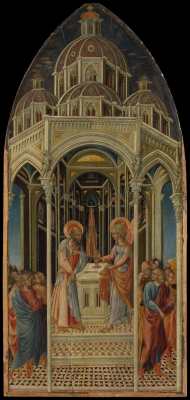
The Annunciation to Zacharias by Giovanni di Paolo, painted1455-1460, Tempera and gold on wood © Metropolitan Museum, New York
Source: Christian Art
Gospel of 19 December 2025
Luke 1:5-25
In the days of Herod, king of Judea, there was a priest named Zechariah, of the division of Abijah. And he had a wife from the daughters of Aaron, and her name was Elizabeth. And they were both righteous before God, walking blamelessly in all the commandments and statutes of the Lord. But they had no child, because Elizabeth was barren, and both were advanced in years.
Now while he was serving as priest before God when his division was on duty, according to the custom of the priesthood, he was chosen by lot to enter the Temple of the Lord and burn incense. And the whole multitude of the people was praying outside at the hour of incense. And there appeared to him an angel of the Lord standing on the right side of the altar of incense. And Zechariah was troubled when he saw him, and fear fell upon him. But the angel said to him, 'Do not be afraid, Zechariah, for your prayer has been heard, and your wife Elizabeth will bear you a son, and you shall call his name John. And you will have joy and gladness, and many will rejoice at his birth, for he will be great before the Lord. And he must not drink wine or strong drink, and he will be filled with the Holy Spirit, even from his mother's womb. And he will turn many of the children of Israel to the Lord their God, and he will go before him in the spirit and power of Elijah, to turn the hearts of the fathers to the children, and the disobedient to the wisdom of the just, to make ready for the Lord a people prepared.'
And Zechariah said to the angel, 'How shall I know this? For I am an old man, and my wife is advanced in years.' And the angel answered him, 'I am Gabriel. I stand in the presence of God, and I was sent to speak to you and to bring you this good news. And behold, you will be silent and unable to speak until the day that these things take place, because you did not believe my words, which will be fulfilled in their time.' And the people were waiting for Zechariah, and they were wondering at his delay in the Temple. And when he came out, he was unable to speak to them, and they realised that he had seen a vision in the Temple. And he kept making signs to them and remained mute. And when his time of service was ended, he went to his home.
After these days his wife Elizabeth conceived, and for five months she kept herself hidden, saying, 'Thus the Lord has done for me in the days when he looked on me, to take away my reproach among people.'
Reflection on the painting
We are accustomed to hearing bad news. Most of what dominates our news programmes focuses on what is wrong with the world rather than what is right. Even when we do hear good news, we can sometimes approach it with scepticism, questioning its truth or searching for its downside.
In today's Gospel, the angel Gabriel brought good news to Zechariah: his wife, Elizabeth, would have a son. Not just any son, but one who would be instrumental in leading many people of Israel back to God. Yet Zechariah struggled to believe this good news. It seemed too good to be true. Doubting the angel's message, he asked, "How can I be sure of this?" Instead of rejoicing in the good news as he was invited to, his disbelief silenced him, leaving him unable to speak.
This story reminds us that failing to listen properly, or being highly sceptical, can negatively affect not only what we say but also how we say it. Good speaking always flows from attentive listening. Like Zechariah, we too can struggle to hear and embrace good news. We may think, 'this might be true for others', but surely not for me. Yet we have to be careful not to be sceptical in our faith. Asking questions in our faith, yes; questioning everything, no!
Our painting depicts exactly the line in our Gospel reading today: "And there appeared to him an angel of the Lord standing on the right side of the altar of incense". The incredulous Zacharias performs his priestly duties in an elaborate architectural church setting whose domes recall Brunelleschi's celebrated cupola which crowns the Duomo in Florence.
Giovanni di Paolo painted this panel around 1455-1460, at the height of the Sienese school's success. Though modest in size, its tempera and gold create a shimmering world of sacred scenery. Giovanni di Paolo's style is adopting the elegance and dream-like atmosphere of Gothic influence with slightly elongated colours and gothic tracery.
LINKS
Gospel in Art: https://christian.art/
Today's Reflection: https://christian.art/daily-gospel-reading/luke-1-5-25-2025/
 Facebook
 Twitter
 LinkedIn
 Print
Print Email
Email












 Facebook
 Twitter
 YouTube
 LinkedIn
 Pinterest