

Gospel in Art: The book of the genealogy of Jesus Christ
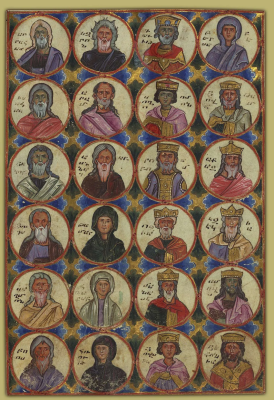
Ancestors of Christ, by Toros Roslin, 1262 © Walters Art Museum, Baltimore, Maryland
Source: Christian Art
Gospel of 17 December 2025
Matthew 1:1-17
The book of the genealogy of Jesus Christ, the son of David, the son of Abraham. Abraham was the father of Isaac, and Isaac the father of Jacob, and Jacob the father of Judah and his brothers, and Judah the father of Perez and Zerah by Tamar, and Perez the father of Hezron, and Hezron the father of Ram, and Ram the father of Amminadab, and Amminadab the father of Nahshon, and Nahshon the father of Salmon, and Salmon the father of Boaz by Rahab, and Boaz the father of Obed by Ruth, and Obed the father of Jesse, and Jesse the father of David the king.
And David was the father of Solomon by the wife of Uriah, and Solomon the father of Rehoboam, and Rehoboam the father of Abijah, and Abijah the father of Asaph, and Asaph the father of Jehoshaphat, and Jehoshaphat the father of Joram, and Joram the father of Uzziah, and Uzziah the father of Jotham, and Jotham the father of Ahaz, and Ahaz the father of Hezekiah, and Hezekiah the father of Manasseh, and Manasseh the father of Amos, and Amos the father of Josiah, and Josiah the father of Jechoniah and his brothers, at the time of the deportation to Babylon.
And after the deportation to Babylon: Jechoniah was the father of Shealtiel, and Shealtiel the father of Zerubbabel, and Zerubbabel the father of Abiud, and Abiud the father of Eliakim, and Eliakim the father of Azor, and Azor the father of Zadok, and Zadok the father of Achim, and Achim the father of Eliud, and Eliud the father of Eleazar, and Eleazar the father of Matthan, and Matthan the father of Jacob, and Jacob the father of Joseph the husband of Mary, of whom Jesus was born, who is called Christ.
So all the generations from Abraham to David were fourteen generations, and from David to the deportation to Babylon fourteen generations, and from the deportation to Babylon to the Christ fourteen generations.
Reflection on the Illuminated Manuscript Page
This morning we begin the octave of Christmas, eight days where the Church gives us some of the richest readings of the entire year. Each first reading is one of the great Messianic promises from the Old Testament, preparing our hearts for the coming of the Saviour. The gospel acclamations are like eight small windows of prayer, each one a different way of saying, "Come, Lord Jesus." The Gospel readings throughout this octave (apart from tomorrow) all come from the opening chapters of Matthew and Luke, the very beginnings of the story of Jesus. And this morning, we hear one of the most unusual Gospel passages in the whole year: the genealogy of Jesus. At first hearing, we might wonder why Matthew offers us such a long list of names. What is the point of this? But Matthew understands something that we modern people understand too: the importance of knowing where we come from. Many today search for their family tree to understand their roots. Our ancestors shape us, even in ways we cannot see, like the deep roots of a tree hidden beneath the soil.
Matthew wants us to see that Jesus also has a family story... and not a perfect one. In His family line are kings and shepherds, saints and sinners, the faithful and the deeply flawed. Some of the names in Jesus' ancestry belonged to people who struggled greatly, people with complicated lives and troubled pasts. And yet Matthew deliberately includes them. Why? To show that God works through imperfect people. God's plan is not stopped by human weakness or failure. In fact, as Saint Paul says, God's power is made perfect in weakness. The genealogy declares that God can bring salvation through any story - even a broken one.
This beautiful illuminated manuscript page comes from the hand of Toros Roslin (c. 1210-1270), the greatest Armenian illuminator of the High Middle Ages. Roslin's work is instantly recognisable for its delicate colours, graceful lines, and classical sense of balance. Drawing on both Armenian tradition and the Western art he encountered through the Crusader era, he expanded the visual language of manuscript painting. In our page, Roslin depicts the lineage of Christ according to Matthew, presenting the ancestors of Jesus in a dignified, orderly procession. Each figure stands calmly within its own frame. The page becomes a theological statement in miniature: God weaving salvation through generations of ordinary, imperfect people, all part of the unfolding story that culminates in the birth of Christ...
LINKS
Gospel in Art: https://christian.art/
Today's Reflection: https://christian.art/daily-gospel-reading/matthew-1-1-17-2025/
 Facebook
 Twitter
 LinkedIn
 Print
Print Email
Email










 Facebook
 Twitter
 YouTube
 LinkedIn
 Pinterest